
Customer retention rate formula: what one point is worth
The customer retention rate formula is ((E−N)/S)×100. Calculate it on your own numbers and price what one percentage point costs you in ARR.

Most SaaS founders track customer retention rate. Almost none have priced what a single percentage point costs them in ARR. The number is larger than they expect — and it is sitting in data they already have.
The customer retention rate formula is not the hard part. The arithmetic that follows it is. This post runs the calculation on a declared product, then turns the result into a dollar figure any founder can compute in ten minutes.
One retained point is not a hygiene metric. It is a revenue line.
Customer retention rate is calculated as ((E−N)/S)×100, where S is users at the start of a period, E is users at the end, and N is new users added during that period. A product starting with 400 users, ending with 384, and adding 20 new users has a customer retention rate of 91%.
Key takeaways
- Customer retention rate is calculated as ((E−N)/S)×100, where you subtract new users to prevent acquisition from masking churn—the metric that signals real health.
- One percentage point of retention gain or loss is worth ARR × 0.01 in annual revenue; at €500k ARR, it's €5,000/year; at €1.5M, it's €15,000.
- Retention breaks early—at signup, first session, onboarding steps, and week two—not at cancellation; the churn you see in month three reflects failures from week one.
- For most SaaS products in the €150k–€1M ARR range, diagnosing retention is worth doing this week, not delaying to next quarter.
- Calculate your CRR this week, then multiply by 0.01 to decide if your retention problem justifies immediate diagnostic action or can wait.
The customer retention rate formula, stated plainly
The formula:
CRR = ((E − N) / S) × 100- S — users at the start of the period
- E — users at the end of the period
- N — new users acquired during the period
The period can be monthly or annual. Monthly is more useful for diagnosis; annual is what investors read.
The subtraction of N matters. Without it, a product that acquires enough new users can mask a leaking base — and founders who track total user count instead of retention rate are doing exactly that.
How to calculate customer retention rate on real numbers
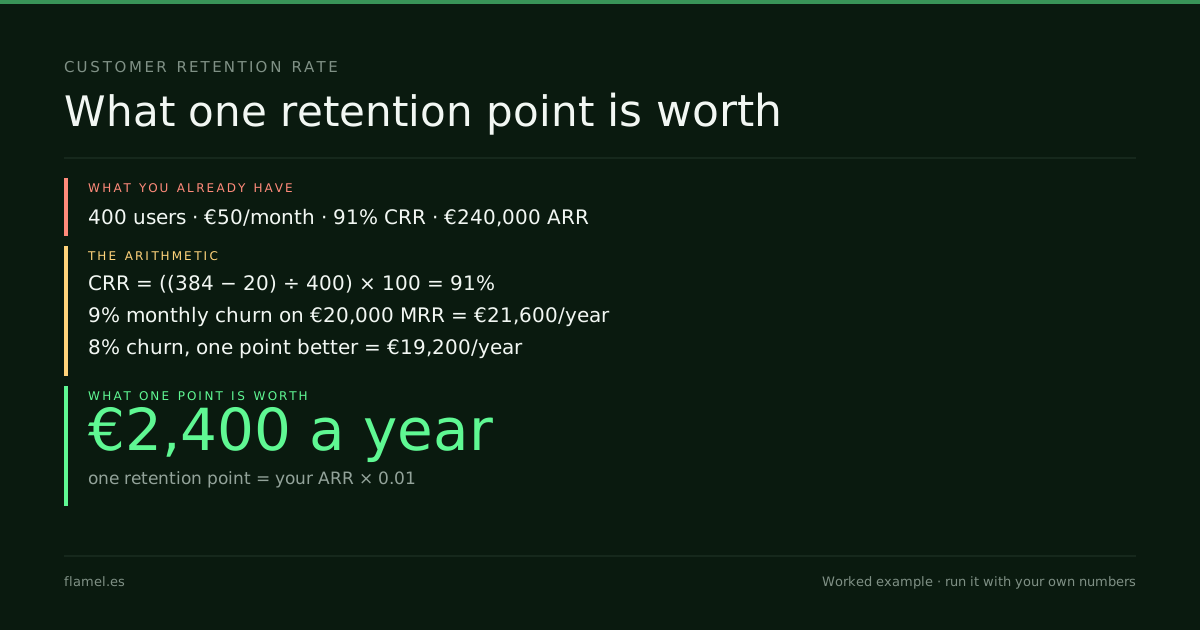
Take a product with 400 active users at the start of the month, 20 new signups during the month, and 384 active users at the end.
CRR = ((384 − 20) / 400) × 100
CRR = (364 / 400) × 100
CRR = 91%
The inverse — churn rate for SaaS — is 9%. One in eleven users left in thirty days.
At a monthly subscription of €50, that product's MRR is €20,000. A 9% monthly churn means €1,800 in MRR leaving every month. Annualized: €21,600 in lost ARR from a base of €240,000.
The product is replacing nearly its entire base every twelve months just to stay flat.

What one retention point is worth in ARR
Here is the arithmetic that most retention posts skip.
Move the retention rate from 91% to 92% — one point. Churn drops from 9% to 8%. On a €240,000 ARR base:
Lost ARR at 91% CRR → 9% monthly churn → €21,600/year
Lost ARR at 92% CRR → 8% monthly churn → €19,200/year

Difference: €2,400/year
One retained point is worth €2,400 in ARR this year on a €240,000 base. It is not a rounding error.
At a €600,000 ARR product, that same single point is worth €6,000/year. At €1.2M ARR, €12,000. The multiplier is your ARR divided by 100.
The formula for any founder:
Value of 1 retention point = ARR × 0.01This is the floor, not the ceiling. It ignores the compounding effect: users who stay beyond month twelve refer more, expand more, and cost less to support. ChartMogul’s SaaS Retention Report confirms that products with high net revenue retention compound growth in ways that acquisition alone cannot replicate.
Where customer retention rate actually breaks
A 91% retention rate is not a benchmark problem. It is a product experience problem — and it almost never breaks in one place.
Activation breaks four times, quietly: at signup, in the first session, in the steps between signing up and the thing they came for, and in week two. By the time a user churns in month three, the break happened in week one. The retention number you calculate today is the invoice for decisions made thirty, sixty, ninety days ago.
When Flamel audits a SaaS product, we sign up cold, a real account with no onboarding call, and read the product analytics and lifecycle emails with your access. That is where the break becomes visible, not in the aggregate churn number.
Improving your churn rate for SaaS starts before any email sequence. It starts with whether the first session shows value or shows a dashboard — the product-led growth question, asked of the base you already have. Cohort retention read on the right cohort — users who completed a specific action in their first session versus those who did not — is where the actual break becomes visible.
How to reduce churn with onboarding rather than win-back campaigns is its own post, and it is coming. So is a piece on reading cohort retention on the right cohort, the one that completed a specific action in their first session, not the full signup base.
What to do by Monday
Calculate your own CRR with last month’s numbers using the formula above. Then apply:
Value of 1 retention point = your ARR × 0.01If your ARR is €500,000, one point is worth €5,000 a year. If it is €1.5M, it is €15,000. That number answers whether the retention problem is worth diagnosing this week or next quarter.
For most products in the €150k–€1M ARR range, the answer is this week.
Work through this with your own numbers
You are a SaaS founder. Your product has [your ARR], [your current monthly users at the start of last month], [your current monthly users at the end of last month], and [your new signups last month]. Calculate your customer retention rate using the formula CRR = ((E−N)/S)×100. Then calculate what one retention point is worth: ARR × 0.01. Based on that dollar value, does your retention problem justify investing diagnostic time this week, or can it wait until next quarter?FAQ
What is the customer retention rate formula?
Customer retention rate is calculated as ((E−N)/S)×100, where S is the number of users at the start of a period, E is the number at the end, and N is new users added during the period. Subtracting new users is essential: without it, acquisition masks churn and the number becomes meaningless as a health signal.
What is a good customer retention rate for a SaaS product?
There is no single benchmark that applies across ARR bands and segments. An annual-contract SaaS product retains differently than a self-serve monthly product. What matters more than a benchmark is the trend: if your retention rate is declining month over month, the cause is almost always in the first session or the first two weeks — not in the product’s core features.
How much is one percentage point of customer retention worth in ARR?
The floor calculation is straightforward: one retention point equals your ARR multiplied by 0.01. A product with €500,000 in ARR loses or saves €5,000 per year for every point of retention gained or lost. This ignores the compounding effect of longer-retained users, which makes the real number higher.
What is the difference between customer retention rate and churn rate?
They are inverses. If your customer retention rate is 91%, your churn rate is 9%. Retention measures the share of users who stayed; churn measures those who left. Both use the same denominator — users at the start of the period, excluding new acquisitions — so they are interchangeable as diagnostic tools, but retention rate is more useful for trend tracking and investor reporting.
When does customer retention actually break in a SaaS product?
Retention almost never breaks at the point of cancellation. It breaks earlier — at signup, in the first session, in the steps between signing up and the first moment of real value, and in week two. By the time a user churns in month three, the experience that caused it happened in their first week. Fixing retention without looking at activation is fixing the wrong end of the problem.
That’s what The Activation Audit is. Five business days, $500, and the map is yours — whether or not you hire us.
Your store, five days.
$500. Zero commitment. Yours either way.