Product led growth: what it costs, and what it returns
Every SaaS founder says PLG is cheaper than sales. The arithmetic usually disagrees — until you know which number to move. Here is the equation.

Every founder who has looked at product led growth has heard the same pitch: move the cost of closing a customer into the product, and watch your CAC drop. The pitch is not wrong. It is just incomplete. PLG shifts costs — from salaries and commissions into engineering time, onboarding infrastructure, and free-tier burn. Whether that shift makes the unit economics better depends on one number: what your product actually costs to activate a user without a human in the room.
This post builds the equation from both sides. What a sales-led motion costs at 150k–3M € ARR. What a PLG motion costs at the same stage. Where the breakeven sits — in ARR per seat. And the one number you can calculate before Friday to know which motion your current product supports.
The arithmetic is uncomfortable for some founders and obvious for others. Either way, it lands on the same Monday action.
Product-led growth (PLG) is a go-to-market strategy where the product itself handles acquisition, onboarding, and initial retention — replacing or reducing the sales team. It shifts cost from salaries into engineering and free-tier infrastructure. The breakeven depends on your product's time to first value and your gross margin per seat.
Key takeaways
- PLG shifts acquisition cost from AE salaries into engineering and infrastructure; the cost does not vanish, it moves into product work.
- Your real PLG CAC equals infrastructure cost divided by signups times activation rate times trial-to-paid rate; most founders miss this denominator.
- PLG breakeven happens when signups times activation rate times trial-to-paid exceeds 27 paying customers yearly; the lever is activation percentage, not ACV.
- Activation breaks at four moments: signup friction, first-session onboarding, steps to first value, and week-two return; each loss compounds into lost revenue.
- Calculate your 90-day activation rate, divide annual PLG cost by paying customers produced, then compare to sales-led CAC to choose which motion fits.
What product led growth actually moves
PLG is not a price model. It is not freemium. It is a decision about where the cost of closing a customer sits — in a person's calendar or in the product's onboarding flow.
In a sales-led motion, you pay an account executive to run discovery, demo, objection-handling, and follow-up. That time is the cost of closing a customer. In a product led growth motion, you pay engineers to build the flow that does all of that without the AE. The cost does not disappear. It moves.
Hila Qu's breakdown of starting a PLG motion, published in Lenny's Newsletter, maps the funnel in detail: the free product is the entry point, but getting users from signup to a paid plan requires product-led activation — and that is engineering work, not marketing. That engineering work is a line on your roadmap — and it competes with every other feature your users are asking for.
The standard PLG framework breaks the motion into three interlocking components: acquisition (the product as its own acquisition channel), activation (the product showing value before the user has spent a dollar), and expansion (the product surfacing the reason to upgrade at the moment the user is ready). All three require engineering investment. None of them are free.
The sales-led cost at 150k–3M € ARR in numbers
Take a SaaS product at €400k ARR with one account executive. The numbers below are illustrative figures for a European SaaS at this stage — replace each line with your own AE cost to get your real number.
`` AE base salary: €60,000 / year Commission (avg 10 %): €40,000 (on €400k closed) Tools and overhead: €8,000 / year ———————————————————————— Total sales cost: €108,000 / year Deals closed (avg): 40 per year at €10k ACV Cost per closed deal: €2,700 CAC payback at 70 % GM: ~4.6 months ``
This is a workable number. Four to six months CAC payback is within range for a product at this ARR. The problem is that the AE is the constraint: they can close roughly 40 deals a year, which caps new ARR at €400k before churn. To grow, you add another AE — and the cost per deal stays the same or rises.
There is also the pipeline ceiling: an AE at full capacity leaves no room for inbound-led expansion. Every deal above their bandwidth goes unclosed or takes longer. That is not a hiring problem. It is a model problem — and adding a second AE doubles the fixed cost before it doubles the output.
Nothing in this model improves with scale unless the product gets better at making its own case. That ceiling is the structural reason most SaaS founders investigate a product led growth motion in the first place.
The PLG cost at the same ARR — what founders miss
Now take the same product and pull the AE out. What fills the gap? The costs below are illustrative figures for a small European SaaS — your stack and team cost will vary. Replace each line with your own numbers before drawing conclusions.
`` Engineering time (onboarding flows, in-app guidance, limit controls, upgrade prompts): 0.5 engineer × €80,000 = €40,000 / year Free-tier hosting and infrastructure: €12,000 / year Product analytics stack (to see where users drop): €6,000 / year Content and SEO for self-serve top-of-funnel: €15,000 / year ———————————————————————— Total PLG cost: €73,000 / year ``
On the surface, €73k beats €108k. But the €73k number assumes the onboarding flow actually works — that a new user can reach the moment the product shows them value without a human explaining it. Insight Partners' analysis of PLG metrics notes that CAC payback can appear artificially low in PLG models because traditional CAC calculations don't capture the full R&D investment required for customer acquisition and free-to-paid conversion. The mechanism is straightforward: users who sign up, never reach first value, and churn within the free tier consume hosting, support, and engineering attention — but they don't appear in the denominator of a standard CAC formula.
Failed free-tier activations are not free. They consume hosting, support tickets, and onboarding infrastructure. They also consume engineering attention when you are debugging why users drop at step three.
The real PLG cost equation is:
`` Real PLG CAC = (Total PLG infrastructure cost) ÷ (Signups × Activation rate × Trial-to-paid rate) ``
If your activation rate — the share of signups who reach the thing they came for — is 20 %, and your trial-to-paid rate is 8 %, then on 1,000 signups a year you close 16 paying customers. At €73,000 in PLG costs, your real CAC is €4,562. That is worse than the AE.
This is the arithmetic most articles on product led growth strategy do not run.

Where the breakeven actually sits
The crossover point between sales-led and PLG is not a headcount decision. It is an activation rate decision.
For the same product at €400k ARR, the PLG model beats sales-led when:
``` PLG CAC < Sales-led CAC
(€73,000) ÷ (Signups × Activation rate × Trial-to-paid rate) < €2,700
Signups × Activation rate × Trial-to-paid rate > 27 paying customers/year ```
With 1,000 signups: you need activation × trial-to-paid ≥ 2.7 %. At 30 % activation and 9 % trial-to-paid, you get 2.7 % — exactly at the line. At 15 % activation and 9 % trial-to-paid, you get 1.35 % — and your PLG CAC doubles.
The number that decides everything is not your ACV, your churn rate, or your NPS. It is what percentage of signups reach the thing they came for — before they have spent a dollar on your product.
Product led growth strategy for a small team: the sequencing question
PLG companies at scale — Slack, Figma, Notion, Linear — did not eliminate sales. They sequenced it. The product handles low-ACV acquisition; a sales-assisted motion handles enterprise expansion. That is the PLG sales motion: self-serve brings the user in, a human closes the company.
For a SaaS at 150k–3M € ARR, this sequencing matters for one reason: you probably cannot afford to run both motions well at the same time. That is the pattern we see when we sign up as a real user and read the product data with access — the onboarding flow and the sales motion are both half-built. Building a self-serve flow that actually activates users is, in our experience, a 12-to-18-month engineering investment on a small team. Running a sales motion in parallel means neither gets the attention it needs.
The strategic question is not "should we do PLG?" It is: at what ARR per seat does moving the customer acquisition cost into the product pay for the engineering time required to do it well?
For products at €200–€500 ACV per year, sales-led is structurally too expensive — the AE cost per deal exceeds first-year revenue in the worked example above, and the economics only close if the customer renews. At that price point, PLG is the motion most founders end up with by necessity. For products at €5,000–€20,000 ACV, sales-led is viable and PLG becomes a complement, not a replacement. Between €500 and €5,000, the answer depends on your activation rate and the engineering cost of moving it by ten points.
What PLG companies at the 150k–3M € ARR stage consistently underestimate is the time required to run the self-serve experiment properly. Cutting an AE before the PLG motion can replace their output is, in our experience, the move that most often stalls growth for six to nine months while the engineering investment catches up. If you are considering this shift, the sequencing matters as much as the economics — and the PLG sales motion and when to add a human back to the funnel is its own post, and it's coming.
What one point of activation is worth — and where it breaks
Back to the declared product: €400k ARR, 1,000 signups per year, 20 % activation rate, 8 % trial-to-paid rate. Sixteen paying customers at €10k ACV.
Move activation from 20 % to 30 % — ten percentage points, achievable by removing friction at the right moment. Paying customers move from 16 to 24. New ARR added: €80,000. At the same €73,000 PLG cost, your real CAC drops from €4,562 to €3,041 — a €1,521 improvement per acquired customer.
The important question is where that 80 % who never activate are losing the thread. Activation almost never breaks once. It breaks four times, quietly: at signup, where everything you ask for before the user has any reason to trust you adds friction and loses users before they see the product; in the first session, where showing a dashboard instead of showing value is a silent churn trigger; in the steps between signing up and the thing they came for, where every extra click is a percentage point off your activation rate; and in week two, where a user who reached value once decides whether the product earns a second visit — or whether an email sequence was the only thing that brought them back.
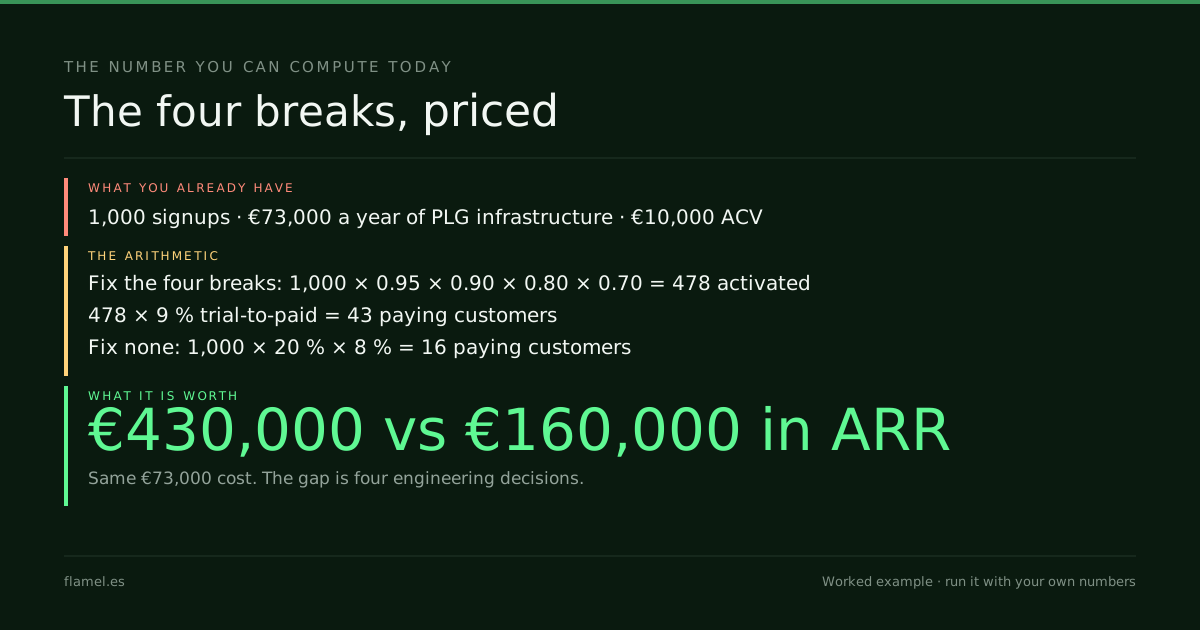
Each of those four breaks has a measurable cost in the PLG model. A 5 % drop at signup, a 10 % drop in the first session, a 20 % drop between signup and first value, and a 30 % drop in week two — those are four separate engineering decisions. Apply them sequentially to 1,000 signups: 1,000 × 0.95 × 0.90 × 0.80 × 0.70 = 478 users who survive all four breaks. At a 9 % trial-to-paid rate, that is 43 paying customers — €430,000 in ARR on the same €73,000 cost. Fix none of those four breaks and stay at 20 % activation with 8 % trial-to-paid: 16 paying customers, €160,000 in ARR. The gap between those two outcomes is not a product decision. It is four engineering decisions, each with a measurable cost and a measurable return. The product analytics required to locate those breaks at the right granularity are their own post, and it's coming.
For a founder with 0–2 AEs who is evaluating the PLG motion: the question is not "does PLG work?" The question is "at which of those four moments does my product lose the user, and what does fixing it cost versus what does it return?" That is the question The Activation Audit answers — by signing up as a real user, reading your product analytics with access, and mapping the drop at each of the four breaks.
`` Activation payback (months) = Engineering cost of +10 activation points ÷ (Additional paying customers × ACV ÷ 12) ``
If the payback is under 12 months, the investment is ahead of another AE hire. Run this with your own ARR, your own signup volume, and your own activation rate estimate. If the payback exceeds 12 months, activation is not the primary bottleneck — volume is, and what your CAC actually is and where it goes is the number to examine first.
What to do by Monday: Pull your last 90 days of signups. Separate users who completed your core action — sent a report, built a workflow, connected an integration, whatever the thing is — from those who never did. That ratio is your activation rate baseline. Then divide your annual PLG infrastructure cost by the number of paying customers that rate produces. That single number tells you whether activation or volume is the constraint in your PLG economics — and which one is worth fixing first. If you don't have the analytics to pull that number cleanly, that gap is itself the finding.
Work through this with your own numbers
You are a SaaS founder evaluating whether to shift from sales-led to product-led growth. Your current product has [monthly signups], an [activation rate]% of users reach your core value prop without sales help, [trial to paid rate]% of activated users convert to paying customers, and your annual PLG infrastructure costs are [total PLG cost in euros]. Your AE cost is [AE annual cost] and closes [deals per year] at [ACV] per deal. Calculate your current sales-led CAC and your projected PLG CAC using the formula: PLG CAC = infrastructure cost ÷ (signups × activation rate × trial-to-paid rate). Which motion has lower customer acquisition cost, and what single metric would you need to improve to flip the outcome?FAQ
What is product-led growth and how does it differ from sales-led growth?
Product-led growth (PLG) is a go-to-market model where the product itself handles acquisition, activation, and initial retention — replacing or reducing the sales function. In a sales-led model, a human closes each deal; in PLG, an onboarding flow does. The cost does not disappear — it moves from salaries and commissions into engineering time, infrastructure, and free-tier hosting. Which is cheaper depends on your activation rate and ACV, not on which model is trending.
What does it cost to run a PLG motion for a SaaS at 400k € ARR?
For a small SaaS (€400k ARR, one to two engineers), a PLG motion typically requires 0.5 engineer equivalents in onboarding and product work, free-tier infrastructure costs, a product analytics stack, and self-serve content. That adds up to roughly €73,000 a year in the worked example — your stack and team cost will vary. The number that determines whether this beats a sales-led model is your activation rate — the share of signups who reach first value without a human's help.
How do I calculate the breakeven between PLG and sales-led for my SaaS?
Divide your total annual PLG infrastructure cost by the number of paying customers you need to match your sales-led CAC. The formula: PLG infrastructure cost ÷ (signups × activation rate × trial-to-paid rate) = PLG CAC. Compare it to your current sales-led CAC (AE cost ÷ deals closed). If your activation rate is too low, PLG costs more per acquired customer than the AE — and fixing activation is the investment to make before reducing headcount.
At what ACV does product-led growth make sense versus a direct sales motion?
At ACVs below €500 per year, sales-led is generally too expensive — the AE cost per deal exceeds first-year revenue. PLG is the only sustainable motion at this price point. Above €5,000 ACV, sales-led is viable and PLG becomes a complement (self-serve for low-touch users, AE for expansion). Between €500 and €5,000, the right answer depends on your activation rate and the engineering cost of improving it by ten percentage points.
What is the biggest hidden cost of a PLG motion that founders overlook?
Failed free-tier activations. A user who signs up, never reaches first value, and churns within the free tier is not free: they consume hosting, support, and engineering attention. Most PLG CAC calculations divide infrastructure cost by paying customers, ignoring the activation funnel. The real cost is infrastructure ÷ (signups × activation rate × trial-to-paid rate). If that number exceeds your sales-led CAC, activation — not headcount — is the problem to fix first.
That's what The Activation Audit is. Five business days, $500, and the map is yours whether or not you hire us.
Your store, five days.
$500. Zero commitment. Yours either way.