
Customer acquisition cost: the formula, and the number that decides where your next dollar goes
Everyone calculates CAC. Almost nobody does the subtraction that comes after it — the one that decides whether your next dollar buys more traffic or a better conversion rate.

You know your CAC. You probably checked it this month.
Here's the problem with that number: on its own, it decides nothing. It tells you what the last customer cost. It doesn't tell you what the next one should cost, and it certainly doesn't tell you where to spend to get them. The decision comes from a subtraction that almost nobody does — and it usually points somewhere other than the ad account.
Key takeaways
- CAC only counts ad spend for most stores, but real acquisition cost includes team salaries, agency fees, tools, and discounts—media reporting alone hides true cost.
- Mixing returning customer orders with new customer acquisitions disguises rising acquisition costs behind falling averages, since retained customers subsidize the metric.
- For 1,200 extra orders, buying 120k sessions costs full price annually; improving conversion 0.4 points costs once and works on every future visitor already paid for.
- Declining organic traffic and mobile conversion gaps mean your next dollar buys traffic at higher cost and worse returns than fixing your existing conversion leak.
- Run the subtraction: calculate sessions needed for new orders at current conversion rate versus conversion uplift needed at current traffic—spend your next dollar on whichever is cheaper.
The formula, and the two places it goes wrong
Customer acquisition cost is the total you spent to acquire customers in a period, divided by the number of customers you acquired in it.
CAC = total acquisition spend ÷ new customers acquired
That's it. The arithmetic is trivial. The two failures are in what you put into it.
The first is the numerator. Most people count ad spend and stop. Acquisition spend is ad spend plus the salaries of the people running acquisition, plus the agency retainer, plus the tools, plus the discounts you gave to close the first order. If your CAC only counts media, it isn't a cost — it's a media report. The number will be flattering and useless.
The second is the denominator. New customers, not orders. If a returning customer buys twice this month, that's two orders and zero new customers. Mixing the two is the most common way a store convinces itself its acquisition is getting cheaper while it's getting more expensive — the returning customers are quietly subsidising the average.
Get those two right and you have a real acquisition cost. Now comes the part that matters.
The subtraction nobody does
Your CAC answers "what does a customer cost?"
The question that decides your quarter is different: is my next dollar worth more spent on traffic, or on what happens after the click?
Those have the same goal — more customers — and radically different economics. One is rent. The other is an asset.
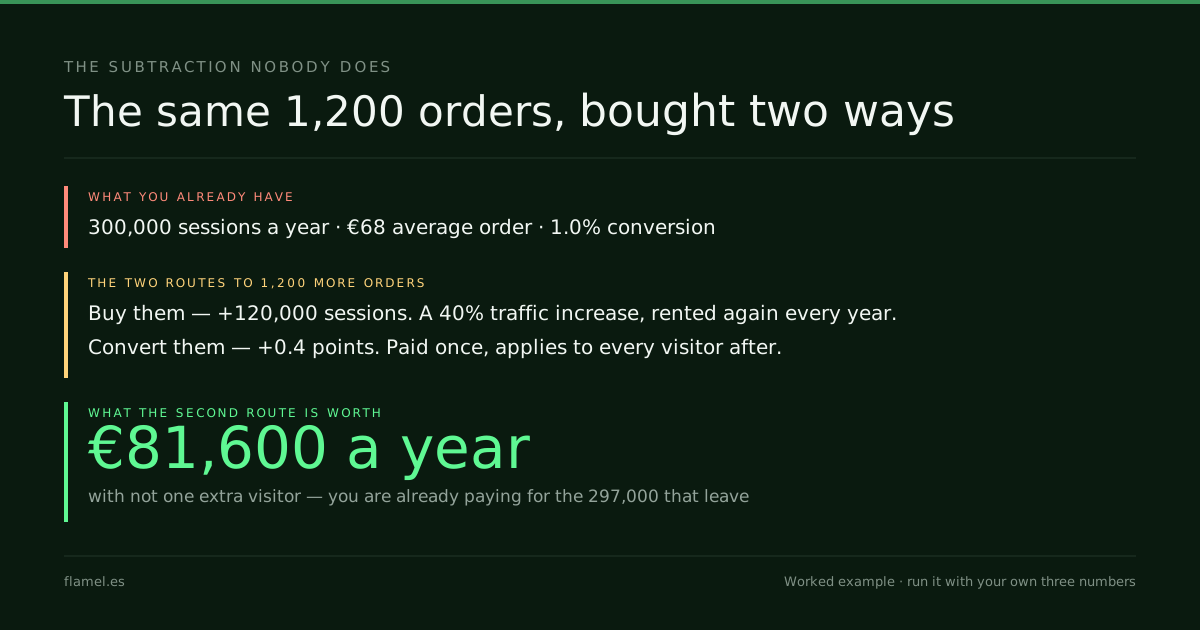
Take a store doing 300,000 sessions a year at a 1.0% conversion rate, with an average order value of €68. That's 3,000 orders and €204,000 a year.
Say you want 1,200 more orders.
Route one: buy them. At a 1.0% conversion rate, 1,200 orders need 120,000 more sessions. That's a 40% increase in traffic. Take whatever you currently pay per session and multiply it by 120,000. That's the bill. Now multiply it again for next year, because traffic you rent stops the day you stop paying.
Route two: convert them. The same 1,200 orders come from moving that conversion rate from 1.0% to 1.4%, with not one extra visitor. At €68 a head, that's €81,600 a year. You pay for the fix once. It applies to every visitor who arrives afterwards, including all the ones you're already paying for.
Four tenths of a percentage point. That's the whole gap. And here's the part that stings: you are already paying full price for the 297,000 sessions a year that leave without buying. That spend is already committed. The only question is whether it's working.

Why this arithmetic changed recently
This was always true. It wasn't always urgent.
For fifteen years, the honest answer for most stores was "buy the traffic". It was cheap, it was abundant, and it was predictable. That has stopped being true, and the clearest evidence comes from a market that's running about eighteen months ahead of the rest: Spain.
Between early 2025 and mid-2026, organic search fell from 52.02% to 40.70% of all web traffic in Spain — a drop of 11.32 percentage points in sixteen months, against 2.59 points globally (SE Ranking, June 2026). Four times faster than the rest of the world. Answer engines are absorbing the clicks that used to land on websites, and they're doing it first in the markets where they launched first.
And conversion isn't picking up the slack. Across 1,265 Spanish digital businesses, the average ecommerce conversion rate sits at 1.22% (Flat 101's annual conversion study). Mobile carries 66% of the traffic and converts at 0.82%, against 2.02% on desktop. Two thirds of your visitors arrive on the device that converts two and a half times worse.
Put the two together and you get the actual condition of the market: fewer visitors arriving, converting worse, and costing more to replace. Every one of those three trends makes the same dollar worth more on the second route than on the first.
If you're not in Spain, don't read this as someone else's problem. Read it as your forecast.
The three numbers, on one line
You don't need a model. You need three numbers next to each other:
| Number | Where it comes from |
|---|---|
| CAC | Total acquisition spend ÷ new customers |
| Conversion rate | Orders ÷ sessions, split by device |
| AOV | Revenue ÷ orders |
Put them in a row and the decision makes itself:
- If your conversion rate is below your category's and your CAC is rising, more traffic is the expensive answer to the wrong question. You have a leak, and you're pouring faster.
- If your conversion rate is at or above your category's and your CAC is stable, buying traffic is a reasonable use of money. Your machine works; feed it.
- If your mobile rate is less than half your desktop rate, you don't have a traffic problem or a pricing problem. You have a specific, findable, fixable problem, and it's costing you two thirds of your visitors.
That last one is worth sitting with, because it's nearly universal and almost never on the priority list.
When more traffic really is the answer
This would be a sales pitch if it didn't include the cases where it's wrong, so here they are.
If you're under about 1,000 sessions a month, you don't have a conversion problem you can measure. You have a discovery problem. Any conversion rate calculated on that volume is noise, and anyone selling you optimisation at that stage is selling you a coin flip with a report attached.
If you're already converting above your category benchmark, the leak isn't at checkout. It's somewhere else — margin, retention, the mix of what you sell — and pushing conversion further will cost more than it returns.
And if your product only sells to people who already know they want it, traffic is your whole business and you should buy it. Not every store is a conversion story.
The honest version of the argument isn't "always fix conversion". It's: the default has flipped. Buying traffic used to be the safe assumption and fixing conversion the special case. Given what traffic now costs and what it now converts at, that's backwards.
What to do with this by Monday
Open your analytics and write down three numbers: CAC for the last full quarter, conversion rate split by device, and average order value.
Then do the subtraction. Decide how many more orders you want. Divide by your conversion rate to see how many extra sessions that needs, and price them. Then work out what conversion rate would produce the same orders with the traffic you already have.
Whichever number is smaller is where your next dollar goes.
Most of the time it's the second one, and by a distance that's uncomfortable to look at. We rebuilt one store's experience over a year and its conversion rate went from 0.5% to 3% — the whole thing is written up here, numbers included.
One warning before you go and test your way there: at 300,000 sessions a year you almost certainly don't have the volume to run a valid A/B test on any of this. That's a genuine problem with a real answer, and it deserves its own post.
If you'd rather not do the subtraction alone, that's what the Conversion Audit is. Five business days, $500, and you keep the map whether or not you hire us.
Work through this with your own numbers
You're the founder of a DTC store. Your current CAC is [your quarterly acquisition spend / new customers acquired]. Your conversion rate is [orders / sessions], with [mobile conversion rate] on mobile and [desktop conversion rate] on desktop. Your AOV is [average order value]. You want [target number] more orders this quarter.

Calculate: How many additional sessions would you need at your current conversion rate to hit that target, and what would that traffic cost if your current CPC is [your cost per click]? Then calculate what conversion rate increase would deliver the same orders without new traffic. Compare the cost of each route. Which route should get your next dollar, and why?
Your store, five days.
$500. Zero commitment. Yours either way.