
Your positioning statement is not a marketing document
A vague positioning statement doesn't just blur messaging. It lets wrong-fit trials in, and that shows up in your trial-to-paid rate.

A positioning statement is the sentence that decides who signs up for your trial before they ever open the product. Most guides treat it as a messaging exercise: words for the homepage, phrasing for a pitch deck. Few measure what it does upstream: it either tells the wrong-fit visitor to leave, or it doesn't, and that single failure shows up weeks later as a trial that never converts.
Most founders write two versions of the same statement without noticing the difference between them. One says what the product does. The other says who it's for, what they're replacing, and what breaks if they don't switch. The second version turns away people who were never going to pay. The first lets everyone in and calls that pipeline.
Below is the arithmetic on one specific-versus-generic pair for a single product, then the number that tells you whether your own statement is decoration: how many of the accounts that already pay you match the customer it names.
A positioning statement defines who a product is for, what it replaces, and why the switch matters, before a visitor starts a trial. Treated as marketing copy, it's decoration. Treated correctly, it's a filter: a specific statement pre-qualifies trials, while a generic one lets wrong-fit users in and inflates early churn and soft trial-to-paid numbers.
Key takeaways
- Positioning statements are usually written as branding copy, but their real function is a qualification filter on who signs up.
- A generic statement widens signup volume while lowering the share of trials that ever convert to paid.
- A narrower statement only beats a larger, unfiltered signup pool if its conversion rate clears the break-even point.
- Published freemium benchmarks range from 3% to 5% as 'good,' wide enough to hide a positioning problem inside that range.
- Score your last 20 closed accounts against the customer your statement names; the share that matches is the number to move.
What a positioning statement actually filters
The usual guide treats a positioning statement as a messaging deliverable: a sentence for the pitch deck, refined until it sounds right in a meeting. What it rarely does is connect that sentence to what happens in the trial that follows it.
That connection is mechanical, not rhetorical. A prospect reads the sentence and decides whether it describes them, before they touch the signup form. If the statement reads "project management for modern teams," almost everyone qualifies, and almost everyone signs up. If it reads "project tracking for ten-person agencies billing hourly, built to replace three spreadsheets and a whiteboard," most of that same traffic rules itself out before the trial starts.
A clearly defined ideal customer profile is supposed to do this filtering earlier, in targeting and in sales qualification. A positioning statement is where that definition either survives contact with the homepage, or gets diluted into something that fits everyone and converts no one especially well. The dilution is rarely a deliberate choice. It happens one stakeholder edit at a time, each one softening a specific noun into a broader category so the sentence offends nobody in the review meeting.

Two positioning statements, one product, and the math between them
Take a freemium project-management tool, declared here as a hypothetical: $1.2M ARR, 4,000 free signups a month, one feature set, one price. Put two different positioning statements on its homepage and work the numbers on paper, with the same acquisition channels and the same product underneath.
Version A, generic: "The project management tool for modern teams." Version B, specific: "The tracker for ten-person agencies billing hourly, replacing three spreadsheets and a whiteboard."
Version A pulls in the full 4,000 signups a month. Some are agencies; most are not: freelancers evaluating anything free, teams that will never pay, people who signed up for a template and left. Version B turns a chunk of that traffic away before it becomes a trial at all. Say signups drop to 2,800.
Here is what has to move with it: free-to-paid conversion rate. ChartMogul's benchmark puts 3%-5% as a good range for freemium self-serve conversion. Say Version A, diluted with non-ICP signups, converts at 3%, the low end. The question is not whether Version B converts better. It is how much better it has to convert to be worth the signups it turned away.
Version A: 4,000 signups × 3% = 120 paying customers/month
Break-even for B: 120 ÷ 2,800 signups = 4.3%
If B reaches 5%: 2,800 × 5% = 140 paying customers/month (+20)
If B stalls at 4%: 2,800 × 4% = 112 paying customers/month (−8)
Version B has to find 1.3 more points of conversion in a better-qualified pool just to break even. If it gets to 5%, the gap compounds: at an average $70 a month per plan, each month's 20 extra customers add $1,400 in MRR, so after 12 months the difference is $16,800 in MRR, about $200,000 in ARR, before churn. The only thing that changed was one sentence, which is why the break-even rate is the number to test before anyone rewrites the homepage.
That's the trial-qualification problem the Activation Audit is built to catch: five business days, $500, and the map is yours whether or not you hire us.
The trial-to-paid math nobody reviews
Twenty paying customers a month, gained or lost, doesn't look like a positioning problem from inside most dashboards. It looks like a soft month for trial-to-paid, a sales team complaining that leads aren't qualified, or a churn number that never quite explains itself in week two.
That's because activation rarely breaks where anyone's looking. Signup is the first place it breaks: everything asked of a user before they have any reason to trust the product. A positioning statement operates one step earlier than that: it decides who even reaches the signup form believing the product is for them. Get it wrong, and the break at signup was set up by a sentence marketing wrote and nobody who watches trial-to-paid ever reviewed.
The product-led growth motion depends on that self-selection working, because there's no salesperson to catch a wrong-fit account before it signs up. And the number that eventually reveals whether a trial produced anything is time to value: how many steps sit between signup and the thing the user came for; a wrong-fit user never has a "thing they came for," no matter how short that path is.
The checklist is short enough to run today:
- Who is this for? Specific enough that someone can rule themselves out.
- What are they replacing? So the switch has a comparison point.
- What breaks if they don't switch? So urgency sits on the page, not assumed.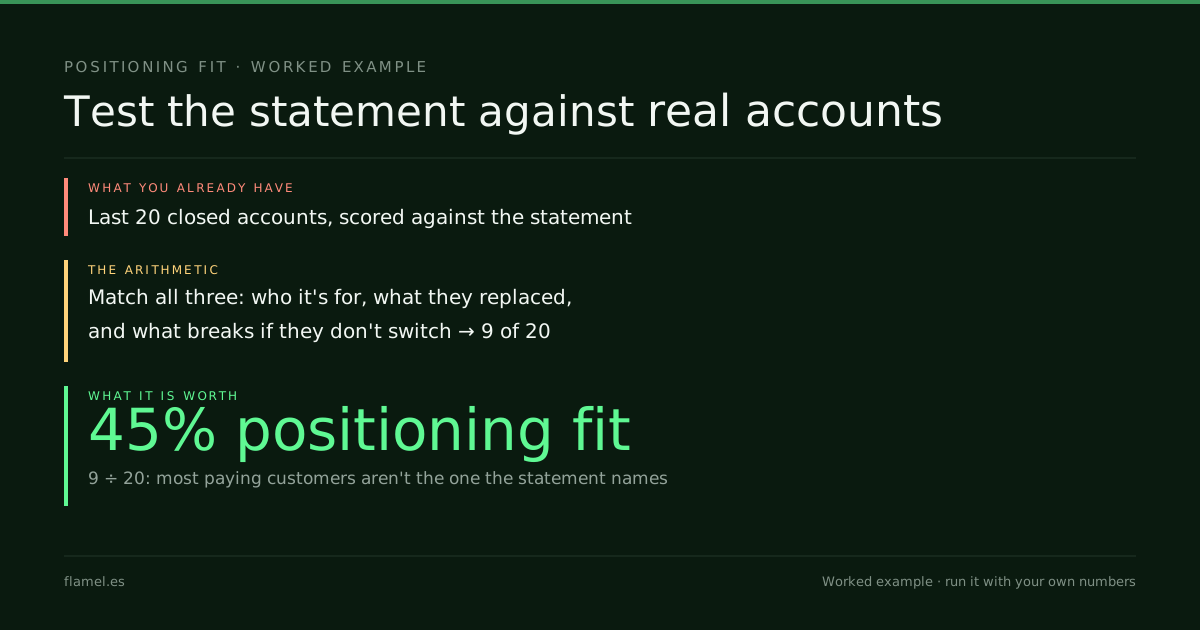
Test the statement against real accounts
The example runs on assumed conversion rates. Your own statement can be tested against something harder: the accounts that already pay you. A positioning statement nobody can falsify is decoration, and two questions falsify it. Does the customer it names match the accounts that renew? And does the value it promises name what those accounts actually pay for?
The first question has a number. Take your last 20 closed accounts and mark each one against the three elements of your statement: who it's for, what they replaced, what breaks if they don't switch. Divide the accounts that match all three by 20. If 9 of 20 match, your positioning fit is 45%: more than half of the customers paying you are not the customer your statement describes. The second question has no formula, but it has a source: the reason those matching accounts gave for buying, checked word for word against the value your statement promises.
What to do by Monday: pull your last 20 closed accounts, score them against your current statement, and write down the share that matches. That percentage is the number your next positioning statement has to raise.
The Activation Audit reads your signup funnel and your trial data with real access. Five business days, $500, and the map is yours whether or not you hire us.
Work through this with your own numbers
You are a SaaS founder about to rewrite your positioning statement before the next quarter's trial push. Here is my current statement: [your current positioning statement]. Here are my numbers: [your monthly trial signups], [your current trial-to-paid conversion rate], and [your average revenue per paying customer per month]. Rewrite the statement to name who it's for, what they replace, and what breaks if they don't switch. Then estimate how much signup volume would likely drop if the new statement filters out non-ICP visitors, and how much trial-to-paid conversion would need to rise to produce the same or more paying customers as today. Show the arithmetic the way a worked example would: signups times conversion rate, before and after, for both versions. Tell me which of the three qualifying elements my current statement is missing.FAQ
What is a positioning statement, and how is it different from a tagline?
A positioning statement is the sentence that names who a product is for, what it replaces, and why the switch matters. A tagline is the short, memorable line that may or may not carry those same three elements. Many teams keep the statement in an internal document, but it only filters trials once its substance is on the homepage, where a visitor can read it and rule themselves out.
Why does a vague positioning statement increase SaaS churn?
A vague statement describes the product broadly enough that almost any visitor can imagine themselves as a fit. That widens signup volume but adds accounts with no real use case, who sign up, never reach a moment of value, and either churn immediately or never convert from trial to paid. The churn isn't a product failure; it starts at the sentence that let them in.
How specific should a positioning statement be?
Specific enough that someone outside the ideal customer profile can read it and rule themselves out. That usually means naming a company size or role, naming what they're replacing, and naming what breaks if they don't switch: three concrete elements, not adjectives like 'powerful' or 'modern'.
Does narrowing a positioning statement always lower signup volume?
Usually, yes. That's the mechanism, not a side effect: fewer visitors self-select in. The worked example above shows the condition for that to pay off. A smaller pool only wins if its conversion rate clears the break-even point, 4.3% in that example.
Where does positioning fit among the places SaaS activation breaks?
Activation breaks at signup, in the first session, in the steps to time to value, and in week two. A positioning statement operates one step before the first of those: it decides who reaches the signup form believing the product is for them, before any onboarding design gets a chance to matter.
That's what the Activation Audit is. Five business days, $500, and the map is yours whether or not you hire us.
Your store, five days.
$500. Zero commitment. Yours either way.