
Time to value: the formula, and the day it decides churn
Time to value is the formula that predicts trial-to-paid conversion. The threshold day, one worked cohort, and the number your own data gives you.

Time to value is the count of days between signup and the first moment a user gets the outcome they came for — not a login, not a product tour, an outcome. For a subscription product, it is the single best predictor of whether a trial becomes a paying account. Below a threshold specific to that product, conversion holds. Past it, conversion collapses, cohort by cohort.
The top results for this term are dictionary-style definitions — Wikipedia among them — and they stop there. Nobody runs the arithmetic on one cohort, in public, with a formula the reader can reuse on their own trials. This post does: a worked subscription product, the formula behind it, and the day past which trial-to-paid conversion drops on your own cohort data.
Three inputs, one threshold, one number you can compute this afternoon.
Time to value (TTV) is the number of days between signup and a user's first real outcome inside a subscription product. It is the strongest predictor of trial-to-paid conversion, ahead of logins or usage volume. Most Business software trials need that outcome inside two weeks — each day past it lowers the odds of converting.
Key takeaways
- Time to value is a count of days, not a feeling — signup to first real outcome, nothing else.
- Trial-to-paid conversion tracks time to value more closely than logins, usage volume, or feature adoption.
- Conversion drops sharply once time to value crosses a threshold specific to the product, not a universal number.
- A subscription product with 1,200 monthly trials can lose over €4,000 in monthly recurring revenue to one slow cohort segment.
- Pull your last two trial cohorts, mark the day each hit first value, and split them at day 14.
Time to value, not a login
Time to value has nothing to do with whether a user logged in twice, clicked through a tour, or opened a dashboard. It is the number of days between signup and the first moment the product delivers what they came for — a report generated, a workflow completed, a result seen. For a subscription product, that gap is the whole point of saas onboarding: everything before first value is cost, everything after is retention.
A generic definition will tell you time to value is a product metric. In practice, for a billed subscription, it measures one thing only: whether the trial converts before the card gets charged.

The formula behind first value
TTV is simple to state and hard to instrument, because "first value" has to be one specific event, not a feeling.
Time to value (days) = date of first-value event − date of signup

First-value event = the one action inside the product that a paying
customer, a year later, would call "the reason I stayed"
Pick the wrong event — a login, a finished checklist, a completed tour — and the metric measures your onboarding experience, not your product's value. Pick the right one, and time to value becomes the single number a founder can chart against trial-to-paid conversion, cohort by cohort.
A worked cohort on one subscription product
Take a subscription product at roughly €900,000 ARR: 1,200 trial signups a month, a €49 average contract, a 14-day free trial. Trial-to-paid conversion falls off sharply once time to value crosses roughly two weeks — one industry roundup of trial benchmarks puts post-day-14 conversion near 1%, against meaningfully higher rates for trials that reach value in the first week, per the same source. A separate ChartMogul analysis argues a fast first session isn't enough on its own — what separates compounding growth is whether users return and build a habit, not just reach a first result.
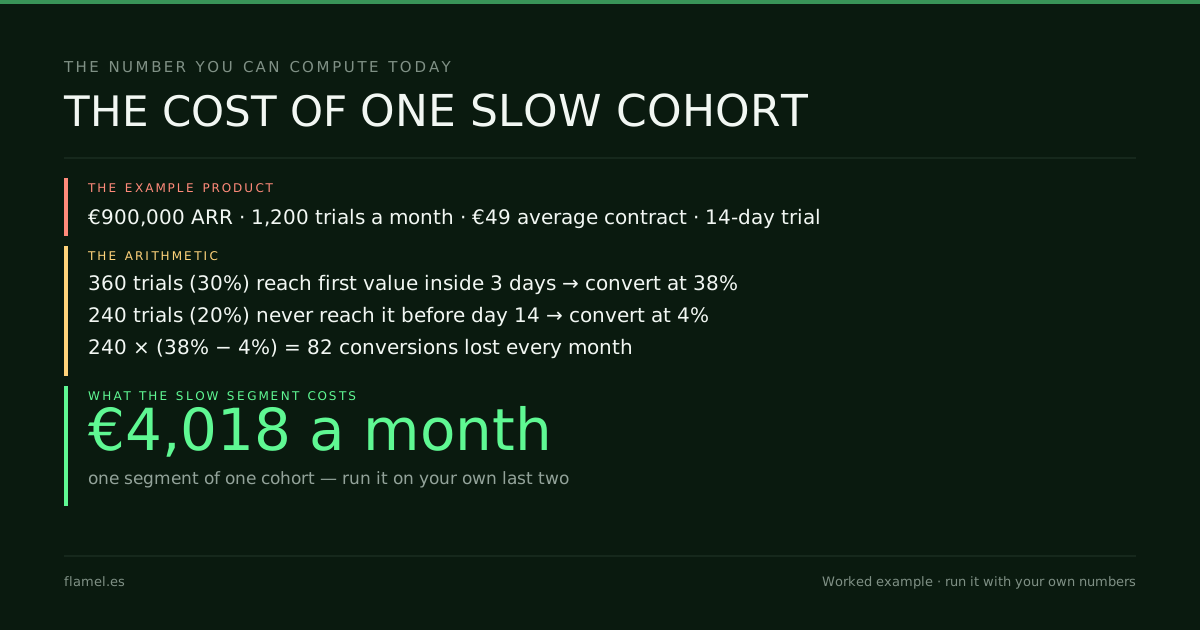
Split that cohort of 1,200 trials as an example: 360 (30%) reach first value inside 3 days and convert at 38%. Another 240 (20%) never reach it before day 14 and convert at 4%. The remaining 600 land in between. The 240 slow trials alone: 240 × (38% − 4%) = 82 lost conversions a month, at €49 a month each. That's €4,018 in monthly recurring revenue left on the table, every month, from one slow segment of one cohort.
What one day of time to value is worth
The formula for revenue at risk from a slow cohort:
Revenue at risk = (trials past threshold) × (fast-cohort rate − slow-cohort rate) × average contract valueRun that on your own onboarding data and the number is rarely small. Product-led growth, the motion built to sell without a sales team, depends on this exact number holding — the day a trial reaches value is the day it starts paying for itself. Retention is the same math one step later: a slow first session predicts a slow week two, and what one point of retention is worth has its own formula. If you're picking which metric to chase before fixing onboarding, that's a north star question, not a time-to-value one.
A teardown of five customer onboarding saas flows against this exact formula is its own post, and it's coming.
A slow number tells you the trial never reached value; it doesn't tell you where it stalled. In practice it breaks in one of four places — signup, the first session, the steps between signing up and the outcome, or week two — and which one it is decides whether the fix is a line of copy, a default setting, or a step nobody built.
What to do by Monday: pull your last two trial cohorts, mark the day each account hit first value, and split them at day 14. Multiply the gap in conversion rate by your average contract value and the count of trials past that line. That number is what a slow first week is costing you this month.
Work through this with your own numbers
You are a SaaS operator reviewing your own trial funnel. I run a subscription product with [your monthly trial signups] trial signups a month, an average contract value of [your average contract value], and a free trial of [your trial length] days. My product's first-value event is [describe the one action a paying customer would call the reason they stayed]. For my last two cohorts, roughly [percentage reaching first value fast] reach that event within [X] days and convert at [fast-cohort conversion rate], while [percentage reaching first value slow] take longer than [threshold in days] and convert at [slow-cohort conversion rate]. Calculate my monthly recurring revenue at risk using: (trials past threshold) × (fast-cohort rate − slow-cohort rate) × average contract value. Then tell me whether the bigger lever is shortening time to value for the slow segment or redefining what my first-value event should be.FAQ
What is time to value in SaaS?
Time to value (TTV) is the number of days between a user's signup and the first moment the product delivers the outcome they came for — not a login, not a finished tour, a real result. For a subscription product it's the strongest early predictor of whether a trial converts to a paid plan, because it measures the product's actual value delivery rather than engagement with the onboarding flow itself.
How do you calculate time to value?
Subtract the signup date from the date of the first-value event: the one action a paying customer, a year later, would name as the reason they stayed. That event has to be specific and outcome-based — a report generated, a workflow completed — not a login or a completed checklist, or the metric ends up measuring onboarding steps instead of product value.
What is a good time to value for a subscription product?
There is no universal number; it depends on the product's complexity and price point. What's consistent is the shape of the curve: conversion holds while time to value stays low and drops sharply past a threshold. One industry roundup of trial benchmarks found post-14-day conversion falling to near 1% for business software trials, against meaningfully higher rates for trials reaching value inside the first week, per the same source.
Does time to value affect trial-to-paid conversion rate?
Yes, and more directly than usage volume or feature adoption. Trials that reach a real outcome quickly convert at meaningfully higher rates than trials that stall, and the gap widens the longer the trial runs: the same benchmark that puts post-day-14 conversion near 1% puts trials that reach value in the first week meaningfully higher.
Is time to value the same as onboarding completion rate?
No. Onboarding completion rate measures whether a user finished a checklist or tour — steps the product asked them to take. Time to value measures whether they reached an outcome they actually wanted. A product can have a 90% onboarding completion rate and still have a slow time to value, if the checklist doesn't lead to the thing the user came for.
That's the map: five business days, $500, and it's yours whether or not you hire us. That's what the Activation Audit is.
Your store, five days.
$500. Zero commitment. Yours either way.