Build measure learn: grow by experimenting
Build measure learn for creative brands: the Lean Startup loop as an experimentation system to grow and innovate, and the loop speed you can count.
Build measure learn is the loop at the core of the Lean Startup method: build the smallest thing that can test an idea, measure what customers actually do with it, and learn whether to keep going or change course. For a creative brand that already sells, it is the experimentation system that lets it grow and innovate at the same time.
Most brands that sell well got there on the founder's taste and a lot of hard work. That works until the market moves faster than intuition can follow: a channel changes its rules, a competitor copies the bestseller within a season, a new product line has to be decided before anyone has bought it. Betting a whole season on intuition is the expensive way to find out.
Build measure learn is the Lean Startup feedback loop: build the simplest test of an idea, measure what customers actually do, and learn whether to keep going or change course. For a creative brand that already sells, run every few weeks, it becomes the experimentation system that lets the brand grow and innovate at the same time.
Key takeaways
- Build measure learn is the Lean Startup loop: build the simplest test, measure what customers do, decide and record.
- For a creative brand the minimum viable product is a presale, a limited first run or a prototype page.
- The same loop serves growth and innovation, so the brand does not bet a season on intuition.
- Loop speed equals 365 divided by the days from idea to a written decision.
What build measure learn means, outside a startup
The Lean Startup principles describe the build-measure-learn feedback loop as a core component of the method: figure out the problem, build a minimum viable product to start learning as quickly as possible, then decide whether to persevere or change course. The same page names the unit of progress: validated learning, not output.
Nothing in that loop is specific to software. Shopify's guide to minimum viable products describes the store version: a page for a product that does not exist yet, which usually ends in a waitlist or a pre-order, and the case of Physical Phones, whose founder collected $100,000 in pre-orders in three days before any supply chain was in place. Translated to a brand that sells through drops, a catalog, a membership or seasons:
- Build means the simplest version of an idea that real customers can respond to: a presale, a limited first run, a prototype page with a waitlist, a new product page for one category.
- Measure means one number, chosen before the launch, that settles whether the idea worked: deposits, sell-through, waitlist signups, the category's conversion rate.
- Learn means a decision written down: the idea stays, changes or goes, and the next loop starts from that record.
The marketing experiments that fit a launch calendar are the "build" step of this loop. Build measure learn is what chains them into a system instead of a series of one-offs.
Why intuition stops working as a brand scales
Most brands start from a hunch: the same Shopify guide cites a survey in which 57% of store owners validated their business idea with personal experience. Early on, you see every order, answer every message and know why the last drop worked. As the brand scales, that view fragments. Orders come through more channels, more people make decisions, and five things change in the same month. Intuition can still produce good ideas; what it cannot do any more is tell which of the five changes moved the number.
The market adds pressure from the other side. A design that sells is copied within a season, a channel that worked last year costs more this year, and the next line has to be chosen before there is any data on it. If you answer each of those with a bigger bet on intuition, you commit the whole production budget before the first order. With a loop, you commit a fraction, read the response and scale what worked.
Build measure learn as a system, not a campaign
The loop is useful only if it keeps running. One experiment teaches one thing; a loop that runs every few weeks becomes the way the brand decides. In growth marketing for creative businesses, each loop targets one of the five moments (Appear, Attend, Recognize, Retain, Know), and the record of the previous loop decides which moment gets the next one.
The same system serves two goals that usually compete for the same budget. Most loops improve what already sells: a product page, the second order, the way returning customers are recognized. Some loops test what might sell next: a new line, a new price point, a new market. Running both through the same loop is how a brand innovates without betting the season, and grows without going stale.
One season on the worked store, three loops
Here is how one season could run on the blog's worked store (300,000 sessions a year, a €68 average order, a 1.0 % conversion rate), as an example. The thresholds are written before each loop starts; the figures are arithmetic, not promised results.
Loop 1, innovate (2 weeks). Build: a prototype page for a new line, with a waitlist instead of a cart. Measure: signups over 14 days, against a threshold of 150 set in advance. Learn: above it, the line goes into a limited first run; below it, the idea is parked with the record of why.
Loop 2, grow (4 weeks). Build: a limited first run of 200 pieces of the new line, offered first to the waitlist. Measure: sell-through and restock alerts. Learn: the size of the next run comes from the alerts, not from a guess.
Loop 3, grow (4 weeks). Build: one message at day 30 for first-time buyers of the new line. Measure: the share who place a second order within 60 days. Learn: the message stays or changes, and the next season's launch plan includes it from day one.
Three loops, three decisions, about ten weeks. If you want to know which of your moments should get the first loop, The Conversion Audit maps it from your own admin in five business days.
How fast your loop runs, in one number
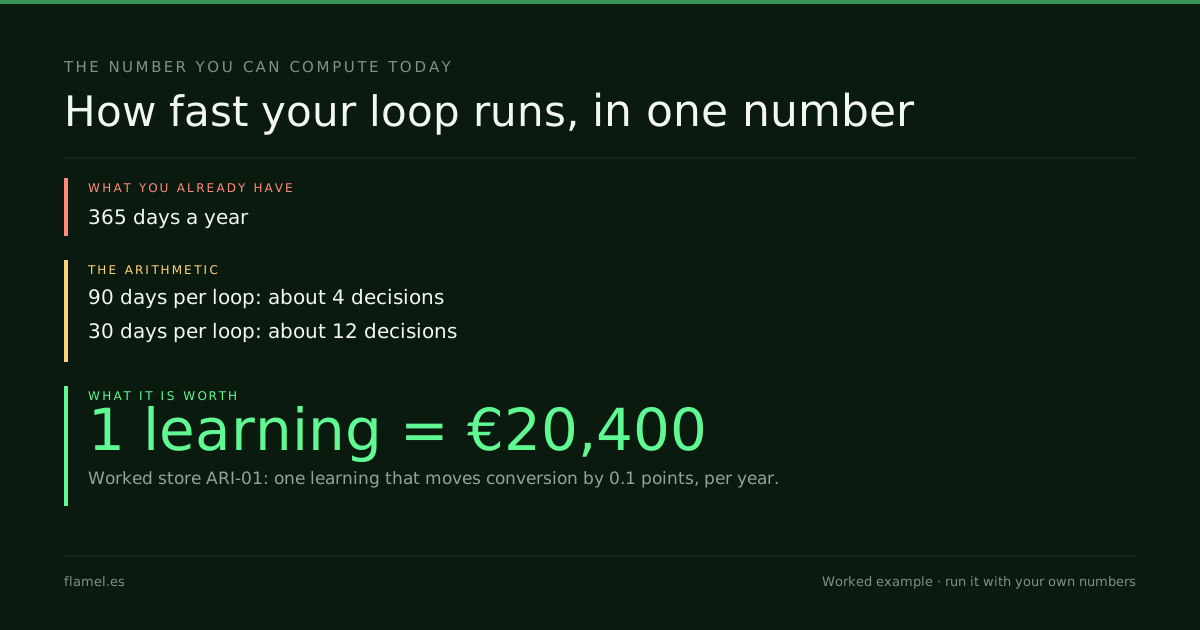
The useful measure of a learning system is not how many ideas it tests but how many decisions it produces per year.
Loop speed = 365 ÷ days from idea to a written decisionA brand that takes 90 days from idea to decision learns about four things a year. One that takes 30 days learns about twelve, with the same team and the same budget. On the worked store, a single learning that moves the conversion rate by 0.1 points is worth 300 orders, or €20,400 a year, so the difference between four and twelve loops is not a matter of style. Choose the one number each loop moves the way you would choose a north star metric: one per business model, read the same way every time. Take your last three ideas, count the days from the idea to a written decision, and divide 365 by the average.
Three things usually slow a loop down, and none of them is the build. The threshold is decided after the result, so every outcome can be read as a success. The measure is something the admin does not count, so someone has to assemble it by hand. And the record is never written, so the decision lives in one person's memory and the next loop repeats the question. Deciding the threshold before the launch, choosing a number the store already counts and writing the paragraph on the day the loop closes usually cut the loop time more than any tool does.
Work through this with your own numbers
You run a creative brand that sells through [drops / a catalog / a membership / seasons], with [annual sessions] sessions a year, a [conversion rate] conversion rate and a [average order value] average order. List your last three product or marketing ideas and, for each, the days from the idea to a written decision, or 'never decided'. Calculate loop speed as 365 divided by the average. Then design one build measure learn loop for your next idea: the simplest version customers can respond to, the one number that settles it, the threshold written in advance, the date the loop closes and what you will do if it fails. Price one learning that moves your conversion rate by 0.1 points.FAQ
What is build measure learn?
Build measure learn is the feedback loop at the core of the Lean Startup method: build the simplest version of an idea that customers can respond to, measure what they actually do, and learn whether to persevere or change course, then start the next loop from that decision.
Is the Lean Startup method only for startups?
No. The loop works for any business that has to decide under uncertainty. For a creative brand, the minimum viable product is a presale, a limited first run or a prototype page, and the unit of progress is a recorded decision.
What is a minimum viable product for a brand that already sells?
The minimum thing real customers can respond to: deposits on a piece before production, a limited first run, a waitlist page for a line that does not exist yet, or one changed product page.
How long should one build measure learn loop take?
Long enough to read one number, usually two to six weeks for a brand with a launch calendar. The measure to watch is loop speed: 365 divided by the days from idea to a written decision.
Finding which of your moments deserves the first loop, in your own admin, is what The Conversion Audit maps. Five business days, $500, and the map stays with you whether or not you hire anyone next.
Your store, five days.
$500. Zero commitment. Yours either way.