What is growth marketing? For creative businesses
What is growth marketing for a creative business? Five moments, one experiment per cycle, and the number that says where the next cycle should go.

What is growth marketing? Growth marketing is the system that makes the people a creative brand is made for find it, buy without friction, come back, and feel recognized when they do, and that learns one concrete thing from every cycle.
Paid media buys attention and stops counting at checkout. A list of one-off tactics moves one number for a month. Growth marketing answers for the whole path, and for what the brand knows at the end of it.
That definition matters most to three people: the founder whose brand already sells and has grown by hand, the CMO whose team ships campaigns that nobody tests, and the head of product who cannot say what makes customers stay. None of them needs a new job title. Each needs a way to decide where the next unit of effort goes, and to know afterwards whether it worked.
Growth marketing is the system that makes a brand's customers find it, buy without friction, come back and feel recognized, and that learns one concrete thing from every cycle. For a creative business it runs across five moments (Appear, Attend, Recognize, Retain and Know), one experiment at a time, judged on the margin a customer leaves after the order.
Key takeaways
- Growth marketing makes customers find a brand, buy, come back and feel recognized, and learns one concrete thing from every cycle.
- It runs across five moments: Appear, Attend, Recognize, Retain and Know.
- Paid traffic is a test instrument with a budget and a date, never the definition.
- Most creative brands cannot finish split tests fast enough, so one experiment per cycle follows the brand's calendar.
- Price one point of each moment: the first cycle goes where there is no number and the value is highest.
What is growth marketing, in five moments
Flamel works with five moments, because they are the places where a creative brand either earns the next customer or loses one it already paid to reach:
- Appear. The brand shows up where its buyers look: search, AI answers, social feeds, a marketplace, a friend's recommendation. Paid traffic belongs here only as a test instrument, bought to learn something with a date.
- Attend. The visit turns into an order without friction: a product page that answers the real doubt, a checkout that does not ask for what it does not need. Across 50 studies, Baymard Institute documents an average cart abandonment rate of 70.22 % (2026 edition), so most of the intent a store pays for still leaves at this moment.
- Recognize. The person who bought once is treated as someone the brand knows: early access to the next drop, a size remembered, an email that is not the one everybody gets.
- Retain. The second order happens. For a store that means repeat purchase; for a membership it means the renewal.
- Know. Every cycle ends with a number the brand reads and a decision it writes down, so the next cycle starts from what the last one proved instead of from a hunch.
The five moments are one system, not five departments. A drop that sells out on day one and never brings those buyers back is a good launch and a weak business. A loyal base that nobody new can find is a business with a ceiling. Growth marketing is the discipline of reading all five as a chain and deciding which link gets the next piece of work.
Which moment leads depends on how customers buy
Creative businesses do not grow in one shape, so the moment that leads changes with the way their customers buy:
- Drops and launches. Appear and Recognize lead. The brand needs the right people in the room on launch day, and last season's buyers first in line. A drop of 200 pieces that sells out in an hour, with 300 restock alerts left unanswered, is an Appear success and a Recognize gap, as an example.
- Catalog. Attend and Retain lead. The store is always open, so the product page and the second order carry the revenue.
- Membership and subscription. Retain and Know lead. Every month without a cancellation is the product working, and every cancellation is information.
- Seasons and bookings. Recognize and Retain lead. The calendar is fixed, so the value sits in who comes back next season.
Copy a plan from a business with a different buying pattern, and you spend your first quarter on the wrong moment. A furniture studio that sells two pieces a year to the same client and a streetwear label that drops every six weeks both need growth marketing, and they need it in a different order.
Three things growth marketing is not
It is not paid media. Paid media buys sessions and reports cost per click, cost per acquisition and return on ad spend, all of it stopping at the order. Growth marketing uses paid traffic as a test instrument: a fixed budget, a fixed window and one question, such as which of two offers, shown to the same audience for 14 days, brings buyers who come back within 60 days.
It is not a list of one-off tactics. A tactic that moves one number for a month, with nobody reading what it did to the rest of the path, teaches the brand nothing it can reuse. Reforge's essay on growth loops makes the point from the systems side: a funnel that only counts what goes in at the top has no compounding effect, so it has to be fed more every quarter.
It is not a job title. The scope of what gets measured decides the job. Someone who runs ads and reports cost per click is buying media under a broader name. Someone who also reads the second order, the share of returning customers and the margin per channel, straight from the store's admin rather than from a slide deck, is doing growth marketing, whether the team has one person or five.

One experiment per cycle, not a campaign
A cycle is a short, dated piece of work with five parts: a hypothesis, one variable, one measure, a decision and a written record. It can be a presale before a drop, a smaller first run, a new product page for one category, or ten conversations with customers who bought twice. What makes it growth marketing is the record: the next cycle starts from it.
Most of those experiments are not split tests, and for most creative brands they cannot be. On the blog's worked store (300,000 sessions a year, about 25,000 a month, a 1.0 % conversion rate), detecting a lift from 1.0 % to 1.2 % with 95 % confidence and 80 % power takes about 42,700 sessions per variant, roughly 85,400 in total: about 3.4 months for a single test. A brand that launches every six weeks would finish one test every two launches. The cycle has to follow the brand's calendar instead of a testing queue.
That is also why the definition puts learning inside growth marketing instead of next to it. A brand that runs eight launches a year with a written hypothesis for each one ends the year with eight answers about its own customers. The same brand without the hypotheses ends it with eight launches and a feeling.
A quarter of growth marketing in one brand
Here is what three cycles could look like in a catalog brand with the worked store's numbers, as an example. The figures are arithmetic on that store, not results anyone has promised.
Cycle 1, Attend (weeks 1 to 4). Hypothesis: shoppers leave the bestselling category because the product page does not answer how the pieces fit. Variable: fit notes and photos on the size guide of that category only. Measure: the category's conversion rate over four weeks against the four before. If the change were worth 0.1 points across the store, that would be 300 orders and €20,400 a year. If it moved nothing, the record says fit was not the doubt, and the next cycle tests the delivery cost instead.
Cycle 2, Retain (weeks 5 to 8). Hypothesis: first-time buyers do not come back because the only email after the order is the receipt. Variable: one message at day 30 with care notes and the piece that completes the first purchase. Measure: the share of first-time buyers who place a second order within 60 days, against the previous cohort. One point of repeat purchase rate is worth €1,275 a year on this store, so even a modest move pays for the work of writing one email.
Cycle 3, Know (weeks 9 to 12). Nothing new is launched. The team reads both records, writes one paragraph per cycle (what was expected, what happened, what changes), and decides which moment gets next quarter's first cycle. This is the cycle most brands skip, and it is the one that turns three tests into a method.
The quarter costs the brand three decisions and three written records. What it buys is a ranking of its own moments by value, built from its own customers rather than from someone else's benchmark.
Where growth marketing meets the margin
Know is the moment most brands skip, and it is where the arithmetic lives. Take two channels on the worked store, as an example: a €68 average order and a 45 % gross margin.
- Channel A brings customers at a customer acquisition cost of €20, and they place 1.6 orders in twelve months: €108.80 of revenue, €48.96 of gross profit, €28.96 after acquisition.
- Channel B costs €35 per customer, and its customers place 2.2 orders in the same window: €149.60 of revenue, €67.32 of gross profit, €32.32 after acquisition.
Judged on acquisition cost, Channel A wins. Judged on what a customer is worth after the order, Channel B returns €3.36 more per customer, and the whole difference sits in the second and third orders. That is why a repeat purchase rate belongs in the same report as cost per acquisition, and why growth marketing reads each channel on its own instead of as a blended average.
Channel contribution per customer =
  (orders per customer × average order value × gross margin %)
  − acquisition cost of that channel
Run it per channel over a stated window. A blended number hides exactly the gap between Channel A and Channel B.
Which number a growth team reads first
Every moment has its own number, and none of them is raw traffic. Appear has the share of new customers by channel. Attend has the ecommerce conversion rate and the checkout completion rate. Recognize has the share of orders placed by known customers. Retain has the repeat purchase rate. Know has the one number the brand agreed to move this quarter: its north star metric, which changes with the business model. A drop brand, a catalog store, a membership and a seasonal business would each pick a different one.
The mistake is reading all of them at once with no order. A team that reports sessions, revenue and followers every Monday is busy. A team that reads the one number its current cycle is supposed to move, and writes down what happened, is learning, and its next decision is cheaper than the last.
What is growth marketing worth, moment by moment
The check takes one sitting. Write the five moments in a column and, next to each, the one number the brand reads today, or "none". Then price one point of each with the brand's own figures.
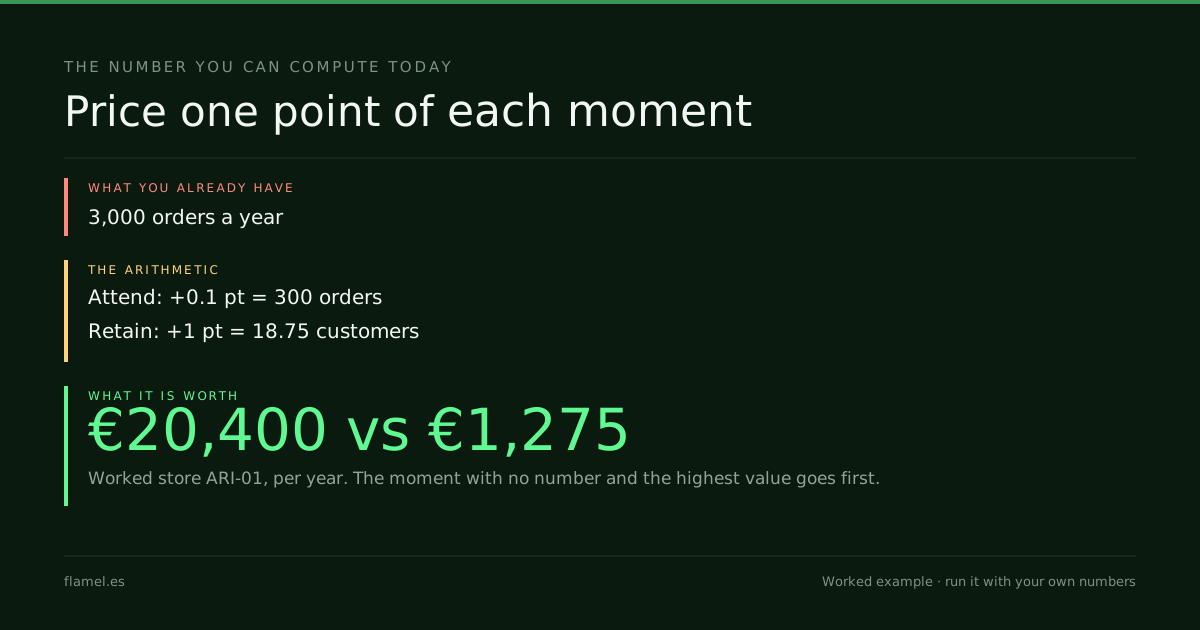
On the worked store (3,000 orders a year from 1,875 customers, a €68 average order):
- Attend: 0.1 points of conversion rate is 300 more orders, or €20,400 a year.
- Retain: one point of repeat purchase rate is 18.75 more customers placing a second order, or €1,275 a year.
The moment with no number and the highest value per point is where the first cycle goes. On that store it is Attend. On a membership with a high cancellation rate it would be Retain. On a drop brand that sells out in hours it might be Recognize. The arithmetic is the same; the answer is the brand's own, and it takes an afternoon with the admin open to get it.
Work through this with your own numbers
You are reviewing the growth system of a creative brand that already sells. The brand sells through [drops / a catalog / a membership / seasons]. For each of five moments (Appear: being found; Attend: the visit turning into an order; Recognize: returning customers treated as known; Retain: the second order or the renewal; Know: the number read at the end of each cycle), list the one number the brand reads today, or write 'none'. Use these figures: [annual sessions], [conversion rate], [average order value], [gross margin %], [customers per year], [repeat purchase rate]. Price one point of each moment in money. Then name the moment with no number and the highest value per point, propose one experiment for it with a hypothesis, one variable, one measure and a date, and say what result would change the decision.FAQ
What is growth marketing, in one sentence?
Growth marketing is the discipline that makes customers find a brand, buy without friction, come back and feel recognized, and that learns one concrete thing from every cycle, judged on the margin a customer leaves after the order rather than on clicks or signups.
How is growth marketing different from paid media?
Paid media buys attention and reports cost per click or return on ad spend, stopping at the order. Growth marketing can use paid traffic, but as a test instrument with a fixed budget and window, and it answers for what happens after the order: repeat purchases and margin.
Can a creative brand do growth marketing without a large team?
Yes, if it runs one experiment per cycle and writes down what each one proved. The work grows with the number of decisions the brand makes rather than with headcount: one person reading one number per cycle is already doing it.
What should a growth marketing team measure first?
The moment that has no number today and the highest value per point. On a store that is often the conversion rate or the repeat purchase rate; on a membership it is usually the share of members who renew.
What is a growth strategy?
A growth strategy is the order in which the five moments get the next experiments, set by how the brand's customers buy and by what one point of each moment is worth. It is a ranking of decisions, with channels as the means.
Finding which of the five moments is losing the most, in your own admin, is what The Conversion Audit maps. Five business days, $500, and the map stays with you whether or not you hire anyone next.
Your store, five days.
$500. Zero commitment. Yours either way.