Conversion Rate Optimization Agency: The Traffic Floor
A conversion rate optimization agency bills by the month; a valid test needs a fixed number of sessions. Here's the traffic floor where the math flips.
A conversion rate optimization agency prices its retainer by the month, not by the test it can actually finish. That gap is where a founder overpays before a single result comes back.
Running one statistically valid experiment takes a fixed number of sessions, not a fixed number of weeks. Below a traffic floor, the retainer's clock keeps running while the test's clock barely moves — and you're billed for both at once.
Signing a monthly retainer before you have the traffic to run enough tests is the same mistake as A/B testing too early. It's just billed differently, and it arrives as an invoice instead of a null result.
Before the arithmetic: The Activation Audit answers the same question a retainer proposal asks — where the money leaves — in five business days, for $500, with no ongoing bill attached.
A conversion rate optimization agency is worth a monthly retainer once your site clears the traffic needed to conclude one valid test per billing cycle — often tens of thousands of sessions to the page being tested, depending on your baseline conversion rate. Below that floor, a fixed-price audit finds more, faster, for less.
Key takeaways
- A CRO agency bills by the month; a valid A/B test needs a fixed number of sessions, and those two clocks rarely align at low traffic.
- Detecting a 20% relative lift off a 2% baseline needs roughly 42,000 sessions split across two variants — a real number, not a guess.
- Below that volume, one concluded test can cost multiples of a $2,000-$50,000 monthly retainer before it clears significance.
- Retainers price for testing velocity; a fixed-price audit prices for a finished map regardless of how much traffic exists.
- Pull your retainer quote and your baseline conversion rate, run the formula, and compare the result to $500 before you sign anything.
What a Conversion Rate Optimization Agency Bills You For: Two Clocks, One Invoice
A retainer buys time: a team on standby, a testing calendar, a monthly report. It does not buy a concluded test. Conversion optimization services are sold and billed on a monthly cadence — public pricing guides put the range anywhere from $2,000 to $50,000-plus a month, depending on scope.
Statistical significance doesn't run on a calendar. It runs on sessions. A test concludes when enough visitors have seen each variant to rule out chance at a stated confidence level — not when the invoice is due. Conversion, Invesp, and Conversion Rate Experts — three of the names on the front page for this term — sell conversion rate optimization consulting as a standing service. None of them publishes the traffic floor below which that service can't produce a finished test inside a billing cycle.
The reason is structural, not dishonest. A retainer's economics work on volume: the agency staffs a team assuming a steady stream of concluded tests, and the pitch reads better as "ongoing optimization" than as "we'll tell you in month four whether this one page change worked." The founder signing the contract rarely asks the one question that would change the quote: how many sessions does the page in question actually get.
How Much Traffic a Conversion Rate Optimization Agency Needs to Prove Anything
The sample size for a two-variant test follows a standard formula, the same one behind free calculators like Evan Miller's A/B test sample size tool:
Sessions per variant ≈ 7.84 × [p₁(1-p₁) + p₂(1-p₂)] / (p₁ - p₂)²
    (a two-variant test needs twice this in total)
    p₁ = your current conversion rate
    p₂ = the rate you're testing for
    (7.84 covers 95% confidence, 80% power, two-tailed)
This is where conversion rate optimization pricing gets honest. The formula doesn't care what the retainer costs. It cares about how far apart p₁ and p₂ are, and how much traffic lands on the page in between. A bigger gap between current and target rate needs fewer sessions; a smaller, more realistic lift needs dramatically more. Most retainer pitches lead with the bigger gap and let the traffic assumption go unstated.

A €1.2M ARR SaaS Runs the Same Math
Take a SaaS product at €1.2M ARR, in the band the Activation Audit serves, as an example. Its pricing page converts visitors to trial signups at 2.0%. The agency proposes testing a redesigned page targeted at 2.4% — a 20% relative lift, the kind of number retainer pitches lead with.
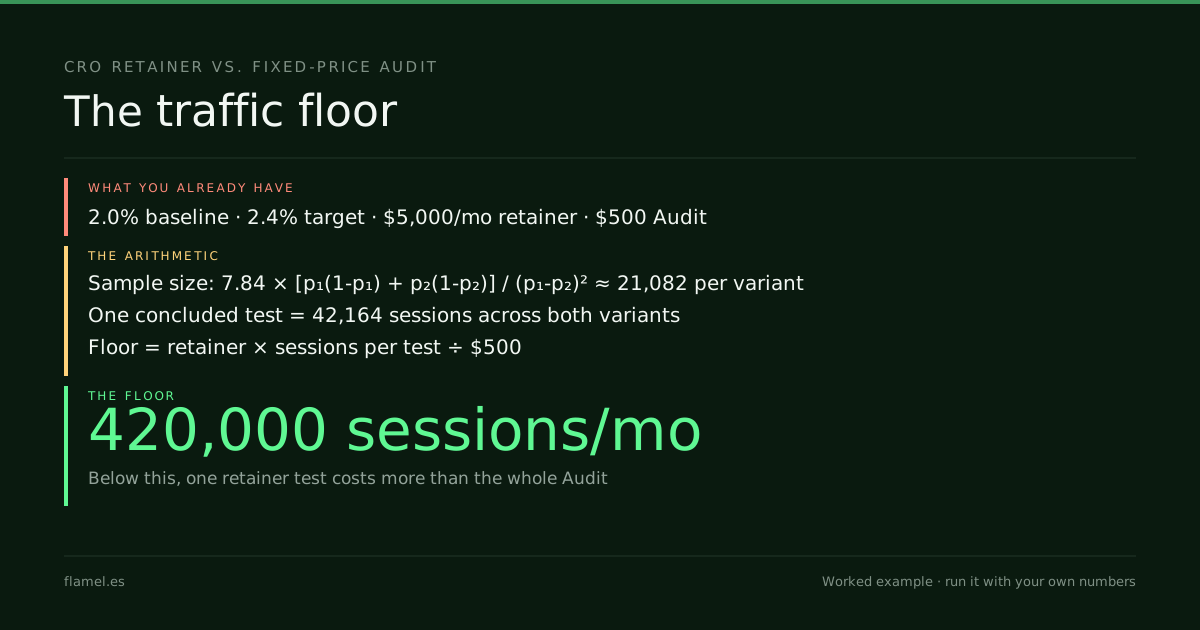
Plug those into the formula: p₁ = 0.02, p₂ = 0.024. The sum of the variance terms is roughly 0.043; the squared difference is 0.000016. Divide, multiply by 7.84, and you get about 21,000 sessions per variant — close to 42,000 in total across the two — before the test can conclude at standard confidence.
That pricing page gets 20,000 sessions a month, as an example. At full allocation — 100% of that traffic split evenly into the test — the test needs a little over two months to gather enough data to say anything. Most programs don't allocate all page traffic to one test; they run it alongside other pages and segments. Realistic allocation stretches the same test to three or four months for one answer. That's assuming nothing about the page changes in the meantime and resets the clock.
The Traffic Floor Where a Retainer Stops Making Sense
Here's the number that turns this into a decision instead of a debate. Set the retainer's cost for that one test equal to the Audit's flat fee, and solve for the sessions that would make them equal:
Traffic floor (sessions/month) = (monthly retainer fee × sessions needed per test) / $500At a mid-range quote of $5,000 a month — well inside the published band — and 42,000 sessions needed per test: the floor comes out to 420,000 sessions a month to the single page being tested. No product in the 150k–3M € ARR range the Activation Audit was built for pushes that kind of volume to one pricing or signup page. Below that floor, every concluded retainer test costs more than the Audit's flat $500, and it answers exactly one question instead of a full page of them.
The agency vs. freelancer vs. in-house comparison for this same math — same formula, different cost structures — gets its own post, and it's coming. For SaaS products with a self-serve motion instead of a sales-assisted one, the traffic constraint shows up again in a piece on what a product-led growth engine costs to run and what it returns: the same low-traffic pages that can't support a test still leak revenue, and reading them costs nothing.
What One Concluded Test Is Actually Worth
A retainer at $5,000 a month, run for three months waiting on one test to clear significance, costs $15,000 for one yes-or-no answer. The Activation Audit costs $500 and returns a full UX audit-style map — every leak ranked red, amber, green — in five business days, whether or not the traffic exists yet to test any one of them.
The patient version of this works: Redi Foods rebuilt for conversion and held the gain across 22 months and 130,465 measured sessions, built on reading the data before testing it, not on a testing calendar that started before the traffic could support one. The lesson isn't that testing is wrong. It's that testing has a price of admission measured in sessions, and no invoice mentions it.
What to do by Monday: Pull your actual retainer quote and your actual baseline conversion rate for the page in question. Run the formula above with the lift the agency is promising. Compare the traffic floor it produces to the sessions that page actually gets. If your number sits below the floor, that retainer invoice is buying a maybe. The Audit buys an answer for $500, in five days, no matter what your traffic looks like.
Work through this with your own numbers
You are a SaaS operator deciding whether to sign a conversion rate optimization agency retainer. Using the formula: sessions needed per test ≈ 7.84 × [p1(1-p1) + p2(1-p2)] / (p1-p2)^2, where p1 is [your current conversion rate] and p2 is [the conversion rate the agency wants to test for], calculate the total sessions required to conclude one valid test. Divide that by [your monthly sessions to the page being tested] to get months per concluded test. Multiply by [the monthly retainer fee you were quoted] to get your real cost per finding. Compare that number to $500. State clearly whether, at your current traffic, a retainer or a one-time audit produces a cheaper first answer, and name the traffic level at which that answer would flip.FAQ
How much does a conversion rate optimization agency typically cost per month?
Published buyer's guides put monthly retainers anywhere from $2,000 to $50,000-plus, scaling with the complexity of the testing program and the size of the team assigned. The range is wide because a retainer prices access to a team, not a finished result — two agencies quoting the same number of tests per month can charge very different fees depending on staffing model. Ask what traffic volume the quote assumes before comparing numbers across agencies.
How many sessions do I need before A/B testing makes sense?
It depends on your baseline conversion rate and the lift you want to detect, not on a fixed number. A standard sample-size formula (95% confidence, 80% power) gives roughly 40,000+ combined sessions to detect a 20% relative lift off a 2% baseline. Below that volume for the page in question, a test won't conclude inside a normal billing cycle, and reading existing data — recordings, funnels, drop-off points — answers more questions per dollar than testing does.
What does the Activation Audit cost and how is it different from a retainer?
The Activation Audit is a fixed $500, five-business-day diagnostic of a SaaS product, with no ongoing commitment. It's credited in full against a project if the client goes ahead, and the deliverables — a video walkthrough, a prioritized roadmap, a live review — stay with the client either way. A retainer bills monthly for testing capacity regardless of whether a test reaches significance in that period.
When does a CRO retainer make sense instead of a one-time audit?
Once the page being tested clears the traffic floor: enough monthly sessions to conclude more than one valid test per billing cycle at your baseline conversion rate and target lift. Below that floor, you're paying monthly for a test that hasn't finished. Above it, a dedicated testing program can outpace what a single audit delivers, because there's enough traffic to actually run the calendar an agency sells.
What's the difference between conversion optimization services and a paid audit?
Conversion optimization services are ongoing: a team runs a testing calendar and bills for the time, independent of how many tests conclude. An audit is a single fixed-price deliverable — a full map of where a product leaks activation or revenue, ranked by priority — produced once, in a fixed window, regardless of the traffic available to test any individual finding.
The Activation Audit is the fixed-price version of the same map a retainer promises. Five business days, $500, and it's yours whether or not you hire Flamel next.
Your store, five days.
$500. Zero commitment. Yours either way.