UX Design Audit: What Free Tools Don't Find
A ux design audit is priced at $500; the read is what costs money. What a paid review finds that free tools can't, and what three fixes are worth.

A ux design audit costs $500. Lighthouse, PageSpeed and a generic UX checklist cost nothing, and you have probably already run all three. None of them told you which finding actually moves revenue, because none of them can.
Free tools score technical severity: contrast ratios, tap target sizes, load time. They cannot place a real order on your checkout, read your GA4 alongside your Shopify admin, or tell you that finding fourteen of forty is the one paying for the other thirty-nine. That reading is the product. The instrumentation was never the expensive part.
This post takes a store with 300,000 sessions a year, a €68 average order and 1.0 % conversion, and runs the arithmetic a ux design audit is supposed to answer: which findings pay, and what they're worth in a given year.
A ux design audit is a paid review of where users abandon a store or product, prioritized by revenue impact rather than technical severity. Free tools like Lighthouse or Microsoft Clarity log every issue; a paid audit ranks which three of the forty found actually move the conversion rate, and prices what fixing them is worth.
Key takeaways
- Free tools score technical severity; none of them rank which finding actually moves revenue.
- Microsoft Clarity gives away unlimited session recordings; almost nobody opens the account twice a month.
- A full store review typically surfaces thirty to fifty findings, and three or four of them pay for the rest.
- One conversion point on 300,000 sessions at €68 average order prices out near €204,000 a year.
- Pull your last twelve months of sessions and average order value, and price your own tenth-of-a-point before you spend on anything else.
What a ux design audit checks that a checklist can't
A free scanner reads code and markup. It flags a missing alt tag with the same weight as a checkout field that drops eleven percent of submissions. Severity and revenue are different axes, and no automated tool scores the second one — that ranking is a judgment call, not a linting rule.
Microsoft Clarity has no traffic cap and no paid tier: every store already has free session recordings and heatmaps sitting in an account nobody opens twice a month. The data was never the scarce resource. Somebody deciding which three of the forty recordings are worth watching is.
A paid ux design audit adds three things a scanner cannot: a real order placed on the device your customers actually use, your GA4 read next to your Shopify admin with real access, and a comparison against systems built and measured in the same category. None of that is technically hard. None of it is free, because nobody hands over admin access for a PDF they didn't pay for.
The same logic runs on the SaaS side of this ICP, with a signup replacing the order and time to first value replacing average order value. What compounds after that first session is its own arithmetic, covered in product-led growth — the audit is the same read, applied to a different first ten minutes.
The free instrumentation is already free
Run the numbers on what you already have. Clarity: unlimited sessions, no cost. Your own GA4: already installed. A generic UX checklist: available in any browser extension. None of that changes what you do Monday morning, because a list of forty flagged items with no ranking is not a plan — it's a longer list, and a longer list is not a strategy either.
This is also why A/B testing is the wrong next step for most stores in this range. In Flamel's experience, below roughly a few hundred thousand sessions a year split across variants, a test needs months to reach significance on anything but the biggest swings. Reading what already happened, on real sessions, answers faster than testing what might happen next — and it's cheaper than waiting out a test that never reaches significance.

Forty findings, three that pay
Take the example store: 300,000 sessions a year, €68 average order, 45 % gross margin, 1.0 % conversion. In Flamel's audits, a full review of a store's checkout, product pages and cart typically surfaces somewhere between thirty and fifty flaggable issues — broken filters, slow image loads, a shipping cost surprise at the last step, a return policy buried three clicks deep.
Most of those thirty-to-fifty cost nothing to leave alone. A handful move the conversion rate because they sit at a point where the customer was already deciding to leave: the shipping-cost reveal, a checkout field that doesn't match the card reader, a product page that never answers the one question stopping the purchase — the kind covered in product page optimization. The job of an audit is separating those three or four from the other thirty-six, and pricing each one before you touch a single line of code.
That separation is the deliverable, not a slide deck: a ranked list, red to green, with the dollar figure for each finding attached. Everything below the line stays documented, so it's not lost — it's just not what you fix this quarter, and it's not what you pay a designer to rebuild before you know it matters.
That's what the Conversion Audit does: five business days, a real order placed, real admin read, and a one-page priority list instead of a longer checklist. $500, credited against the project if there is one, and the map is yours either way.
What a ux design audit costs, and when it pays for itself
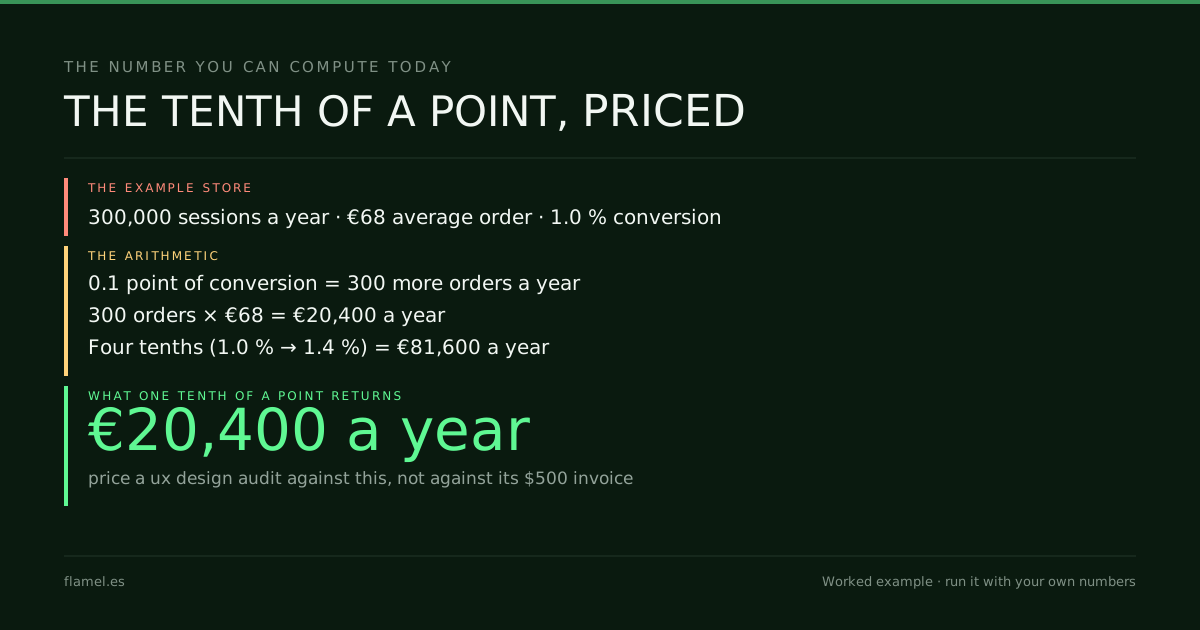
The math is short. Here's the store's revenue per tenth of a conversion point:
Revenue per 0.1 point of conversion
= sessions × 0.001 × average order value
= 300,000 × 0.001 × €68
= €20,400 a year
At $500, the audit pays for itself if it surfaces one fix worth seven extra orders a year — about two thousandths of a conversion point. Given that a real audit typically prices three to four findings above that line — not thirty-nine below it — the arithmetic favors paying for the read almost every time a store clears six figures in annual sessions. Below that, the same review still tells you which of the free tools' forty flags to ignore, which is worth something even at zero return this year.
The fuller breakdown — audit formats, what changes at SaaS activation versus store checkout, and where a conversion rate optimization program picks up after the audit ends — gets its own post, and it's coming.
What one point of conversion is worth
Moving the example store from 1.0 % to 1.4 % is worth €81,600 a year without a single additional session — the same store, the same traffic, four-tenths of a point. A full point, extrapolated, prices out near €204,000. That's the number a ux design audit is priced against, not the $500 line item.
A parallel case: one Flamel client moved conversion 4.8× over two years — from 0.4 % to 1.8 % on 666,000 measured sessions — after an audit-led rebuild (the case, in full). The finding that mattered wasn't the fortieth thing on a checklist. It was the third, and it was the one nobody had priced before someone got paid to look.
What to do by Monday: pull your last twelve months of sessions and average order value, run the €20,400-per-tenth formula above, and compare that number to what you're about to spend on more traffic instead. If a single finding could clear it, the audit already paid for itself before you signed anything.
Start with the Conversion Audit — five business days, $500, and the map is yours whether or not you hire us.
Work through this with your own numbers
You are reviewing whether a paid UX/CRO audit is worth its cost for a specific store. Use these numbers: annual sessions [your annual sessions], average order value [your average order value], current conversion rate [your current conversion rate], gross margin [your gross margin], and the price of the audit you're considering [audit cost]. Calculate revenue per tenth of a conversion point using sessions × 0.001 × average order value. Then estimate how many findings, out of a typical thirty-to-fifty from a full review, would need to move your conversion rate by that tenth of a point to clear the audit's cost. State the number of findings required, and whether that bar looks realistic given your current checkout, product pages and cart flow. If it doesn't clear that bar, say what would have to change first before an audit makes sense.FAQ
What does a UX design audit actually check?
A paid ux design audit places a real order or opens a real account, reads your analytics next to your admin with real access, and compares your flow against systems built and measured in the same category. It ends in a ranked list of findings priced by revenue impact, not a severity score.
How much does a UX design audit cost?
Flamel's version, the Conversion Audit, costs $500 with a five-business-day turnaround. It's credited in full against the project if you hire Flamel afterward, and the deliverables are yours either way.
Is a free UX audit tool as good as a paid audit?
No: free tools like Lighthouse or Microsoft Clarity log technical issues and session recordings, but none of them can place a real order, read your admin with access, or rank forty flagged issues by which three actually cost you revenue. That ranking is what you pay for.
Should I run an A/B test instead of paying for a UX audit?
Only if your traffic can reach statistical significance in a reasonable window. In Flamel's experience, most stores under a few hundred thousand annual sessions can't split traffic fast enough for a test to resolve; reading what already happened in existing sessions answers faster than testing what might happen next.
How do I know if a UX audit will pay for itself?
Calculate your revenue per tenth of a conversion point: sessions × 0.001 × average order value. If a single finding in the audit is likely to move you past that number, the audit has already paid for itself before you fix anything.
That's what the Conversion Audit is. Five business days, $500, and the map is yours whether or not you hire us.
Your store, five days.
$500. Zero commitment. Yours either way.