
Free Shipping Threshold: the Margin-Safe AOV Formula
A free shipping threshold isn't a guess — it's your AOV plus a margin buffer for the shipping you give away. Here's the formula.

A free shipping threshold is the order value at which you stop charging for shipping — and it should equal your current average order value plus a margin buffer wide enough to cover what you give away. Most stores skip that math entirely.
They copy a competitor's number, or round to $50 because it sounds fair. Neither number has any relationship to your margin, your shipping cost, or your actual average order. A €68 average order and a €6 shipping cost set the real floor — not what the store next door charges.
The formula below takes ten minutes with your own numbers. It turns a guess into a threshold you can defend the next time someone on your team asks why it isn't a round number.
A free shipping threshold should sit near your current average order value, adjusted for how much margin you can spend on shipping. A store with a €68 AOV and 45% margin can absorb roughly €6 in shipping cost, putting the threshold around €82 — high enough to lift order size, low enough to still clear the margin floor.
Key takeaways
- A free shipping threshold copied from a competitor ignores your margin, your shipping cost, and your actual basket size.
- The AOV formula — revenue divided by orders — is the starting input, not the threshold itself.
- A store with a €68 average order and 45% margin needs a threshold near €82, not a round €70 or €75.
- Setting the threshold €12 below the margin-safe number leaks over €5 in margin on every order that ships free.
- Pull last month's shipping report, count orders that shipped free, and multiply by your own margin leak per order.
What a free shipping threshold really protects
A free shipping threshold does two jobs at once. It removes the line item that shows up as one of the leading reasons carts get abandoned: unexpected costs, shipping chief among them (Baymard Institute). And it sets a bar shoppers stretch to clear, which is the only legitimate way to lift average order value without cutting price.
Shopify's own guidance on cart abandonment echoes the same fix: clearer pricing and a free-shipping threshold both reduce the share of shoppers who cite extra costs as the reason they bail at checkout (Shopify).
None of that works if the threshold itself is wrong. A number copied from a competitor protects nothing — it wasn't built on your margin, your shipping cost, or your current basket. A number set from a hunch works exactly as often as hunches do, and you find out it was wrong when the P&L does, not before.

The formula, not the round number
The average order value formula is the input, not the answer: revenue divided by orders, over the same window. The free shipping threshold formula builds on it by asking one more question — how much margin can this store spend making the shipping cost disappear?
Free shipping threshold = Current AOV + (Average shipping cost ÷ Gross margin rate)Three numbers, all of which you already have. Average order value from your last full quarter. Average shipping cost per order, blended across carriers. Gross margin rate, the same one on your P&L. The threshold isn't a marketing decision. It's the point where the extra basket size a customer adds pays for the shipping you're giving away.
One store's free shipping threshold, worked in euros
Take a store with 300,000 sessions a year, a €68 average order and 45% gross margin — the numbers this blog uses throughout because the arithmetic has to stay honest across posts. Say its blended shipping cost is €6 per order.
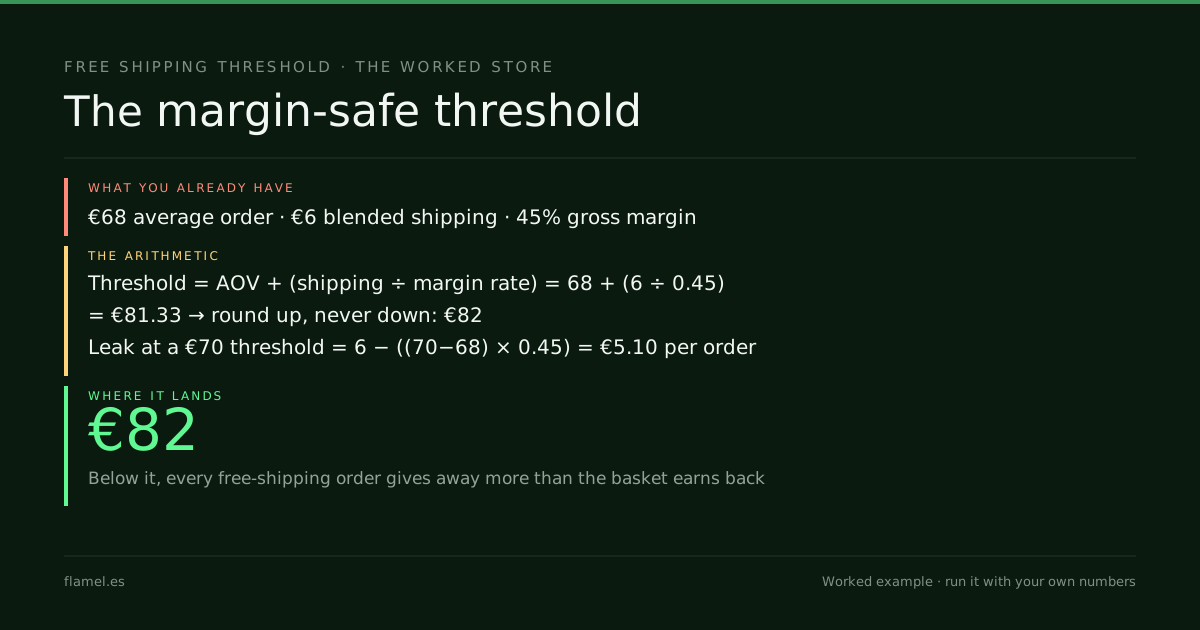
Run the formula: €68 + (€6 ÷ 0.45) = €81.33. Round up, not down — €82 is the threshold that clears the floor with room, not the one that sits exactly on it.
Compare that to what most stores actually set: a round €70 or €75, chosen because it looked reasonable next to a competitor. At €70, the store gives free shipping to any order past €70 while only collecting €2 of extra basket — nowhere near the €6 it's giving away.
A bundling and volume-discount play can push baskets toward that €82 line faster than a banner ever will. That's its own post, and it's coming.
The margin leak nobody tracks
Here's the number that matters more than the threshold itself: what a mis-set one costs, per order, every single day.
Margin leak per free-shipping order = Shipping cost − ((Threshold set − AOV) × Margin rate)At a €70 threshold instead of €82: €6 − ((70 − 68) × 0.45) = €6 − €0.90 = €5.10 given away on every order that ships free. This store's 300,000 annual sessions at its current 1.0% conversion come to 250 orders a month; multiply €5.10 by however many of those clear €70 and you have the monthly leak — through a number nobody has recalculated since launch.
A threshold this small rarely moves a P&L on its own. It's one of the four places revenue leaves a store, sitting next to the product page, the checkout, and whether a second order is designed for or left to luck — and it compounds with all three, not instead of them.
What to do by Monday: pull last month's shipping report, count how many orders qualified for free shipping, and run your own version of that formula. Multiply the leak per order by that count. If the number is bigger than what a threshold change would cost you in lost urgency, move the threshold — not the marketing copy around it.
Work through this with your own numbers
You are an ecommerce operator setting a free shipping threshold from your own numbers, not a competitor's. Using [your average order value], [your average shipping cost per order], and [your gross margin rate], calculate the margin-safe threshold: AOV + (shipping cost ÷ margin rate). Then compare that number to [your current free shipping threshold]. If your current threshold is lower, calculate the margin leak per order: shipping cost − ((current threshold − AOV) × margin rate). Multiply that leak by [number of orders that shipped free last month] to get your monthly margin leak. Tell me what threshold you should actually run, and what changing it would be worth over a year at [your current monthly order volume].FAQ
What is a free shipping threshold?
A free shipping threshold is the order value a customer must reach before shipping is free. It should be set from the store's own average order value and gross margin, not copied from a competitor. Set correctly, it covers the shipping cost given away with the extra margin earned from the larger basket, so the store doesn't subsidize orders that would have happened at the lower amount anyway.
How do you calculate a free shipping threshold?
Add your average shipping cost divided by your gross margin rate to your current average order value: threshold = AOV + (shipping cost ÷ margin rate). For a €68 average order, a €6 shipping cost and a 45% margin, that's €68 + (6 ÷ 0.45) ≈ €82. Any threshold below that number gives away more margin than the larger basket earns back.
Should a free shipping threshold equal average order value?
No. Setting it exactly at average order value gives free shipping to roughly half of existing orders without asking any of them to spend more, which is a pure margin loss. The threshold needs to sit above AOV by enough to cover the shipping cost from the incremental margin the larger order generates.
Does a free shipping threshold actually increase average order value?
It increases average order value only for the customers who add items specifically to clear it, not for everyone. Baymard's checkout research finds unexpected shipping costs are a leading cause of cart abandonment, so the threshold's first job is removing that friction; the AOV lift is the secondary effect, and it only shows up if the threshold sits close enough above current AOV to be reachable.
What happens if the free shipping threshold is set too low?
The store gives away free shipping on orders that were already happening, without any extra basket size to cover the cost. The margin leak equals the shipping cost minus the extra margin earned from any basket growth. Multiplied across every order that ships free in a month, that gap is real, recurring revenue that never reaches the P&L.
That's what the Conversion Audit maps: five business days, $500, and the map is yours whether or not you hire us.
Your store, five days.
$500. Zero commitment. Yours either way.