
SaaS churn rate: the denominator that flatters it
SaaS churn rate explained: the starting-base formula, two reporting traps, and what cutting monthly churn by one point preserves on a €50,000 MRR base.

SaaS churn rate measures the share of paying customers or recurring revenue lost over a stated period. For a starting-cohort customer rate, divide customers lost from that cohort by paying customers at the start, then multiply by 100. Revenue churn uses the revenue lost from the starting cohort instead.
The denominator decides what question you answered. Adding new accounts to it can make the percentage fall while the same existing customers leave. Before spending money to improve a headline rate, ask which customers entered the calculation, when they entered, and whether the number counts accounts or money. Those details determine what one point is worth.
SaaS customer churn rate is customers lost from a starting cohort divided by its starting paying customers, multiplied by 100. Gross revenue churn instead divides canceled and downgraded MRR from that cohort by starting MRR. Keep the period and base fixed: adding new customers to the denominator changes the comparison.
Key takeaways
- Customer retention complements customer churn only when both use the same starting cohort and period.
- A constant monthly churn rate compounds across a closed cohort; multiplying it by twelve gives the wrong annual rate.
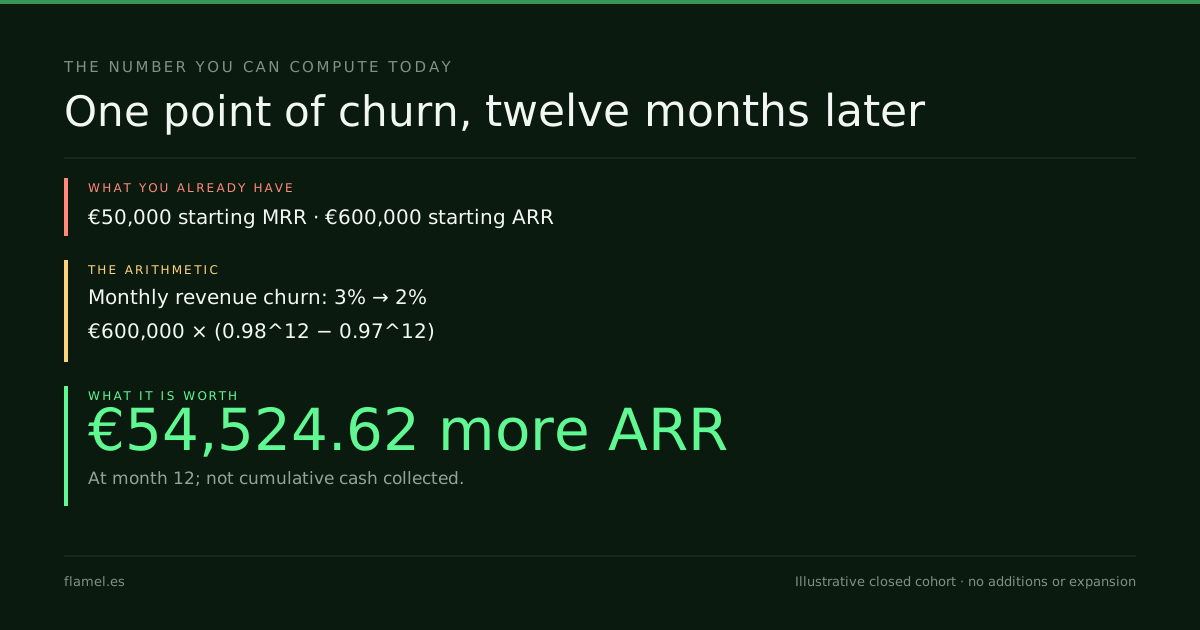
- On €50,000 starting MRR, cutting constant monthly revenue churn from 3% to 2% preserves €54,524.62 more ARR at month twelve.
- Adding new customers to the denominator can lower reported churn without retaining any additional starting customer.
- Compare starting-cohort customer and revenue rates, then calculate the month-twelve ARR difference using explicit scenario assumptions.
The SaaS churn rate formula starts with one cohort
ChartMogul's customer churn definition anchors the calculation to customers present at the start of the period. Here, losses come from that starting group; customers who join and leave within the month are tracked separately.
Customer churn = customers lost from starting cohort ÷ starting customers × 100
Gross revenue churn = (canceled MRR + downgrade MRR from starting cohort) ÷ starting MRR × 100
MRR means monthly recurring revenue. Gross revenue churn counts cancellations and downgrades without offsetting them with expansion. Customer retention is 100% minus customer churn on the same cohort and period; gross revenue retention is the matching complement of gross revenue churn. Net revenue retention also includes expansion, so it is a different comparison. Customer retention rate walks through the account-based calculation.
Two ways the report can flatter the number
First, dilute the starting base. In a hypothetical month, 500 paying customers start, 15 of those leave, and 100 new customers arrive and stay. Starting-cohort churn is 15 ÷ 500 = 3%. Divide those same departures by 600 and it reads 2.5%. Half a percentage point disappears from the report; no additional customer stayed.
That broader denominator can be an intentional product convention: Stripe Billing documents a subscriber rate that includes new subscribers. It answers a different question. The mistake is comparing it with a starting-cohort rate as though the bases matched, or attributing its decline to better retention without checking acquisition.
Second, let account count stand in for revenue. Suppose, separately, that 15 departing accounts each pay €200 a month on a €50,000 starting MRR base. Those cancellations remove €3,000, or 6% of MRR, even though 15 departures from 500 customers still represent 3% customer churn. Neither calculation is false. Presenting the smaller percentage as the revenue loss is. The reverse happens when departing accounts are cheaper than average.
Both traps can change a spending decision: whether to fund more acquisition or investigate why existing revenue leaves. Put the cohort, interval, and customer-versus-revenue label beside every rate before comparing months. A lower percentage alone does not tell you that the product retained more value.

Monthly churn needs a declared horizon
A constant 3% monthly churn rate does not become 36% annual churn. For a closed cohort, monthly retention compounds: 0.97^12 ≈ 69.38% remains after twelve monthly intervals, so annual churn is about 30.62%. If monthly rates vary, multiply each month's retention factor instead of assuming one constant rate.
This distinction matters when a team puts monthly churn beside annual recurring revenue (ARR). You cannot multiply ARR by a monthly percentage and call the result the total revenue lost during the year. You must state whether you mean next month's MRR, the run rate at month twelve, or cumulative receipts. Each measures a different financial outcome.
What one point preserves on a €50,000 MRR base
Take a hypothetical SaaS product starting with €50,000 MRR, equivalent to €600,000 ARR. Compare constant monthly gross revenue churn of 3% and 2% for twelve months. Assume no new sales, expansion, reactivation, or price changes; all recurring revenue losses are included in the churn rate. This isolates the starting revenue cohort rather than forecasting the whole company.
At 3%, month-twelve MRR is €50,000 × 0.97^12 = €34,692.12. At 2%, it is €50,000 × 0.98^12 = €39,235.84. The difference is €4,543.72 of MRR remaining at that point. Calculate with unrounded values before rounding the displayed result. The same persistence of recurring revenue underlies customer lifetime value.
The number to take into planning
For your own starting ARR, the month-twelve ARR difference is starting ARR × [(1 − lower monthly churn)^12 − (1 − higher monthly churn)^12]. This is a scenario, not a promised improvement or a causal diagnosis. Churn can reflect onboarding, product fit, pricing, failed payments, or other causes. Our product-led growth breakdown provides context for investigating activation.
Ask for the starting-cohort rates and the assumptions behind the proposed improvement. In this example, multiply the unrounded MRR difference by twelve: reducing monthly churn from 3% to 2% preserves €54,524.62 in ARR at month twelve. That is annualized recurring revenue at the endpoint, not extra cash collected during the year.
Work through this with your own numbers
You are a SaaS operator reviewing a retention investment. Use [starting MRR and currency], [MRR lost through cancellations and downgrades from that starting cohort during the month], [starting paying customers], [customers lost from that cohort], and [proposed monthly revenue churn reduction in percentage points]. Calculate customer churn and gross revenue churn separately using matching starting bases. Ask for missing inputs rather than substituting current MRR. Model the starting revenue cohort for twelve monthly intervals at the current and proposed constant revenue churn rates. Assume no new sales, expansion, reactivation, or price changes. Report both ending MRR amounts, their difference, and that difference multiplied by twelve as endpoint ARR. Keep full precision until final rounding. Explicitly distinguish endpoint ARR from cumulative receipts. State the assumptions and which evidence would be needed before treating the improvement as achievable.FAQ
What is a good SaaS churn rate?
There is no single target that answers the question for every product. Compare like with like: customer or revenue churn, gross or net, monthly or annual, and the same customer segment. Start with your own cohort trend. A lower reported rate deserves investigation if the customer mix, acquisition volume, or calculation changed at the same time.
How is churn different from retention?
For the same starting cohort and period, customer retention equals 100% minus customer churn. Gross revenue retention similarly complements gross revenue churn. Net revenue retention also credits expansion, so it cannot be compared with customer churn as though the two must add to 100%. Label both the base and the treatment of expansion before using that shortcut.
Should I track customer churn or revenue churn?
Track both. Customer churn shows how many paying accounts from the starting cohort left. Revenue churn shows the recurring revenue lost through cancellations and, for the gross definition here, downgrades. Losing one expensive account can cause a small customer-churn movement and a large revenue loss. Neither metric alone describes the full retention picture.
How do I convert monthly churn to annual churn?
For a constant rate on a closed cohort, annual churn is 1 − (1 − monthly churn)^12, with rates expressed as decimals. At 3% monthly, that gives about 30.62% annually. With varying rates, multiply the twelve monthly retention factors and subtract the product from one. The reverse conversion gives an equivalent constant rate, not the actual path taken.
What is one point of monthly churn worth?
It depends on the starting revenue, the original rate, and the horizon. Under this article's closed-cohort assumptions, €50,000 MRR at 2% monthly churn leaves €4,543.72 more MRR after twelve intervals than at 3%. That represents €54,524.62 more ARR at the endpoint. It is neither a universal multiplier nor cumulative revenue collected over the year.
If the cohort points to an activation problem, The Activation Audit examines the experience and your data. Five business days, $500, and the map is yours whether or not you hire us.
Your store, five days.
$500. Zero commitment. Yours either way.