
The aha moment: the threshold, not the example
The aha moment is a 2x retention split you compute from your own cohorts — not a screenshot from someone else's onboarding flow.

The aha moment is the earliest action in a SaaS product that predicts a user is still paying weeks later. You find it by comparing what your paying customers did in their first week with what everyone else did, and a working threshold is a gap of 2x or more. Most pages that rank for the term show screenshots of other companies' onboarding flows. Those are examples; your threshold is specific to your product, and you can compute it from a cohort you already have.
This post gives you that threshold: a formula that compares week-four retention between users who took a candidate action in their first session and users who didn't. If the gap holds at 2x or more, you've found your aha moment. If it doesn't, you're looking at a vanity milestone — a step that correlates with engagement but not with staying. Once the moment has a name, product and marketing can finally point at the same thing: onboarding builds the first session around it, and the campaigns promise it.
An aha moment is the earliest user action that predicts retention: the point where users completing it in their first session retain at roughly 2x the rate of users who don't, measured at week four. You find it by splitting your own signup cohort into two groups and comparing — not by copying another product's onboarding screenshots.
Key takeaways
- An aha moment is a measurable split in week-four retention, not a UI moment a design team happens to like.
- The pages that rank for the term show other products' onboarding screens; none hands you a way to compute your own threshold.
- A worked example on a subscription tool for creative businesses shows the arithmetic: 60 of 220 signups reach the moment, and ten more are worth €3,960 of ARR.
- A 2x retention gap between cohorts is the line between a real aha moment and a vanity milestone worth dropping from onboarding.
- Pull your signup cohort from ninety days ago, split it by one candidate first-session action, and compare week-four retention between the two groups.
What the aha moment actually measures
The term spread through growth-team stories about one early action that separated the users who stayed from the users who left. The stories got famous. The method behind them got lost. What those stories actually describe is a retention split — a comparison between two cohorts, one that did something early and one that didn't, measured weeks later. Amplitude's research on activation and retention found a 69% correlation between strong seven-day activation and strong three-month retention — evidence that the gap is real and worth measuring, not evidence of which action causes it in your product. That part is yours to find, and it's the same arithmetic behind time to value, the number that decides whether your onboarding is working at all.
The distinction matters because most teams skip straight to building a tour around whatever action feels important — usually the one the product team is proudest of, or the one a sales deck leads with. Neither is evidence. The only evidence is what happens to a cohort twenty-eight days after they do or don't do the thing.

A worked example: the first shared project
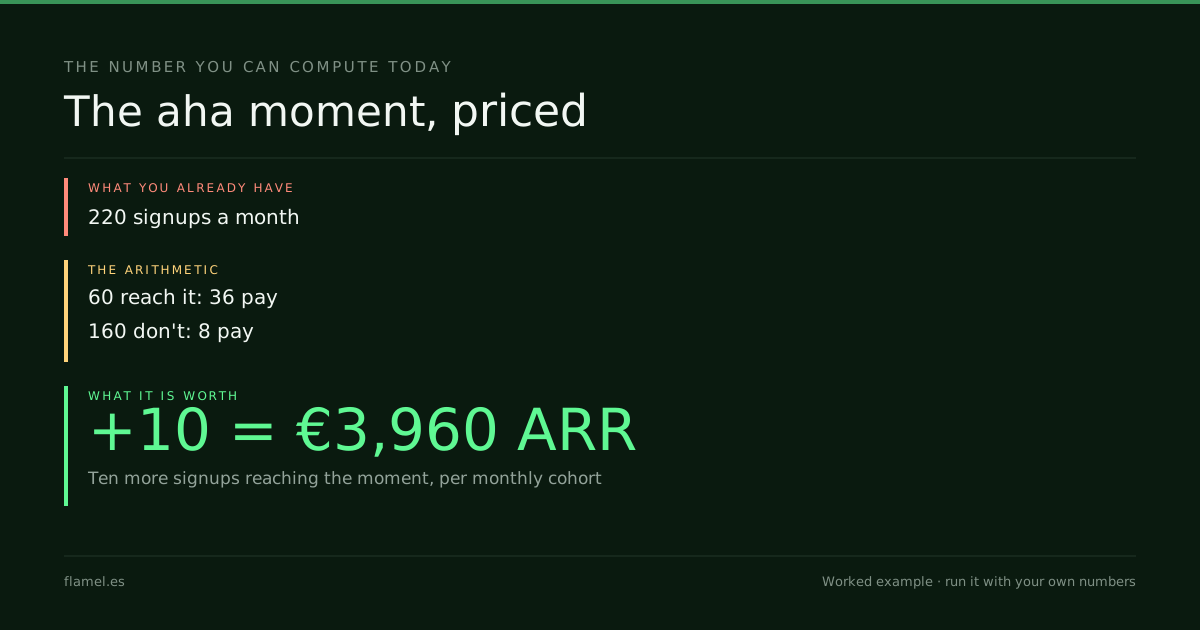
Take a subscription tool for small creative businesses: 1,100 customers paying €60 a month, and 220 signups last month. 60 of those signups shared their first project with a client in their first session, and 36 of the 60 are paying at week four. Of the 160 who didn't share anything, 8 are.
36 of 60 is 60 in every 100. 8 of 160 is 5 in every 100. Divide one by the other: a 12x gap, far past the threshold. Sharing the first project isn't a nice-to-have step in this product's onboarding. It's the aha moment, and it's the moment both teams should aim at: onboarding gets new users there in session one, and marketing promises it before the signup.
The formula that finds your aha moment
Week-four retention, cohort A (did the candidate action in session one)
÷
Week-four retention, cohort B (did not)
= activation ratio

Ratio ≥ 2.0  → candidate action is your aha moment
Ratio 1.2–2.0 → correlated, not causal — keep testing
Ratio < 1.2  → drop it from onboarding; it's not doing the work
Run this against two or three candidate actions, not one. Most products have a handful of early steps that look like they matter. Only one or two will clear 2.0, and the rest are the steps SaaS onboarding teaches people to click through without earning anything.
What one threshold is worth
Once you know the action, the number that matters isn't the ratio. It's how many signups reach the action in session one. On the example, 60 of 220 do. Ten more signups reaching it means 10 × (60 − 5) in every 100 = 5.5 more paying customers, and at €60 a month that is €3,960 of ARR from one monthly cohort. Every cohort after it repeats the sum, the same way product-led growth compounds: once, at signup, for every cohort that follows.
What to do by Monday: pull your signups from the last ninety days, pick the one action your team already suspects is the aha moment, split the cohort in two, and run the ratio above. If it's under 1.2, stop designing onboarding around it this week.
Work through this with your own numbers
You are a SaaS founder trying to find your product's real aha moment instead of guessing from a competitor's onboarding screenshots. Here is my data: my product had [number of signups] in the last [time period]; I suspect the aha moment is [candidate action, e.g. inviting a teammate, uploading a file, completing setup]; of my signups, [number] took that action in their first session and [number] did not; at week four, [percentage]% of the group that took the action is still active, versus [percentage]% of the group that didn't. Calculate the activation ratio (first percentage divided by second). Tell me whether this action qualifies as my aha moment under a 2.0 threshold, what it means if the ratio falls between 1.2 and 2.0, and what one other candidate action I should test next if this one doesn't clear the bar.FAQ
What is an aha moment in SaaS?
An aha moment is the earliest user action that predicts long-term retention. It isn't a feeling or a UI highlight — it's measured as a gap in week-four retention between users who took a specific action in their first session and users who didn't. If that gap is roughly 2x or more, the action qualifies.
How do you find your product's aha moment?
Pick two or three candidate actions your team suspects matter — inviting a contact, uploading a file, completing a setup step. Split your signup cohort by whether each action happened in session one, then compare week-four retention between the two groups. The action with the largest ratio, at or above 2x, is your aha moment.
Is the aha moment the same as time to value?
They're related but not identical. Time to value measures how long it takes a user to reach their aha moment; the aha moment itself is the specific action or outcome that predicts retention. You need to know the aha moment before time to value becomes a number worth shortening.
Can a SaaS product have more than one aha moment?
Yes, especially for products serving more than one user type. A collaboration tool might have one aha moment for the person who signs up and invites a team, and a different one for the teammate who joins and uses the product solo. Test each segment's cohort separately rather than assuming one action fits all users.
What retention window should I use to test an aha moment candidate?
Week four is a reasonable default for most SaaS products with weekly or more frequent usage, because it's far enough past onboarding to separate real habit from first-session curiosity. Products with longer natural cycles — monthly reporting tools, for example — should test at a window that matches at least two full use cycles.
That's what the Activation Audit maps — five business days, $500, and the map is yours whether or not you hire us.
Your store, five days.
$500. Zero commitment. Yours either way.