Annual vs monthly subscription: the discount, repaid
Annual vs monthly subscription: two months free is repaid by €191 in year one on the example product. The renewal decides the rest. The math.

Annual vs monthly subscription is a trade, not a pricing detail. Two months free on an annual plan gives up revenue today in exchange for customers who cannot leave for a year. Marketing makes the offer; product has to earn the renewal twelve months later. The decision needs both halves of the sum before the toggle goes on the pricing page.
On the example product this blog uses for SaaS, the discount is repaid by €191 in the first year. Everything else is decided at month 12, in a single renewal that most teams only start watching when the invoices go out.
Annual vs monthly subscription is a trade: an annual discount gives up revenue now for customers who cannot cancel for a year. On a product with 4 of every 100 customers leaving each month, two months free is repaid by €191 per 10 customers in year one, and at least 61 of every 100 must renew.
Key takeaways
- An annual discount trades revenue now for customers who cannot cancel for a year; the first renewal decides whether it paid.
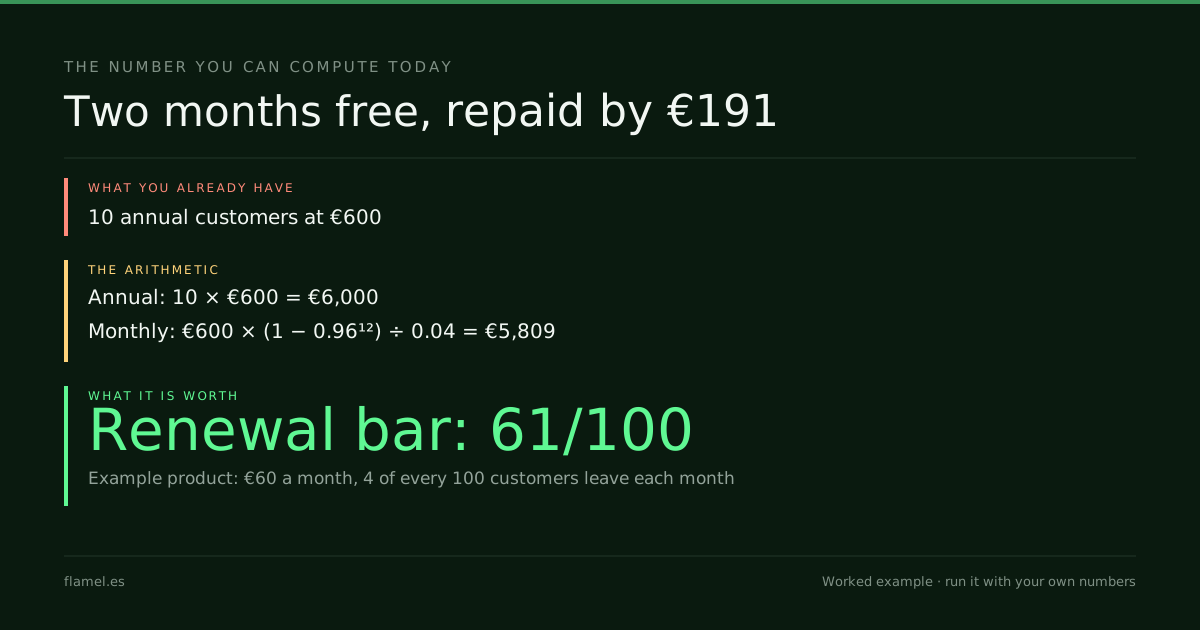
- On the example product, two months free is repaid by €191 in year one: €6,000 against €5,809.
- Renewal bar = (1 − monthly churn)^12: at 4 in 100 a month, 61 of every 100 must renew.
- The lower the monthly churn, the less the discount repays: at 2 in 100 it loses €458 in year one.
- Marketing owns the offer; product owns months 9 to 11, before the renewal invoice.
Annual vs monthly subscription: what the discount buys
The case for annual billing is cash and commitment. Paddle's guide to annual plans puts it plainly: “Even if only 10-20% of customers take the option, it will improve your cash flow immediately” and “boost your customer retention in the long-term” (Paddle). The same guide describes the usual price of that commitment as “a discount of typically 15-20%”. Two months free on a twelve-month plan is a 16.7 % discount, inside that range.
The cost has two parts. The first is the discount itself, paid up front on every annual customer, including the ones who would have stayed anyway. The second is where churn goes. Paddle's own metrics documentation counts a customer as churned “when their paid period ends instead of the moment they click cancel” (Paddle developer docs). On a monthly plan, cancellations arrive a few at a time. On an annual plan, a whole year of them lands in the renewal month.
Annual vs monthly subscription on the example product
The example product: 1,100 paying customers at €60 a month, €66,000 of MRR and €792,000 of ARR. Marketing brings in 44 new customers a month and, every month, 4 of every 100 customers leave, which is why the line stays flat. SaaS churn rate covers how to read that number honestly.
The offer is two months free on an annual plan: €600 a year instead of €720. As an example, 10 of the 44 new customers in a month take it.
- On annual, those 10 pay €6,000 up front. At list price they would have paid €7,200, so the discount is €1,200.
- On monthly, the same 10 pay €600 in their first month, €576 in the second (9.6 customers left), €553 in the third, and so on. By month 12, 3.87 of them have left, and their first year adds up to €5,809.
The annual plan collects €6,000 against €5,809. The €1,200 discount is repaid by €191 in year one, because the churn it prevents was worth €1,391 of first-year revenue.
Working out how far an annual offer is repaid on a product's own churn curve, before the toggle reaches the pricing page, is part of what The Activation Audit maps.

The renewal decides the rest
At month 12 the two groups look very different. On monthly, 6.13 of the 10 are still paying, worth €4,412 of ARR. On annual, all 10 are still there, and all 10 face the same renewal in the same month.
For the annual plan to enter year two with as many customers as monthly billing would have kept, at least 61 of every 100 annual customers have to renew. If the renewal keeps the discount, the bar in revenue is higher: €4,412 ÷ €6,000, about 74 of every 100.
That bar is not a formality. In consumer apps, RevenueCat found that “annual subscriptions have a median renewal rate of 27% after their first year”, while monthly subscriptions renew at a median of 56% at their first renewal (RevenueCat, more than 10,000 apps). The two figures measure different points and software sold to teams is not a consumer app, but the pattern holds: the annual plan is decided at its first renewal. The same Paddle documentation claims annual customers carry a lifetime value two to four times higher than monthly ones. The renewal bar is where that claim gets tested on a real customer lifetime value, not assumed.
The size of the discount changes the sign
The same sum, with the same 10 customers and the same churn, moves quickly with the size of the offer:
- One month free (€660 a year): €6,600 collected against €5,809 on monthly, €791 ahead in year one. If the renewal keeps that price, about 67 of every 100 annual customers have to renew.
- Two months free (€600 a year): €191 ahead, and a bar of about 74 of every 100 at the discounted price.
- Three months free (€540 a year): €5,400 against €5,809, €409 behind before the first renewal, and a bar of about 82 of every 100.
The share of new customers who choose annual changes the size of the result, not its sign. At 5 of the 44, or at 15 of the 44, every figure above scales with the number of annual customers. That is why the offer and the price are two different decisions: a bigger discount may move more customers to annual, and it repays less on each one of them. The size of the discount is the lever that decides whether the annual plan buys customers or only borrows next year's cash.
Who owns the annual plan: marketing and product
Marketing owns the offer: the size of the discount, whether annual is the default on the pricing page, how the plan is described at checkout. Product owns months 9 to 11: whether the account still uses what it paid for when the renewal invoice is a few weeks away. An annual plan removes 11 chances to cancel and concentrates them into one decision, and a monthly churn chart hides that decision until the month it lands.
That is why the discount is a pricing decision with a cost, like the one SaaS pricing strategy prices for a model change. It also depends on the product's churn more than on the offer. The lower the monthly churn, the less the discount buys: below about 3.4 cancellations in every 100 customers a month, two months free is no longer repaid in year one.
The renewal bar: the number to take
Renewal bar = (1 − monthly churn)^12.
Year-one repayment = annual customers × annual price − annual customers × monthly price × (1 − (1 − c)^12) ÷ c, where c is monthly churn.
On the example product, with two months free and 10 annual customers:
- 2 in 100 leave each month: the bar is 78 of every 100, and the discount loses €458 in year one.
- 4 in 100 leave each month: the bar is 61 of every 100, and the discount is repaid by €191.
- 6 in 100 leave each month: the bar is 48 of every 100, and the discount is repaid by €759.
Run both lines with your own churn and price before the annual toggle goes live. If the bar sits above the renewal rate your product can plausibly earn, the discount is buying cash, not customers, and product has to change months 9 to 11 before marketing changes the offer.
Work through this with your own numbers
I run a SaaS product with [paying customers] customers at [monthly price] a month, about [new customers per month] new customers a month and a monthly churn of [churn]. I am considering an annual plan at [discount, for example two months free], and I expect [share] of new customers to take it. Calculate the first-year cash from those customers on annual and on monthly, the size of the discount, and whether the discount is repaid in year one. Then calculate the renewal bar, (1 − monthly churn)^12, and the renewal rate needed if the renewal keeps the discount. Finally, tell me what the product should show those accounts in months 9 to 11 so the renewal can clear the bar.FAQ
Is annual or monthly billing better for a SaaS product?
Neither by default. Annual billing brings cash up front and removes eleven chances to cancel; monthly billing keeps the full price and spreads cancellations over the year. Annual wins when the product's monthly churn is high enough to repay the discount and its customers clear the renewal bar.
How much discount should an annual plan have?
Paddle describes the usual range as 15 to 20 off list. Two months free is 16.7 off. The right size depends on monthly churn: on the example product the discount is repaid in year one only while more than about 3.4 of every 100 customers leave each month.
Does annual billing reduce churn?
It moves churn more than it removes it. Customers cannot leave for a year, so the year's cancellations arrive together at renewal. Whether annual billing lowers churn overall depends on how many annual customers renew against the share monthly billing would have kept.
What renewal rate does an annual plan need?
At least the share of monthly customers who would still be there after a year: (1 − monthly churn)^12. With 4 of every 100 leaving each month, that is 61 of every 100 annual customers, or about 74 if the renewal keeps the discount.
When should a SaaS product not offer an annual discount?
When monthly churn is already low. On the example product, with 2 of every 100 customers leaving each month, two months free loses €458 in year one, and 78 of every 100 annual customers would have to renew just to match monthly billing.
Pricing the annual offer against a product's own churn curve, and naming what has to happen before the first renewal, is part of what The Activation Audit maps. Five business days, $500, and the map stays with you whether or not you hire anyone next.
Your store, five days.
$500. Zero commitment. Yours either way.