SaaS Pricing Strategy: The Switch Cost Number
A SaaS pricing strategy switch has a cost. Here's the ARPU uplift a value-based move must clear before it pays for itself.

A SaaS pricing strategy is not a branding choice. It is the metric that decides which customers you keep, and how fast revenue per account grows without a new signup. Founders treat the move to value-based pricing as a marketing exercise. It resets what the product optimizes for, the way a north star metric change does, and it has a price tag before it returns a cent.
The pitch for value-based pricing is always the same: charge for the outcome, not the seat, and ARPU rises. What gets left out is the migration itself — the repricing work, the customer communication, the churn that shows up in the first two renewal cycles. That cost has a number. So does the uplift required to clear it.
This is the kind of number the Activation Audit prices out for a product's activation — here, the same discipline applied to the price sheet instead. Five business days, $500: the map on your pricing switch, whether or not you hire Flamel to run it.
A SaaS pricing strategy switch pays for itself only when the resulting ARPU increase, applied to current MRR over the payback window, exceeds the migration's cost: repricing work, customer communication, and transition churn. Below roughly 8-12% ARPU uplift, the payback math rarely clears within two quarters — Flamel's read of the threshold, not a measured market average.
Key takeaways
- A pricing model change costs money before it returns any — repricing, communication, and churn during the first two renewal cycles.
- Value-based pricing only outperforms cost-plus once the ARPU uplift clears the migration cost inside a stated payback window.
- On a $792,000 ARR product, a $40,000 migration needs roughly a 10% ARPU lift in six months to pay for itself.
- The model you choose also decides what week two looks like — pricing steers activation, not just revenue.
- Pull your current MRR, your estimated migration cost, and the payback window you can tolerate, then run the formula below.
A SaaS pricing strategy is really three models in disguise
Every SaaS company prices one of three ways: cost-plus, where price scales with what it costs to serve the account; competitor-based, where price sits wherever the category has settled; or value-based, where price scales with what the outcome is worth to the customer. A SaaS pricing strategy conversation that skips this distinction is usually a conversation about a discount, not a model. None of the three is inherently right; the question is which one matches how the product actually creates value for the account paying the bill.
| Model | What you compare | What it costs to run | What it returns |
|---|---|---|---|
| Cost-plus | Delivery cost plus margin | Almost nothing to maintain | Predictable, capped ARPU |
| Competitor-based | The category's anchor price | Sales cycles spent justifying parity | ARPU tied to competitors, not your product |
| Value-based | Value delivered per account | Repricing, communication, transition churn | ARPU that scales with the outcome you produce |
Cost-plus is the easiest to defend internally — it's arithmetic, not judgment — and the worst at capturing willingness to pay. Competitor-based pricing outsources the decision to whoever set the category anchor, which works until your product outgrows it. Value-based pricing is the only one of the three that lets ARPU grow without a new signup, because the bill scales with the result, not the seat.
None of that makes the switch free. It has a cost, and most pricing advice treats that cost as a rounding error.
What a pricing switch costs before it returns anything
Three line items show up whether the target is value-based, usage-based, or a straightforward tier restructure:
- Repricing engineering. Billing logic, plan structures, invoicing edge cases for accounts mid-contract.
- Customer communication. Support tickets, calls to explain the new number, and the cancellations that arrive before anyone reads the explanation.
- Transition churn. Accounts that leave in the first one or two renewal cycles specifically because the price moved, not because the product changed. Paddle's churn research defines the loss itself — MRR lost to cancellations, downgrades, and failed renewals. In Flamel's read, that churn counts as recoverable only if the new ARPU clears the migration cost within a stated window — otherwise it's ordinary churn with better branding.
A pricing model is a leading metric: it decides what the product optimizes for, weeks before churn — a lagging metric — confirms whether the bet worked. That gap is where most SaaS pricing strategy decisions get made on conviction instead of arithmetic.

The switch cost number your SaaS pricing strategy has to clear
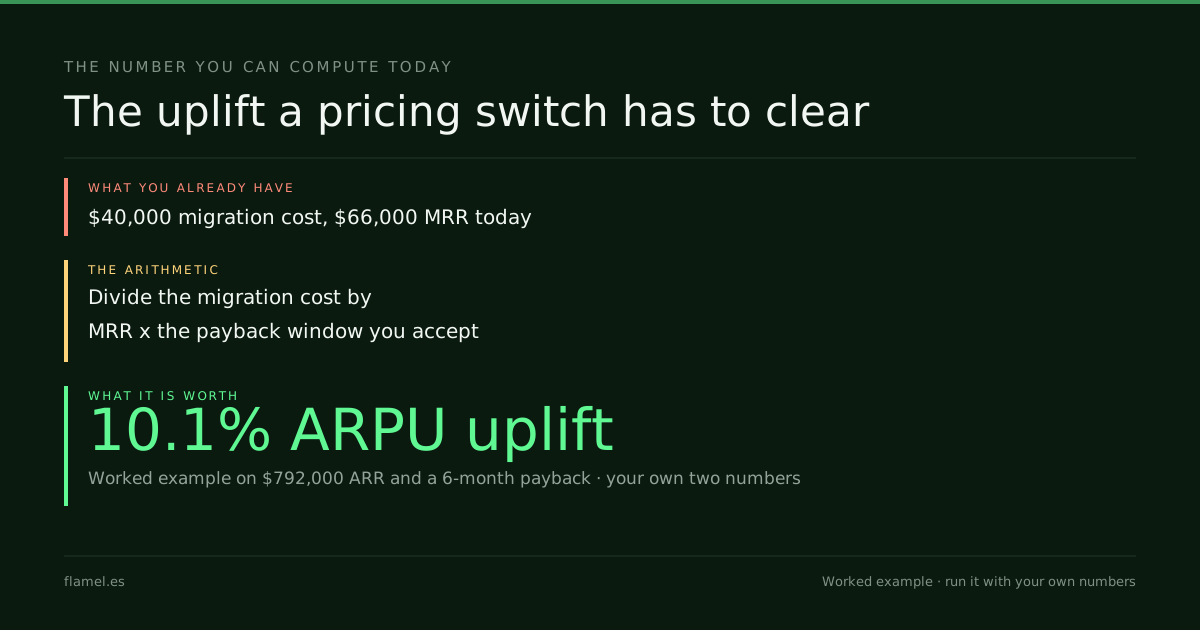
Take a product with $792,000 in ARR: 1,100 customers at $60 ARPU a month, $66,000 in MRR. The founder prices the full migration — repricing engineering, a communication sprint, and the discounting needed to hold flight-risk accounts — at $40,000. She wants it to pay back inside two quarters.
Required ARPU uplift (%) = Migration cost ÷ (Current MRR × Payback window in months)$40,000 ÷ ($66,000 × 6) = 10.1%
ARPU has to rise from $60 to at least $66.06 — and hold there through two renewal cycles — before the switch was worth making. Below that line, the migration is a cost with no return. Above it, every additional point of uplift is what the model was supposed to deliver in the first place.
Run the same formula with a twelve-month window and the bar drops to roughly 5%: $40,000 ÷ ($66,000 × 12) = 5.05% — half the required lift, because the same migration cost is spread across twice the renewal cycles. The payback window isn't a technicality: it's the difference between a switch that clears in one renewal cycle and one that never quite does.
When the math says don't move
In Flamel's read of the payback math, above roughly 20-25% required uplift inside two quarters, a full pricing model change rarely pays back before the next one gets proposed. Cheaper moves, in order:
- Grandfather existing accounts at the current price and put the new model in front of new customers only — no transition churn, because nobody's price moves.
- Add a usage-based tier on top of the existing plan instead of replacing it. ARPU rises on the accounts that use more, without repricing the base.
- Repackage before you reprice. Moving one feature to a higher tier changes ARPU without a single support ticket about why the price changed.
Any of the three also protects a number a pricing switch quietly resets: customer lifetime value. Recalculate it with the new price before deciding, not after — a switch that raises ARPU but stretches payback also moves the LTV:CAC ratio, the second number worth checking before the sheet changes. The packaging-versus-pricing distinction gets its own post, and it's coming.
What one point of ARPU uplift is worth
On the $792,000 example, one point of ARPU uplift — $0.60 a month per account — is $7,920 a year across 1,100 customers. Against a $40,000 migration cost, that's roughly five points of uplift to break even in a year, or ten to break even in six months.
The payback math isn't the only thing the model choice moves. It also decides what week two looks like, which is where activation actually breaks. A usage-based price makes the first session the moment the meter starts running; a seat-based price makes signup the only event anyone tracks. Choose the model without asking that question, and you optimize activation around a number nobody's paying for — the same quiet break as a signup flow built for conversion instead of the first session.
Below your own uplift number, don't touch the model. Fix packaging instead, which is what the product-led growth argument prices out before pricing itself ever enters the conversation.
What to do by Monday: pull your current MRR, your best estimate of the one-time migration cost, and the payback window you're willing to accept. Run the formula above. If the required uplift is a number your product can credibly deliver, the switch is a decision. If it isn't, you already have your answer, and it isn't "wait and see."
Redi Foods sets the same standard for sustained results: a 4.4% conversion rate over 22 months, not a one-month spike — the bar a pricing switch should clear too.
Work through this with your own numbers
You are a SaaS operator deciding whether to switch from cost-plus or competitor-based pricing to a value-based model. Using your own numbers — your current MRR [your current MRR], your active customer count [your active customer count], the estimated one-time cost of repricing and customer communication [estimated migration cost], and the payback window you're willing to tolerate in months [payback window in months] — compute the ARPU uplift percentage required to break even: uplift % = migration cost ÷ (current MRR × payback window). Compare that required uplift to what you realistically expect the new price to produce, based on your own willingness-to-pay data if you have it. State clearly whether the migration clears the bar within your stated window, and if it doesn't, name the smaller move — a packaging change, an add-on tier, or grandfathering — you'd make instead.FAQ
What's the difference between cost-plus, competitor-based, and value-based SaaS pricing strategies?
Cost-plus prices from your delivery cost plus a margin; competitor-based prices relative to what similar products charge; value-based prices from what the outcome is worth to the customer. Only value-based pricing scales ARPU with usage or outcome instead of capping it at a market average, but it requires you to quantify value per account, which the other two models never ask for.
How much does it cost to switch a SaaS pricing model?
The direct costs are repricing engineering (billing logic, plan structures), customer communication, and discounting used to retain accounts during the transition. The indirect cost is churn in the first one to two renewal cycles, when existing customers see a price they didn't sign up for. In Flamel's read, this transition churn counts as recoverable revenue, not lost revenue, if the new ARPU clears the migration cost within a stated window.
What ARPU uplift justifies a move to value-based pricing?
There's no universal number — it depends on your migration cost, your MRR, and how fast you want it to pay back. On a product with $792,000 ARR and a $40,000 migration cost, a six-month payback needs roughly a 10% ARPU uplift. Divide your own migration cost by your MRR times your payback window in months to get your figure.
When should a SaaS company avoid changing its pricing model?
When the required ARPU uplift is higher than what your product can credibly deliver — in Flamel's read, usually above 20-25% within two quarters. In that case, a packaging change, a new add-on tier, or grandfathering existing accounts at the old price returns more than a full pricing overhaul, without resetting the metric the whole team optimizes for.
Does a pricing strategy count as a north star metric?
Not on its own, but the model you choose decides what a north star metric can even measure. Seat-based pricing optimizes for logins; usage-based pricing optimizes for consumption; value-based pricing optimizes for outcomes delivered. Getting that choice wrong means the metric you track afterward measures the wrong thing, no matter how disciplined the tracking is.
That's what the Activation Audit is. Five business days, $500, and the map is yours whether or not you hire us.
Your store, five days.
$500. Zero commitment. Yours either way.