
Community-led growth: members, against churn
Community-led growth does two jobs: it brings customers in and keeps them. How to price both halves in ARR, and how much of the churn gap to believe.

Community-led growth works when a community does two jobs at once. It brings people in, which is marketing's half. It keeps customers, which is product's half. Without measuring members against everyone else, nobody knows which job it is doing, or whether it is doing either.
Most SaaS teams run the community from one side. Marketing counts members and posts. Product counts the support questions the forum answered. Neither puts members' churn next to everyone else's, so the community gets a budget line and no number.
The sum below runs on the example product this blog uses for SaaS, which is flat: marketing brings 44 customers a month and churn takes 44. It ends on what the community is worth in ARR, and how much of that figure to believe.
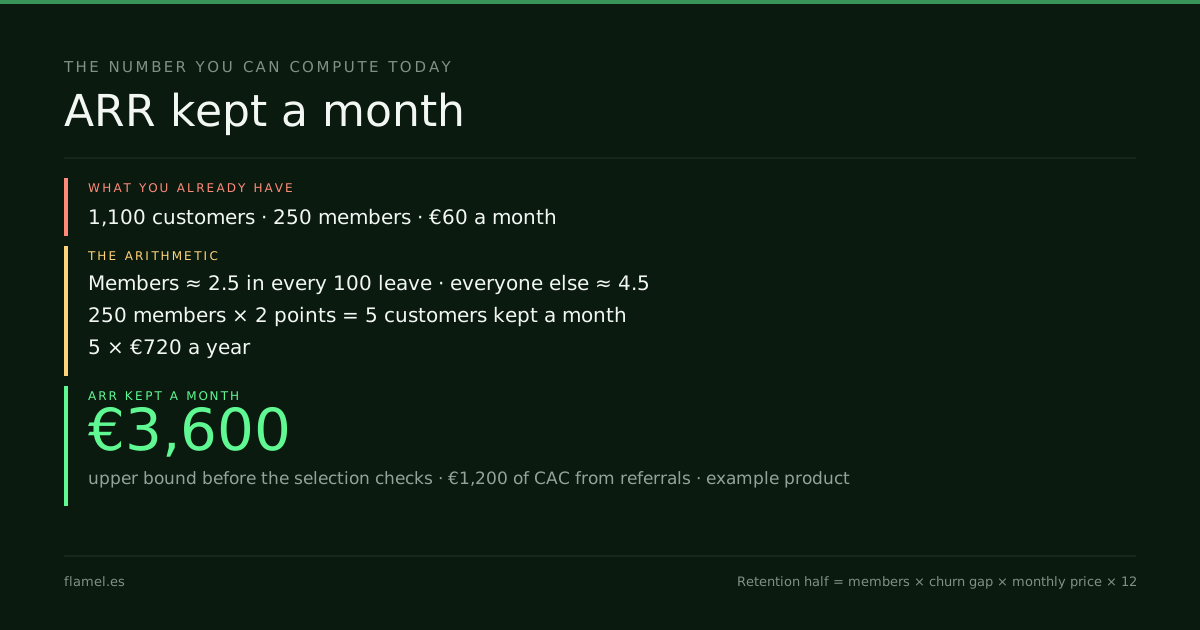
Community-led growth is worth what members keep and what they bring. On a product with 1,100 customers at €60 a month, 250 members who churn 2 points less a month keep 5 customers: €3,600 of ARR a month. Three referred customers a month save €1,200 of acquisition cost.
Key takeaways
- Community-led growth does two jobs: it brings customers in for marketing and keeps them for product. Measure both halves.
- On 1,100 customers, 250 members churning 2 points less a month keep 5 customers: €3,600 of ARR a month.
- Three of the 44 new customers a month arrive referred by a member: €1,200 of acquisition cost already covered.
- The churn gap is an upper bound: engaged customers join communities, so compare members with non-members of the same age and usage.
- Tag members in the billing data and put their monthly churn next to everyone else's for the last six months.
What community-led growth claims to do
Bessemer Venture Partners' five laws for community-led growth, by Talia Goldberg and Kate Walker (2022), puts the claim in one line: “CLG leverages the power of the people to accelerate customer acquisition, retention, and engagement.” Acquisition and retention sit in the same sentence. In most companies they sit in different teams.
The same essay sets a ceiling: “Companies that are best-in-class at fostering community are able to engage up to 30% of their customer base.” A community is a minority of customers, even when it works. That is why its value is measured per member, not per product.
In a tool for creative businesses, the community is often already there. Photographers trade presets in a forum. Studio owners compare class schedules in a group. Academy founders ask each other how to price a course. The question is not whether to build one. It is what the one that exists is worth.
The community-led growth example: 250 members
The example product this blog uses for SaaS has 1,100 paying customers at €60 a month (€720 a year). Churn is 4 in every 100 a month, so 44 customers leave, and marketing brings 44 new ones at €400 each. The product is flat. All of it is declared, not a client's numbers.
Now declare a community. 250 of the 1,100 customers are members, about 23 in every 100, under the ceiling Bessemer gives. Members leave at about 2.5 in every 100 a month. Everyone else leaves at about 4.5. Together that is still the product's 44 a month.
Members:        250 × 2.5 in every 100  ≈ 6 leave a month
Everyone else:  850 × 4.5 in every 100  ≈ 38 leave a month
Churn gap:      250 × 2 points          = 5 customers kept a month
ARR kept:       5 × €720                = €3,600 a month
If members left at everyone else's rate, the product would lose 49 customers a month instead of 44. The flat line would already be falling. The community holds part of it up, and the SaaS churn rate on the dashboard does not say so.
Whether the customers who stay share a behavior, in the community or in the product, is part of what The Activation Audit maps in five business days, for $500.

Members against churn: an upper bound
The 2-point gap is not proof. Customers who join a community are often the ones who already use the product most. They might have stayed anyway. Part of the gap is the community. Part of it is who chose to join.
Three comparisons make the gap more honest:
- Same age. Compare members with non-members who signed up in the same month. New customers leave more, and they join communities less.
- Same usage. Compare members with non-members who reached the same activation step in their first weeks. That separates the community from the product's own pull.
- Before and after. Compare each member's usage in the three months before joining with the three months after. Usage that rises after joining is a stronger signal than a gap between two groups.
If half the gap survives those comparisons, the community keeps 2.5 customers a month: €1,800 of ARR. That is still a number a team can defend. The post on customer retention rate shows how to read the base it sits on.
Community-led growth and the referral half
The other half is acquisition. Bessemer calls community “a cost effective, owned source of lead generation.” Members recommend the product to peers who run the same kind of business, and the essay describes members who “further raise awareness and validate the product.” In a creative niche, that word of mouth often travels faster than an ad.
Declare it on the example product: 3 of the 44 new customers a month arrive referred by a member. Bought through marketing at €400 each, they would cost €1,200 a month.
Referred customers:  3 a month
Acquisition cost:    3 × €400 = €1,200 a month not paid
This half is easier to measure than retention. Ask at signup how the customer heard about the product, and give members a referral link. The count belongs in marketing's report, next to paid channels. That is where product-led growth and community meet: the product makes members, and members bring signups.
The headcount check, on a flat product
Bessemer offers one health check: “a strong leading indicator is when the growth rate of community members is greater than or equal to customer growth.” It is a useful bar for a product that grows. On a flat one, it says very little.
The example product adds no customers in a net month: 44 in, 44 out. Any growth in members clears that bar, including members whose churn never changes. A community can grow every month and keep nobody.
So the check that matters on a flat product is the gap, not the headcount:
Members grow to 300, gap holds at 2 points:  300 × 0.02 = 6 kept a month
ARR kept:                                    6 × €720 = €4,320 a month
If the gap holds as the community grows, each new member adds to what it keeps. If the gap shrinks, the newer members joined for a reason that does not keep them, and the headcount is hiding it.
The community-led growth number for your product
Retention half    = members × churn gap × monthly price × 12
Acquisition half  = referred customers a month × acquisition cost
On the example product: 250 × 0.02 × €60 × 12 = €3,600 of ARR a month, and 3 × €400 = €1,200 of acquisition cost a month. The first figure is an upper bound until the same-age and same-usage comparisons confirm it.
What to do by Monday: tag community members in the billing data. Put their monthly churn next to everyone else's for the last six months, split by signup month. Then count last quarter's signups that name a member or a community post as their source.
Work through this with your own numbers
You are measuring what a SaaS product's community is worth. Inputs: [paying customers], [community members among them], [monthly price per customer], [customer acquisition cost], [monthly churn of members and of non-members for the last six months, by signup month] and [signups last quarter referred by a member]. Calculate the churn gap in points and the customers it keeps each month as members × gap. Turn it into ARR as customers kept × monthly price × 12. Calculate the acquisition cost the referred signups save. Then check selection: compare members with non-members of the same signup month and, if I give usage data, the same activation step. Report the gap before and after those comparisons and say which figure to trust. Do not assume the community causes the gap.FAQ
What is community-led growth?
Community-led growth is a strategy where a product's community brings in new customers and keeps existing ones. Bessemer Venture Partners described it in 2022 as using people to accelerate acquisition, retention and engagement. It works alongside product-led growth, not instead of it.
How do you measure community-led growth?
Measure both halves. For retention, compare members' monthly churn with non-members of the same signup month and usage. For acquisition, count signups referred by members. On 1,100 customers, a 2-point gap across 250 members keeps 5 customers a month: €3,600 of ARR.
Does a community reduce churn?
Members usually churn less, but part of the gap is selection: engaged customers join communities. Compare members with non-members of the same age and usage, or the same customers before and after joining. What survives those comparisons is what the community keeps.
How many customers join a SaaS community?
A minority. Bessemer Venture Partners wrote in 2022 that best-in-class companies engage up to 30 in every 100 customers. That is why community value is measured per member: 250 members on 1,100 customers is about 23 in every 100.
Whether a community keeps customers, brings them or does neither is a question with a number. The Activation Audit maps where activation breaks and what to fix first: five business days, $500, and the map stays with you whether or not you hire anyone.
Your store, five days.
$500. Zero commitment. Yours either way.