User acquisition: priced at signup, paid at month three
User acquisition, defined for SaaS: three prices of the same user, and why the one that matters is set by product as much as by marketing.

User acquisition is everything a SaaS company spends and does to turn strangers into new users: ads, content, partnerships, referrals and the free trial itself. It is usually priced per signup, because that is where marketing's dashboard ends. The price the business actually pays arrives later: what each customer still paying at month three cost to bring in.
The same user has three prices, depending on which team is looking. Marketing sees the signup. Finance sees the paying customer. Product decides how many of those customers are still there when the bill comes due. Putting the three prices side by side is the first conversation a head of product and a marketing lead need to have, and it takes one division each.
User acquisition is the set of channels and spend a SaaS company uses to bring in new users. Measure it three ways: cost per signup, cost per paying customer and cost per customer still paying at month three. The third is the price the business actually pays, and it falls when onboarding keeps more of the users marketing already bought.
Key takeaways
- User acquisition is everything a SaaS company spends and does to turn strangers into new users.
- The same user has three prices: per signup, per paying customer and per customer still paying at month three.
- On the worked example the three prices are €80, €400 and €452 for the same month of spend.
- Onboarding that keeps 2 more of every 100 customers a month lowers the third price to €425 with the same budget.
- Divide last quarter's acquisition spend three times and put the three prices in one table for both teams.
What user acquisition means in SaaS
AppsFlyer's glossary defines it as the process of attracting new users to a website, service, platform or app through marketing activity. In mobile apps that usually means installs. In SaaS the install is a signup, and a signup is not yet a customer. It becomes one when the trial converts, and it becomes revenue only if the customer keeps paying.
That is why acquisition and the product cannot be measured apart. In a product-led growth motion the product does part of the acquiring itself: the free plan, the shared link, the invitation. Even in a sales-led motion, the first weeks inside the product decide whether the money spent on the signup comes back. And channels differ in who they bring, not only in what they cost: compare the third price by channel and the cheapest signup is often not the cheapest customer.

The three prices of one user
Cost per signup        = acquisition spend ÷ signups
Cost per customer      = acquisition spend ÷ new paying customers
Cost per kept customer = acquisition spend ÷ customers still paying at month three
The first is the number marketing reports, because it is the one marketing controls. The second is the customer acquisition cost finance already knows. The third has no owner in most teams, and it is the only one that tells you what a customer who stays actually cost.
Month three is a working line, not a law. Pick the month after which your customers rarely leave. For a monthly subscription with a two-week trial, month three is usually past the first renewal and the first real use of the product.
A worked example: one month, three answers
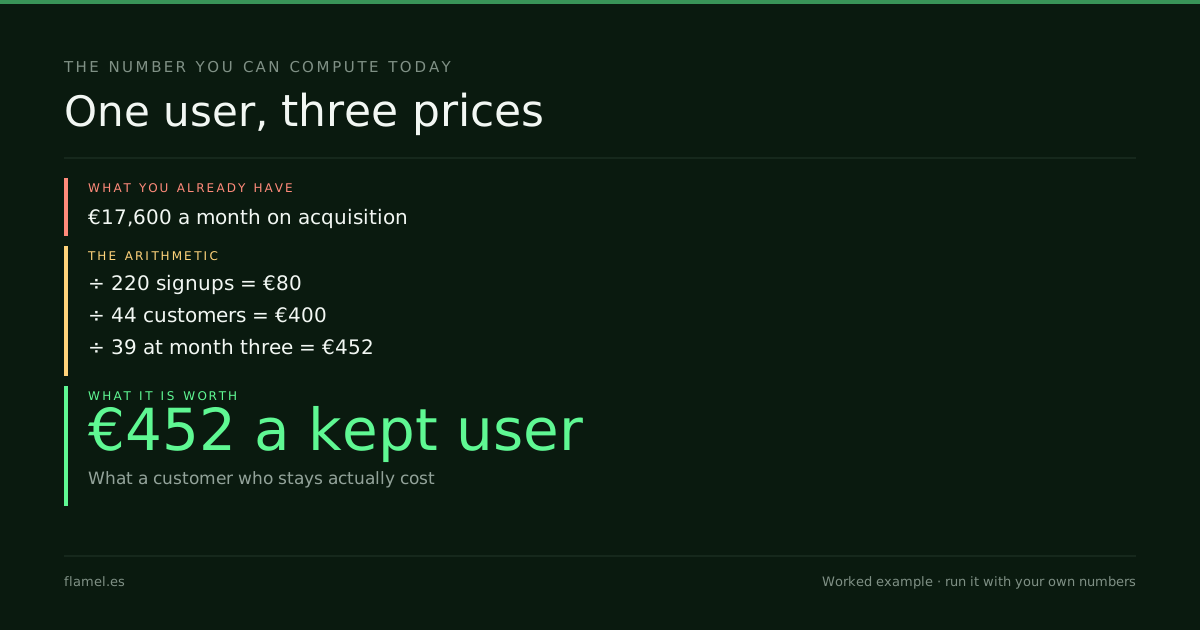
Take a subscription tool for small creative businesses: 1,100 customers paying €60 a month. It spends €17,600 a month on acquisition. That buys 220 signups, and 44 of them, 20 in every 100, start paying. Like the rest of the base, they leave at 4 in every 100 a month, so about 39 are still paying three months later.
- €17,600 ÷ 220 signups = €80 per signup
- €17,600 ÷ 44 new customers = €400 per paying customer
- €17,600 ÷ 39 customers at month three = €452 per kept customer
The 39 comes from the monthly loss: 44 × 0.96 × 0.96 × 0.96 = 38.9. Use your own loss rate, or better, count the actual cohort three months on; a measured number beats a modeled one.
Same users, same month, same spend. Marketing reports €80, finance reports €400, and the business pays €452. None of the three is wrong. Each one answers a different question, and the gap between them is where the two teams usually talk past each other.
Where product lowers the price
The third price is the only one that can fall without touching the ad budget. If onboarding cuts the loss in the first three months from 4 to 2 customers in every 100 a month, 41 of the 44 are still paying at month three instead of 39. The same €17,600 now buys kept customers at €425 each. That is €27 less per customer, and nobody changed a campaign.
The lever runs the other way too. A campaign that doubles signups from people who never reach the product's first useful result lowers the cost per signup and raises the cost per kept customer. A dashboard that only shows the first price will call that campaign a win.
This is the same logic that makes the LTV:CAC ratio a two-team number: marketing sets what a customer costs, and product sets how long that customer pays it back.
What to do by Monday: take last quarter's acquisition spend and divide it three times: by signups, by new paying customers and by the customers from those cohorts still paying three months later. Put the three prices in one table and send it to both teams.
Work through this with your own numbers
You are reviewing user acquisition for a SaaS product with marketing and product leads in the room. Last quarter we spent [acquisition spend] on acquisition, got [signups] signups and [new paying customers] new paying customers, and [customers still paying at month three] of those customers were still paying three months later. Calculate the three prices of one user: cost per signup, cost per paying customer and cost per customer still paying at month three. Then show how the third price changes if onboarding keeps [extra customers kept in every 100] more customers in every 100 through the first three months, with the same spend. Say which of the three prices each team should report, and which one both teams should read together.FAQ
What is user acquisition?
User acquisition is the work and spend that bring new users to a product: paid ads, content, partnerships, referrals and the free plan or trial. In SaaS a newly acquired user is a signup, which only becomes revenue when the trial converts and the customer keeps paying.
Is user acquisition the same as customer acquisition cost?
No. User acquisition is the activity; customer acquisition cost is one way to price it, spend divided by new paying customers. Cost per signup is a cheaper-looking price of the same spend, and cost per customer still paying at month three is a more expensive and more honest one.
Why measure user acquisition at month three?
Because the users who leave in the first weeks were paid for too. Dividing acquisition spend by the customers still paying after the first renewals shows what a customer who stays actually cost. Pick the month after which your own customers rarely leave; for many monthly subscriptions it is around month three.
Who owns user acquisition in a SaaS company?
Marketing usually owns the spend and the signups, and product owns what happens after them. The cost per kept customer depends on both, which is why it works best as one number the two teams read together rather than two dashboards that never meet.
Putting the three prices in one table, with your own data, is part of what The Activation Audit maps. Five business days, $500, and the map stays with you whether or not you hire anyone next.
Your store, five days.
$500. Zero commitment. Yours either way.