Growth and innovation: a new collection is not a plan
Growth and innovation are two jobs: innovation gives people a reason to buy, growth makes a launch find its people and come back. What a launch is worth.

Growth and innovation are two different jobs. Innovation is the new collection, format or product: it gives people a reason to buy. Growth is making that launch find its people and bringing them back for a second order. A creative brand needs both, and it usually treats them as one: a new collection becomes the plan, when the plan is what the launch has to prove.
The confusion is easy to make in a brand that grows by launching. Every drop, season or new line feels like progress, and the calendar fills up with things to make. What it rarely holds is a question: who this launch should reach, what would make them buy, and whether the people who bought the last one came back. That question is the growth half of the work, and without it the brand keeps innovating on a guess.
Growth and innovation are different jobs. Innovation creates the reason to buy: a new collection, format or product. Growth makes that launch reach the right people and earns their second order. Innovation without growth is a launch nobody finds or nobody returns to; growth without innovation optimizes a catalog that is getting old.
Key takeaways
- Innovation gives people a reason to buy; growth makes a launch find its people and brings them back for a second order.
- Innovation without growth sells once to the people who already follow the brand, and the launch stops at its first orders.
- Growth without innovation tunes a catalog that ages, until returning customers have nothing new to come back for.
- On the worked store, one launch month is worth €17,000 in first orders, and €23,800 if its buyers return at the store's usual rate.
- Before the next launch, write down who it should reach, what it should prove and how many of its buyers should order again.
Growth and innovation: two different jobs
McKinsey's study of innovative growers set out to find companies that did both at once: profitable growth above their industry between 2016 and 2021, and excellence in the capabilities associated with innovation. It found 53. What set them apart, the authors write, is that they pursue excellence in execution as well as invest in innovation. Having to search for the overlap says something on its own: being inventive and growing are separate achievements, and plenty of companies manage only one.
In a creative brand the split is easy to draw:
- Innovation is what the brand makes new: a collection, a format such as a box or a workshop, a material, a collaboration, a new line. It answers why buy now.
- Growth is what happens to that novelty once it exists: who hears about it, whether the page makes buying easy, whether the buyer is recognized next time and whether they come back. It answers who buys, and do they return.
In the five moments of growth marketing for creative businesses, innovation feeds Appear, because a launch gives the brand something new to show. Growth runs all five: Appear, Attend, Recognize, Retain and Know.
Innovation without growth: a launch nobody finds
The first failure looks like success for a few weeks. The collection is good, the shoot is beautiful and the announcement goes out to the people who already follow the founder. They buy, the launch sells through, and then the revenue chart goes flat until the next one.
Two things went missing. The launch never reached anyone outside the first circle, so it measured the audience, not the market. And nobody planned what would bring those buyers back, so each new collection has to be bought by the same people again, or by strangers the brand pays to find every time. Selling out to a first circle proves that the idea works; it does not prove there is a market beyond it, which is the difference between problem-solution fit and the second proof described in how to measure product market fit.
That second path is the expensive one. Depending on the study and the industry, Harvard Business Review puts the cost of acquiring a new customer at anywhere from five to 25 times the cost of keeping an existing one. A brand that only innovates pays that cost again with every launch.

Growth without innovation: an aging catalog
The opposite failure is quieter. The brand stops launching and puts its energy into the store it already has: faster pages, a cleaner checkout, better emails, tighter ads around the same bestsellers. Each of those is real growth work, and for a while the numbers improve.
Then they stall. Returning customers have nothing new to come back for, ads show the same products to the same people until they stop responding, and the second order runs out of reasons. Growth can make a launch reach more people and bring more of them back; it cannot invent the reason to buy. A brand that sells in drops or seasons rarely falls into this trap, because its calendar forces something new. A brand that sells from a catalog falls into it easily.
What each job looks like by revenue mechanism
How a creative brand earns its revenue decides what innovation and growth mean in practice:
| Mechanism | Innovation | Growth | Number to watch |
|---|---|---|---|
| Drops | The next drop | Reaching beyond the list, a waitlist that converts, buyers of one drop who buy the next | Buyers of this drop who bought a previous one |
| Catalog | New lines and refreshed bestsellers | Product pages, checkout and the second order | Repeat purchase rate |
| Membership | New box contents, perks or classes | The first month of use and the renewals | Members still paying at month three |
| Seasons | The season's collection | Who hears first, early access, last season's buyers | Last season's buyers who return |
The innovation column is where most creative brands already spend their attention. The growth column is where the revenue of the second order is decided, and it usually has no owner.
A launch is a plan when it carries a question
A new collection becomes a plan when it carries one question with an answer the brand writes down before the launch: a hypothesis about one moment, one variable, a measure with a threshold and a date to decide. Eight launches a year with no written hypothesis teach the brand nothing it can reuse; with one question each, the same calendar becomes eight answers. That is the idea behind running marketing experiments when you launch in drops.
Two examples of the kind of question a launch can carry:
- Reach. This collection will be found by people outside the first circle: at least 3 in every 10 first-time buyers arrive from search, ads or press, not from the brand's own list.
- Return. A message to launch buyers around day 30 brings back more of them within 90 days than the previous launch did without it.
The innovation decides what to make. The question decides what the launch will teach, and that is the part that compounds from one launch to the next.
What a launch is worth: the second order
The value of a launch has two parts, and only the first shows up in the launch week:
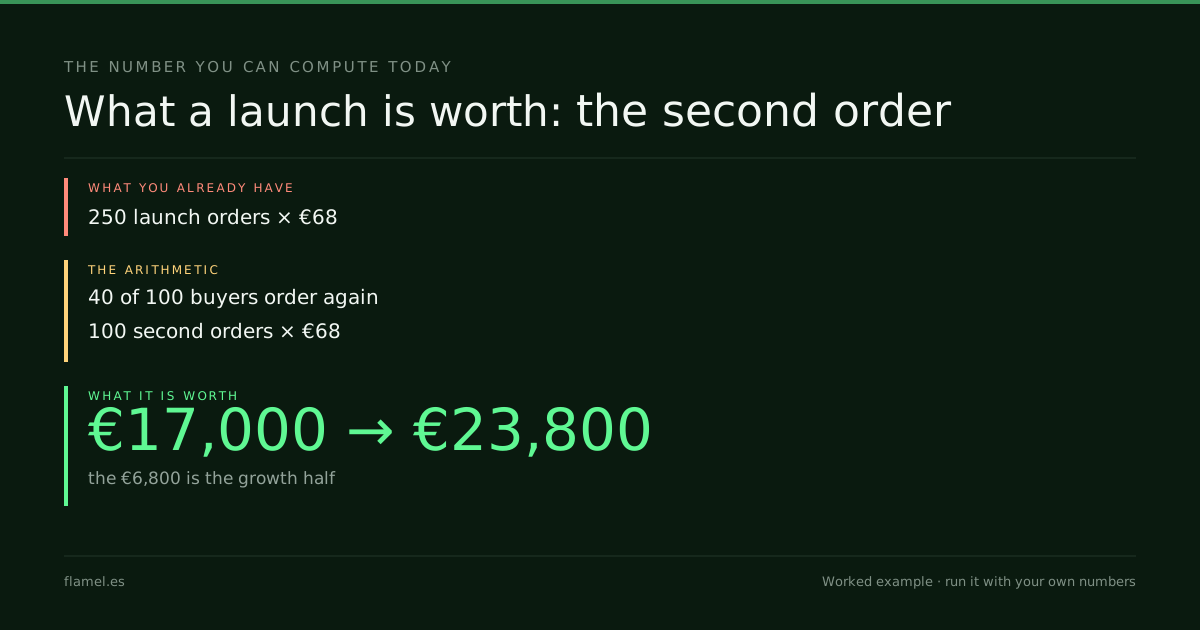
Launch value = launch orders × average order + second orders × average orderTake the store used across this blog: 300,000 sessions a year, a €68 average order and a 1.0 % conversion rate, which is 3,000 orders and €204,000 a year. A launch month brings about 25,000 sessions, the store's monthly average. At 1.0 % that is 250 orders. Count each as one buyer, and the launch makes €17,000.
Now suppose those 250 buyers come back at the store's usual rate. On this store 40 of every 100 customers order again within the year, the repeat purchase rate worked out for the same numbers. That is 100 launch buyers placing a second order: €6,800 more. The launch is worth €23,800. If its buyers never return, it stops at €17,000.
The two figures count different things. The 40 of every 100 counts customers who come back; the share of the store's orders that are repeat orders is a separate number, and on the same store it comes out lower than 40, because each returning customer places more than one extra order.
The €6,800 is the growth half of the launch, and no one designs it into the collection. It comes from the work around the launch: being recognized on the second visit, a reason to come back and a message at the right moment.
What to do before the next launch: take the last one, count its buyers and count how many have ordered again since. Multiply the ones who returned by your average order. That is the growth half of your last launch; write the target for the next one before it ships.
Work through this with your own numbers
You run a creative brand that sells through [drops / a catalog / a membership / seasons], with a [average order value] average order. Your last launch brought [launch sessions] sessions and [launch orders] orders from [launch buyers] buyers, of whom [buyers from outside your own list] came from search, ads or press rather than your own list, and [buyers who ordered again] have ordered again since. Calculate the launch value as launch orders times the average order plus second orders times the average order, and show which part came from the second order. Then say whether this launch was innovation without growth, growth without innovation or both, and write one question with a threshold for the next launch: one about reaching people outside the first circle and one about bringing launch buyers back.FAQ
What is the difference between growth and innovation?
Innovation is what a business makes new: a product, a collection, a format or a service. It gives people a reason to buy. Growth is what happens to that novelty once it exists: whether the right people find it, whether buying is easy, and whether buyers come back for a second order. A brand can be very inventive and not grow, or grow for a while by optimizing what it already sells.
Can a brand grow without innovating?
For a while. Better product pages, checkout, emails and ads can lift a store that sells the same catalog. The gains flatten when returning customers have nothing new to come back for and ads keep showing the same products to the same people. Growth work can widen the reach of a reason to buy and earn the second order, but it cannot create the reason to buy in the first place.
Why doesn't a new collection grow the business on its own?
Because a launch usually reaches the people who already follow the brand, and nothing is planned to bring its buyers back. It sells through, revenue jumps for a few weeks and then goes flat until the next launch. Growth comes from the work around the collection: reaching people outside the first circle, making the purchase easy, and giving first-time buyers a reason to place a second order.
How do you measure whether a launch created growth?
Count two things: the first-time buyers the launch brought in from outside the brand's own list, and how many of the launch buyers ordered again in the months after. Multiply the second orders by the average order to see the part of the launch's value that the first week never shows. Write a target for both numbers before the next launch, so the result can be read against it.
Reading what your last launches earned in first and second orders, from your own admin, is part of what The Conversion Audit maps. Five business days, $500, and the map stays with you whether or not you hire anyone next.
Your store, five days.
$500. Zero commitment. Yours either way.