A growth partner for creative businesses: what Flamel is
What Flamel is, who it works for, what it does and what makes it different: a growth partner for creative businesses that want to scale digitally.

Flamel is a growth partner for creative businesses: a team that works with founders, CMOs and heads of product at companies that want to scale digitally, so that what makes each brand unique is also what makes it grow. It blends into their marketing and product teams to understand their challenges, experiment with real customers and transform the business.
That is the whole definition. The rest of this post takes it apart sentence by sentence, because each part answers one of the four questions a buyer asks before talking to anyone: what Flamel is, who it works for, what it does and what makes it different.
Flamel is a growth partner for creative businesses. It works with founders, CMOs and heads of product at companies that want to scale digitally, blending into their marketing and product teams to understand their challenges, experiment with real customers and transform the business, starting with a five-day Blueprint that costs $500.
Key takeaways
- Flamel is a growth partner for creative businesses that want to scale digitally.
- It works with founders, CMOs and heads of product, each arriving with a different need.
- The work goes in three steps: understand with a five-day Blueprint, experiment with real customers, transform through recurring cycles.
- It works inside the team and joins experience, marketing and product in one cycle.
Flamel, a growth partner for creative businesses: in plain words
A growth partner. Not a campaign shop and not a consultant billed by the hour. A partner shares the problem for long enough to see whether the solution worked, and is measured on what the brand learns and earns, not on what it ships. Growth here means the full path a customer takes: finding the brand, buying without friction, coming back and being recognized, and the brand knowing what happened at each step. The five moments of growth marketing (Appear, Attend, Recognize, Retain and Know) are how Flamel reads that path.
Of the creative industries. Fashion and accessories, design objects, food and drink with a brand, publishing, music, education and the businesses where the brand carries a large part of the decision to buy. What these businesses share is not a sector but a way of selling: through drops, catalogs, memberships or seasons. The way a brand's customers buy decides which moment matters most, so the first question Flamel asks is never "what channel?" but "how do your customers buy?".
Who Flamel works for: three people, three needs
Flamel works with three roles, and each arrives with a different need:
- Founders. The company already sells and has grown by hand. What they need is someone to think about growth alongside them, without carrying the fixed cost of an in-house team before the business can use one.
- CMOs. The team produces campaigns and content, but nobody tests what works or connects marketing to the website and the product.
- Heads of product. The product has customers or users, but nobody can say what makes them stay, or how to get product and marketing pushing in the same direction.
Different needs, same underlying problem: decisions that are made without a way to read whether they worked. That is the problem a growth partner exists to solve.

What Flamel does: understand, experiment, transform
The work follows three steps, in that order:
1. Understand. Every engagement starts with the Digital Experience Blueprint: five business days in which Flamel goes through the brand as a customer would, reads the store's own admin and analytics, and maps where growth is lost and what to fix first. For online stores it is called The Conversion Audit; for software products, The Activation Audit. It costs $500, and the map stays with the brand whether or not it hires anyone next.
2. Experiment. The first cycle runs with real customers: one hypothesis, one variable, one measure and a decision written in advance. For brands that sell in launches, most of these are not split tests but marketing experiments that fit a launch calendar: presales, limited first runs, prototype pages, customer conversations.
3. Transform. Cycles keep running, every few weeks, each one starting from the record of the last. Over a season, the build measure learn loop turns into the way the brand decides, and what the team learned stays with the team.
On a store with 300,000 sessions a year, one finding worth 0.1 points of conversion is about €20,400 a year, against a $500 Blueprint. If you want to see what the first step would find in your own store, The Conversion Audit is the place to start.
What makes Flamel different: inside the team
Three things, each of them checkable:
It works inside the team, not beside it. Flamel blends into the marketing and product teams it works with: same tools, same admin, same weekly decisions. The difference shows in the questions it can answer. An outside agency reports what it did; a partner inside the team can say what changed for the customer and why.
It joins experience, marketing and product in one cycle. Most growth offers stop at marketing: traffic, ads, emails. Flamel treats the product page, the checkout, the second order and the way a returning customer is recognized as part of the same system, because that is where the money a brand already paid to attract is won or lost.
It does growth without needing huge traffic. A split test needs a fixed number of sessions, and most creative brands do not have them. So each cycle is tied to the brand's own calendar (the next drop, the next season, the next collection) and paid traffic enters only as a test instrument, bought to learn something with a date.
Redi Foods, a meal-kit brand in Colombia, is one example: its store was rebuilt for conversion and has been read for 22 months and 130,465 sessions since, as the case study documents.
When Flamel is not the right call
A definition is also what it leaves out, and three situations fall outside this one:
- The brand has not sold yet. Growth work needs customers to learn from. Before the first orders, the useful purchase is the diagnosis, not a monthly cycle.
- The need is a guaranteed result. Flamel promises the map and the cycles that test it, not a number decided in advance. Anyone who guarantees a result before reading your admin is guessing.
- The need is only to run ads. If nothing on the website, the offer or the product is going to change, a media buyer is cheaper and better suited to the job.
Saying no to these early is part of the definition too: a partner that takes every engagement is not choosing the problems it can actually solve.
What the first step is worth, in your numbers
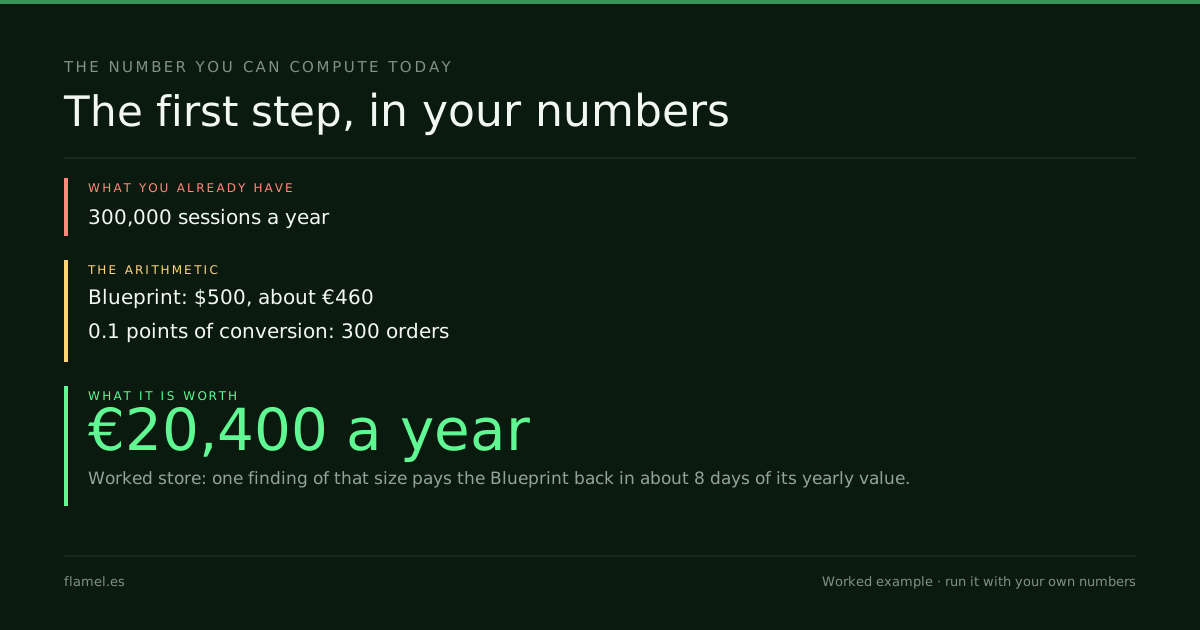
The useful way to judge a partner's first step is to compare its price with the value of one finding. Take the blog's worked store as an example: 300,000 sessions a year, 3,000 orders and a €68 average order.
- The Blueprint costs $500, about €460, and five business days.
- One finding worth 0.1 points of conversion rate on that store is 300 more orders a year, or €20,400.
- At that rate, the finding pays the Blueprint back in about 8 days of the value it creates in a year.
Run the same arithmetic with your own numbers: your sessions per year times 0.001 gives the orders behind 0.1 points of conversion, and your average order turns them into money. If one finding of that size is worth more than $500 to your brand, the first step has already paid for itself on paper.
Work through this with your own numbers
You lead [a creative brand / a product for creatives] that sells through [drops / a catalog / a membership / seasons], with [annual sessions] sessions a year and a [average order value] average order. Your role is [founder / CMO / head of product]. Describe in two sentences the growth problem you are facing today and how you currently decide what to try next. Then calculate how many orders 0.1 points of conversion rate would add per year (annual sessions × 0.001) and what they are worth at your average order. Compare that value with a $500 five-day diagnostic, and list the three questions you would want such a diagnostic to answer about your store or product.FAQ
What is Flamel?
Flamel is a growth partner for creative businesses. It works with founders, CMOs and heads of product at companies that want to scale digitally, so that what makes each brand unique is also what makes it grow.
Who does Flamel work with?
Founders whose company already sells and has grown by hand, CMOs whose teams produce campaigns that nobody tests, and heads of product who cannot yet say what makes their customers stay. All of them at creative businesses that want to scale digitally.
What does Flamel do first?
Every engagement starts with the Digital Experience Blueprint: five business days, $500, and a map of where growth is lost and what to fix first. For online stores it is called The Conversion Audit; for software products, The Activation Audit.
How is Flamel different from a marketing agency?
A marketing agency runs campaigns and reports what it did. Flamel works inside the marketing and product teams, treats the website, the second order and the product as part of the same system, and ties each cycle to the brand's own calendar instead of needing huge traffic for split tests.
Finding where your store loses growth, in your own admin, is what The Conversion Audit maps. Five business days, $500, and the map stays with you whether or not you hire anyone next.
Your store, five days.
$500. Zero commitment. Yours either way.