
Net revenue retention: the customers who grow
Net revenue retention is the revenue existing customers keep after upgrades, downgrades and churn. The formula, a worked example and the yearly view.

Net revenue retention (NRR) is the share of recurring revenue that the same customers still pay at the end of a period, after upgrades, downgrades and cancellations. The formula: starting MRR, plus expansion, minus contraction, minus churned MRR, divided by starting MRR. Above 100, existing customers grow revenue on their own. Below 100, the base shrinks unless marketing refills it.
It is the fullest answer to the question every SaaS team asks: what makes customers stay? NRR counts the ones who stay and the ones who grow. Split into its three movements, it also shows which one the next cycle should work on.
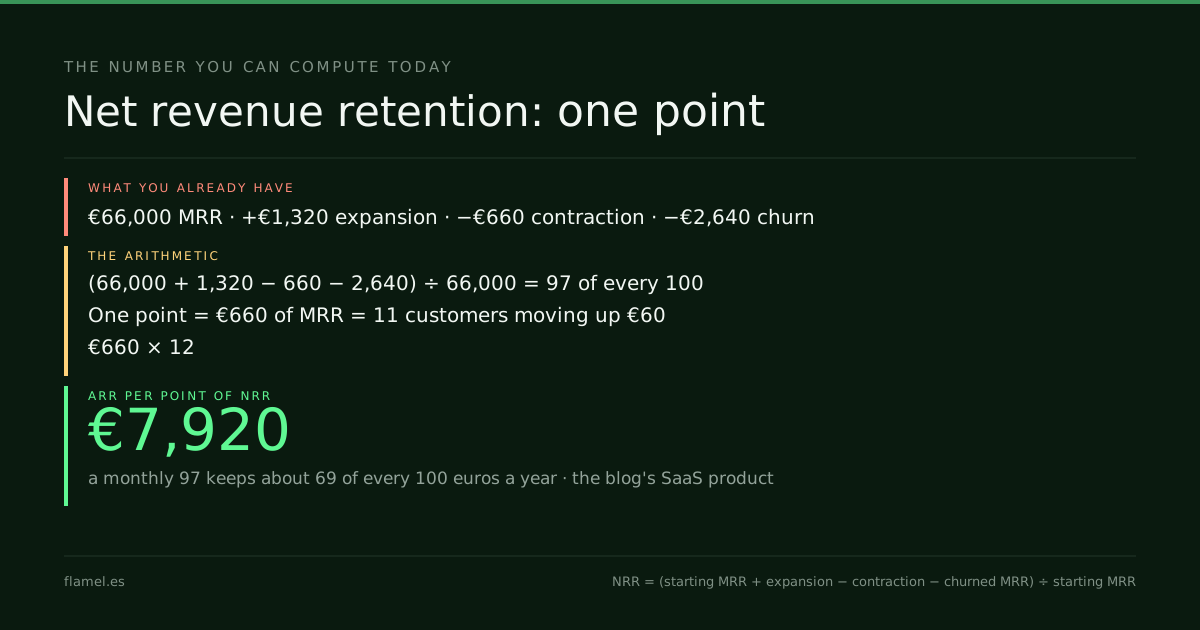
Net revenue retention = (starting MRR + expansion − contraction − churned MRR) ÷ starting MRR. On a product with €66,000 of MRR, €1,320 of expansion, €660 of contraction and €2,640 of churn give 97 of every 100 a month, about 69 over a year. Each extra €660 of monthly expansion is one point: €7,920 of ARR.
Key takeaways
- Net revenue retention follows the same customers' revenue: what they add by upgrading, minus what they remove by moving down or leaving.
- On the example product, NRR is 97 of every 100 a month: churn takes €2,640, expansion returns only €1,320.
- A monthly 97 compounds to about 69 a year, under the 82 median ChartMogul reports for SaaS sold to businesses.
- Each extra €660 of expansion a month, 11 customers moving up a €60 step, is one point of NRR and €7,920 of ARR.
- Split last month's MRR movement into expansion, contraction and churn, and give the next cycle the largest one.
The net revenue retention formula, line by line
NRR = (starting MRR + expansion − contraction − churned MRR) ÷ starting MRR

starting MRR = recurring revenue from customers paying at the start
expansion    = what those customers added: upgrades, seats, add-ons
contraction  = what they removed by moving to a cheaper plan
churned MRR  = what left with the customers who canceled
New customers stay out of it on purpose. NRR asks what the existing base does by itself. The group is fixed at the start: a customer who signs up during the month counts neither in the starting MRR nor in the expansion, even if they upgrade a week later. ChartMogul's NRR guide puts the line at 100: “A net retention rate of 100% or over means the business is growing its revenue from existing customers, even after accounting for churn.”
It is the counterpart of SaaS churn rate, which counts only what leaves, and of customer retention rate, which counts customers instead of euros.

Net revenue retention on the example product
Take the product this blog's SaaS posts use: 1,100 paying customers at €60 a month, €66,000 of MRR and €792,000 of ARR, the base from SaaS pricing strategy. Every month 4 of every 100 customers leave: 44 customers, €2,640 of MRR. Say the rest add €1,320 a month by moving up a plan and remove €660 by moving down. Those two figures are declared for the example.
NRR = (66,000 + 1,320 − 660 − 2,640) ÷ 66,000
    = 64,020 ÷ 66,000
    = 97 of every 100
Marketing brings 44 new customers a month, €2,640 of new MRR, and they only replace the ones who left. So the whole growth of the product, €660 a month, is net expansion: the customers who grow, minus the ones who shrink.
On a tool for studios, academies and photographers, expansion tends to follow the customer's own business: a second teacher, more students, a bigger archive. That is why it answers what makes customers stay better than churn does. It shows who found enough value to pay more for it.
Net dollar retention, monthly or yearly
Net dollar retention is the same number under another name. ChartMogul says so, and adds the convention that matters most when reading it: “Retention can be measured over any time period, but it is common to measure it over 12 months.”
A monthly figure compounds. If every month looks like this one, a monthly 97 keeps 0.97¹² ≈ 0.69 of the revenue a year later: about 69 of every 100 euros. For scale, ChartMogul's December 2025 analysis of 3,500 software companies puts the median NRR of SaaS sold to businesses at 82%, with the top quartile at 97%. The monthly 97 reads like the top quartile. The yearly 69 sits under the median. Compare like with like.
What one point of NRR is worth
One point of monthly NRR = 1 of every 100 euros of starting MRR = €660
€660 a month × 12        = €7,920 of ARR
That is 11 more customers a month moving up to a plan that costs €60 more. At 98 a month instead of 97, the yearly view goes from about 69 to about 78 of every 100 euros.
The same €660 of new MRR from new customers means 11 signups that pay, at the €400 each the example product spends to acquire one: €4,400 of acquisition. Expansion buys the same revenue from customers who already chose the product.
What to do by Monday: pull last month's MRR movements from billing: starting MRR, expansion, contraction and churned MRR. Calculate NRR, then raise it to the twelfth power to see the year. Rank the three movements by size. The largest one is where the next cycle goes, and each point of monthly NRR is 12 times one hundredth of the starting MRR in ARR.
Work through this with your own numbers
You are a SaaS operator reviewing last month's revenue movements. Inputs: [starting MRR], [expansion MRR from upgrades, seats and add-ons], [contraction MRR from downgrades], [churned MRR from cancellations] and [monthly ARPU]. Calculate net revenue retention as (starting MRR + expansion − contraction − churned MRR) ÷ starting MRR. Raise the monthly figure to the twelfth power to get the yearly view, and compare it with a yearly benchmark, not a monthly one. Rank expansion, contraction and churn by size and say which one the next release should work on. Then calculate what one more point of monthly NRR is worth: one hundredth of starting MRR, times 12, in ARR, and how many customers moving up one plan that point takes, at a price difference between plans of [price difference].FAQ
What is net revenue retention?
Net revenue retention is the share of recurring revenue the same customers still pay at the end of a period, after upgrades, downgrades and cancellations. New customers are left out. Above 100, the existing base grows revenue by itself; below 100, it shrinks unless new customers refill it.
How do you calculate NRR?
Add expansion to starting MRR, subtract contraction and churned MRR, and divide by starting MRR. On a product with €66,000 of MRR, €1,320 of expansion, €660 of contraction and €2,640 of churn, NRR is 64,020 ÷ 66,000: 97 of every 100 for the month.
Is net revenue retention the same as net dollar retention?
Yes. Net dollar retention, net MRR retention and net revenue retention are names for the same metric. What changes between companies is the period: it is common to measure it over twelve months, so check the period before comparing two figures.
What is a good net revenue retention?
Above 100 over a year means existing customers grow revenue on their own. In ChartMogul's December 2025 analysis of 3,500 software companies, the median for SaaS sold to businesses was 82 and the top quartile reached 97, both measured on a yearly basis.
Why does monthly NRR look better than yearly NRR?
Because it compounds. A monthly 97 means 3 of every 100 euros leave each month, net. Kept for twelve months, it leaves about 69 of every 100 euros of the starting revenue. A monthly figure should be raised to the twelfth power before it is compared with a yearly benchmark.
If you don't know which of the three movements your next release should work on, the Activation Audit maps where activation breaks in five business days, for $500, and the map stays with you whether or not you hire anyone.
Your store, five days.
$500. Zero commitment. Yours either way.