SaaS website design agency: the half after signup
Before hiring a SaaS website design agency, check which half of the path the brief covers and how many extra signups the redesign must add to pay.

A SaaS website design agency redesigns the half of the path that ends at the signup button: the homepage, the pricing page and the landing pages. The other half, from signup to the first result, decides whether those signups ever pay. Before hiring one, check which half the brief covers, and how many extra signups the redesign has to add to pay for itself.
Marketing usually owns the website and product owns what happens after signup. An agency briefed by marketing will improve the first half and leave the second half where it was, even when the second half is where most of the money leaves.
A SaaS website design agency usually redesigns the half of the path that ends at signup. Before hiring one, check whether the brief covers what happens after signup, and price it: on the example product, a €15,000 redesign needs about 130 extra signups a year to pay for itself.
Key takeaways
- A SaaS website design agency usually redesigns the half of the path that ends at signup.
- The half after signup decides whether those signups pay.
- On the example product, a €15,000 redesign needs about 130 extra signups a year to pay for itself.
- The same money spent after signup needs about one more payer in every hundred signups.
- Judge a redesign by paying customers against a baseline, not by signups alone.
What a SaaS website design agency covers, and what it leaves
The usual scope is the marketing site: positioning on the homepage, a pricing page that answers the plan question, landing pages for campaigns, a design system and often the build in a no-code tool the marketing team can edit. The brief ends at the signup form because the person who writes it owns everything up to that point.
The new user does not stop there. Nielsen Norman Group's research on onboarding puts it plainly: “Users want to start using the product right away” (NN/g). What they meet next is the signup form, the first session, the time to the first result and the second week. Those four places belong to the product team, and a website brief rarely names them. SaaS onboarding prices the first of them: what the first session is worth.
If you want to know which half is losing more before you write the brief, The Activation Audit maps both in five business days, for $500.
The half after signup decides the revenue
Take the example product this blog uses for SaaS: 11,000 visits a month, 2 of every 100 visitors sign up (220 signups), and 20 of every 100 signups pay (44 new customers a month).
A website redesign that lifts signups from 220 to 231 a month adds 11 signups, and 2.2 new customers at the same rate. A change after signup that lifts the paid rate from 20 to 22 of every 100 adds 4.4 new customers a month, on the same 220 signups and without touching the website. In this example, two more payers in every hundred signups are worth twice the eleven extra signups.
That is the point product-led growth makes from the cost side: the selling moves into the product, and that move has a concrete invoice at signup, the first session, the time to first value and week two. A redesign that ignores that invoice can win more signups and still leave the same number of customers.
Before you hire: four questions for the brief
- Which half does the brief cover? If it ends at signup, name the person who owns the other half, and invite them to the kickoff.
- Which number will judge the redesign? Signups alone reward the first half. Paying customers from those signups judge the whole path.
- Radical or incremental? Nielsen Norman Group's advice is to “make incremental changes to reach these goals and only resort to a complete redesign if the data tells you to do so,” and “never make radical changes when minimal adjustments will suffice” (NN/g).
- Who reads the result, and when? A redesign launched without a baseline cannot be judged. Measure the four weeks before launch and agree the date of the read.
A UX audit answers the first three questions with data the product already collects: what already happened, on which page, for which users.

When a SaaS website design agency is the right hire
The agency is the right call when the first half is the bottleneck. That looks like visits holding steady while the share who sign up falls, a positioning that no longer matches the product, a site the marketing team cannot edit without a developer, or technology too old to support the changes the team needs, which is the case Nielsen Norman Group reserves for a full redesign.
It is the wrong first hire when signups are healthy and few of them pay, when nobody can say what the first result in the product is, or when there is no baseline to read a redesign against. In those cases the brief belongs to the half after signup, and the website can wait one cycle.
What to ask a SaaS website design agency in the first call
Three questions separate an agency that designs a site from one that cares what the site is for:
- How will you know the redesign worked? A good answer names paying customers, a baseline and a date. An answer that stops at signups, sessions or a cleaner look covers half the path.
- What happens on the screen after signup? Ask how they would hand the new user over to the product. If the answer is that it is out of scope, put the other half in someone else's brief before launch, not after.
- What will you leave behind? Pages the team can edit, a design system it can extend, and the baseline numbers. A site the team cannot change without the agency becomes the next bottleneck.
The worked product: what a redesign has to add
The example product: 1,100 customers paying €60 a month (€66,000 of monthly recurring revenue), 220 signups a month, 20 of every 100 signups paying, and 4 of every 100 customers leaving each month. The redesign costs €15,000, as an example.
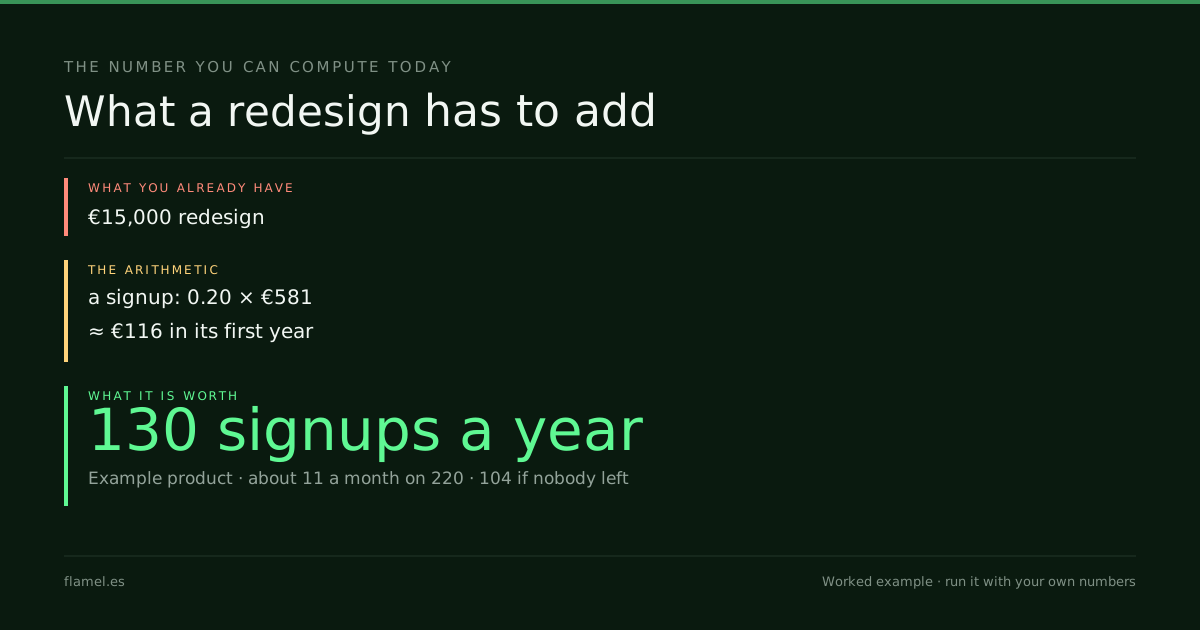
If nobody ever left, a signup would be worth 0.20 × €720 = €144 in its first year, and the redesign would need 104 extra signups. Customers do leave. With 4 of every 100 leaving each month, a paying customer bills €60 × (1 − 0.96¹²) ÷ 0.04 ≈ €581 in its first twelve months, so a signup is worth about €116. The redesign needs 130 extra signups a year: about 11 a month on top of 220.
Now spend the same €15,000 on the half after signup. It needs 15,000 ÷ 581 ≈ 26 extra paying customers a year. Out of 2,640 signups a year, that is about one more payer in every hundred signups, from 20 to 21.
Signups to repay a redesign: the number to take
Signups needed to repay a redesign = cost ÷ (paid rate × what a paying customer bills in its first twelve months).
On the example product: €15,000 ÷ (0.20 × €581) ≈ 130 signups a year, about 11 a month on 220. Run it with your own price, churn and paid rate. Then run the other half: cost ÷ first-year billing per customer ÷ yearly signups gives the extra payers per signup the same money would need. Whichever number looks easier to move on your product is where the brief should start.
Work through this with your own numbers
My SaaS product has [paying customers] customers at [monthly price] a month, gets [monthly visits] visits and [monthly signups] signups a month, turns [paid rate] of signups into paying customers and loses [monthly churn] of customers each month. An agency quoted [redesign cost] for a website redesign. Calculate what a paying customer bills in its first twelve months with my churn, how many extra signups a year the redesign must add to pay for itself, and how many more payers per hundred signups the same money would need if I spent it after signup instead. Tell me which half of my path the brief should cover first.FAQ
What does a SaaS website design agency do?
It designs, and usually builds, the marketing website of a software product: homepage, pricing page, landing pages and the entry to signup. Most briefs end at the signup button, so the work rarely covers what new users meet after they create an account.
How much does a SaaS website redesign cost?
It depends on scope, and this post uses €15,000 as a declared example. The more useful number is how many extra signups the redesign must add to pay for itself: on the example product, about 130 a year, or 11 a month on top of 220.
Should a SaaS company redesign its website or fix onboarding first?
Compare the two halves on your own numbers. On the example product, a €15,000 redesign needs about 130 extra signups a year, while the same money spent after signup needs about one more payer in every hundred signups.
When is a full website redesign worth it?
When the data shows incremental changes have stopped paying, or when the site's technology cannot support the changes the team needs. Otherwise Nielsen Norman Group advises incremental change, judged against a baseline.
What should a SaaS website design brief include?
Which half of the path it covers, the number the redesign will be judged by (paying customers, not only signups), a baseline measured before launch, and who reads the result and when.
Before you sign a redesign brief, The Activation Audit maps both halves of the path, from the first visit to the first result, and shows which one is losing more. Five business days, $500, and the map stays with you whether or not you hire anyone next.
Your store, five days.
$500. Zero commitment. Yours either way.