User onboarding audit: the five-day map
What a user onboarding audit should find, and what one point of week-two retention is worth: priced on a product with 220 signups a month.

A user onboarding audit is worth buying only if it pays back in users who stay past week two. The Activation Audit takes five business days and costs $500: someone opens an account cold, follows the product to its first value, asks AI assistants who they recommend in the category, and ranks where people stop. The map stays with the team whether or not it hires anyone.
Most product teams already own a checklist for this. What a checklist cannot say is which stop costs the most, or what fixing it is worth in monthly revenue. That needs the product's own data and a price on one point of week-two retention.
What follows is what an audit should find, what one point is worth on the example product this blog uses for SaaS, and how many months the audit takes to pay back.
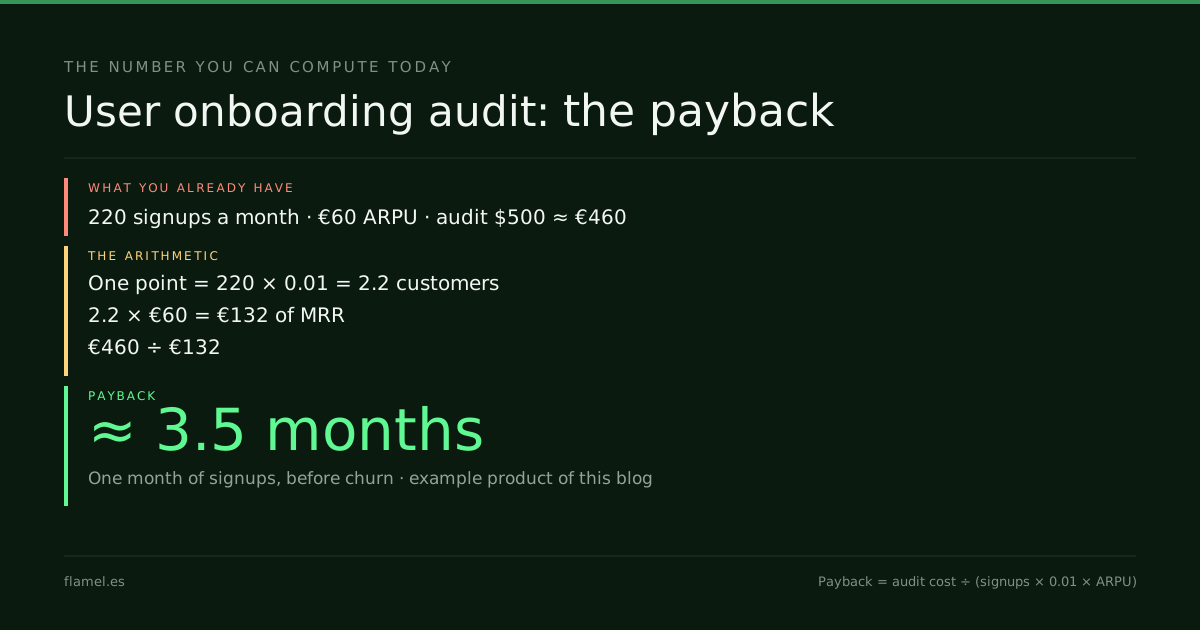
A user onboarding audit pays back when more signups stay past week two and pay. On a product with 220 signups a month at €60, one more paying customer per 100 signups adds €132 of MRR, so a $500 audit, about €460, pays back in about 3.5 months.
Key takeaways
- A user onboarding audit is worth buying only if it pays back in users who stay past week two and pay.
- It should read four stops, signup, first session, time to first value and week two, and rank them by cost.
- On a product with 220 signups a month at €60, one point of week-two retention adds €132 of MRR.
- A $500 audit, about €460, pays back in about 3.5 months on that product.
- Multiply your monthly signups by your ARPU, divide by 100, then divide $500 by the result.
What a user onboarding audit should find
Activation rarely breaks in one place. It breaks in four, quietly, and each one has a different owner:
- Signup. Everything the product asks for before the user has a reason to trust it.
- First session. Whether the product shows value, or shows an empty dashboard.
- Time to first value. How many steps sit between signing up and the thing the user came for.
- Week two. Whether the return is designed, or left to an email sequence.
Two of those stops already have their own post here. The post on user onboarding prices the first session. Time to value counts the days to the first outcome and shows where conversion collapses past a threshold. An audit joins them into one path. Its output is not a score per screen. It is a ranked list of where people stop, ordered by what each stop costs in activation and retention.
That ranking is the whole point. A team with 40 possible fixes does not need 40 findings. It needs to know which one to ship first, and what it is worth.
Why week two is the line
Most users who leave decide early. Mixpanel's 2024 Benchmarks Report, built on product usage data from over 7,700 of its customers, found that "in 2023, the average week one retention rate across industries fell from 50% to 28%." Read plainly: in a typical product, most people who sign up do not come back in their first week.
Week two is where a trial turns into a habit, or does not. A user who reaches it has found the first value and returned for more. A user who does not reach it will not answer a survey about why. That is why the audit's unit is the signup who stays past week two and pays, not the signup alone. On the example product below, marketing brings 44 new customers a month and the product loses 44. Every extra customer who stays past week two is one that marketing does not have to replace.

One point, priced on the example product
The example product this blog uses for SaaS is a subscription tool for small creative businesses: studios, academies, photographers. It has 1,100 paying customers at €60 a month, which is €66,000 of MRR. Each month 220 people sign up, and 20 of every 100 become paying customers, so 44 new customers arrive. Each month 4 of every 100 customers leave, so 44 go. The product is flat.
One point here means one more signup in every 100 who stays past week two and pays, from 20 in every 100 to 21:
One point       = 220 signups × 0.01 = 2.2 customers a month
MRR per point   = 2.2 × €60 = €132
Audit           = $500 ≈ €460
Payback         = €460 ÷ €132 ≈ 3.5 months
That counts a single month of signups and ignores churn. At 4 of every 100 customers lost a month, that one cohort takes closer to four months. If the fix holds for every month of signups after it, each month adds another 2.2 customers, and the audit is paid inside the third month.
That reading is what The Activation Audit is built to produce: where activation breaks, ranked by what each break costs, in five business days, for $500.
A user onboarding audit: template or paid
Free audit templates are easy to find, and most of them score screens against a checklist. They are useful for a designer. They cannot answer the buyer's question, because they never see the product's data.
A paid audit should have four ways in:
- A cold account. A real signup, no onboarding call and no hand-holding, as a new user meets the product.
- The product's data. Product analytics, the CRM and the lifecycle emails, with the team's access.
- A comparison against systems already built and measured.
- The AI assistants. Ask them about the category and see whether they recommend the product, and who they recommend instead.
A free audit cannot do the first two well, and nobody hands over analytics for a PDF they did not pay for. A UX audit makes the same case for websites: free tools find problems, but not which problem moves revenue.
What the buyer should receive is short. A 15 to 20 minute screen-recorded video of where activation breaks and what it costs. A one-page roadmap, red, amber and green by priority. A live review session to decide what happens next. And a living document kept updated for 30 days. The map stays with the team, hired or not.
What happens after the map
The map says what to fix. It does not prove the fix works. That takes real customers.
The next step is to set up the system the product is missing and run the first experiment on the stop at the top of the list. After that, the work runs one growth cycle per release. Each release ships with a question, one number read from the product's own data, and a written decision before the next release. On the example product, a release that moves one point is worth €132 of MRR in its first month, so every cycle has a number to beat before the next one starts.
This is also where product and marketing stop pulling apart. Marketing counts signups and product counts usage. The signup who stays past week two and pays is the one number both teams can own.
The number for your own product
One point       = signups a month × 0.01
MRR per point   = one point × monthly ARPU
Payback months  = audit cost ÷ MRR per point
On the example product, one point is 2.2 customers and €132 of MRR, so a $500 audit pays back in about 3.5 months.
What to do by Monday: take last month's signups, multiply by your monthly ARPU and divide by 100. Divide $500 by the result. If the answer is under 12 months, the audit pays back inside the year, before counting the cohorts that follow.
Work through this with your own numbers
I run a subscription product. Last month [SIGNUPS] people signed up, [PAYING SIGNUPS] of them stayed past week two and became paying customers, and my monthly ARPU is [ARPU]. My monthly churn is [CHURN] customers in every 100. Calculate what one point means for my product: one more signup in every 100 who stays past week two and pays. Then calculate the MRR that one point adds (signups × 0.01 × ARPU) and the payback in months of a $500 onboarding audit (about €460): audit cost ÷ MRR per point. Then rerun the payback twice: once with my churn applied to that single cohort, and once assuming the fix holds for every month of signups after it. Show every step of the arithmetic and tell me which stop of my onboarding I should look at first.FAQ
What is a user onboarding audit?
A review of the path a new user takes from signup to the first value and back in week two. The useful version opens an account cold, reads the product's own data and ranks where people stop by what each stop costs.
How long does a user onboarding audit take?
A focused one takes about five business days: enough to open an account cold, read product analytics, the CRM and the lifecycle emails, and turn the findings into a ranked roadmap.
What should a user onboarding audit include?
Four stops (signup, first session, time to first value and week two), a ranking of where people stop by what it costs, and deliverables the team keeps: a video walkthrough, a one-page roadmap and a review session.
How much is a user onboarding audit worth?
Payback in months = audit cost ÷ (signups a month × one point × ARPU). With 220 signups a month at €60, one more paying customer per 100 signups adds €132 of MRR, so a $500 audit pays back in about 3.5 months.
If you do not know where your users stop, The Activation Audit maps it from signup to week two. Five business days, $500, and the map stays with you whether or not you hire anyone next.
Your store, five days.
$500. Zero commitment. Yours either way.