AI search visibility: how to measure it without a tool
AI search visibility is how often an assistant names your product. How to count it by hand, who owns the answer, and what 3 in 20 is worth in ARR.

AI search visibility is how often an AI assistant names a product when a buyer asks it what to use. It matters because the buyer has moved: in G2's March 2026 survey of 1,076 software buyers and decision-makers, half (51 of every 100) start their research in an AI chatbot more often than on Google.
The answer the assistant gives draws on two kinds of pages. Marketing writes the site. Product writes the documentation and the pricing page. So being named is a question both teams answer together, and it can be measured before anyone pays for a tool: ask the assistants the questions buyers ask, and count who they name.
Below: what the count measures, what it showed in 552 real answers, what it is worth on a worked product, how to run it by hand and who owns the result.
AI search visibility is the share of buyer questions in which an AI assistant names a product: prompts that name it ÷ prompts tested. A product named in 3 of 20 prompts, getting 500 visits a month from those answers, adds 2 customers and €1,440 of ARR every month.
Key takeaways
- AI search visibility is a share: prompts that name the product ÷ prompts tested, counted on questions buyers really ask.
- Half of software buyers in G2's survey now start research in an AI chatbot more often than on Google (March 2026).
- In 552 answers about 101 stores, 40 of every 100 stores were never named: visibility splits into named often and never named.
- Marketing owns what the site says; product owns the docs and pricing page. Check robots.txt for OAI-SearchBot first.
- On the worked product, 3 of 20 prompts bring €1,440 of ARR a month; run your 20 prompts before buying a tool.
What AI search visibility actually counts
The count is simple:
AI share = prompts that name the product ÷ prompts testedA prompt is a question a buyer would really type: the category, the job, a competitor, a budget. The share is the fraction of those answers in which the product appears at all.
It is worth counting because the answer shapes the list. G2 reports that AI chatbots are now "the top source influencing buyer shortlists," and that 69 of every 100 buyers chose a different vendor than they first planned because the chatbot recommended it. A product missing from the answer may never reach the comparison.
AI search visibility in 552 real answers
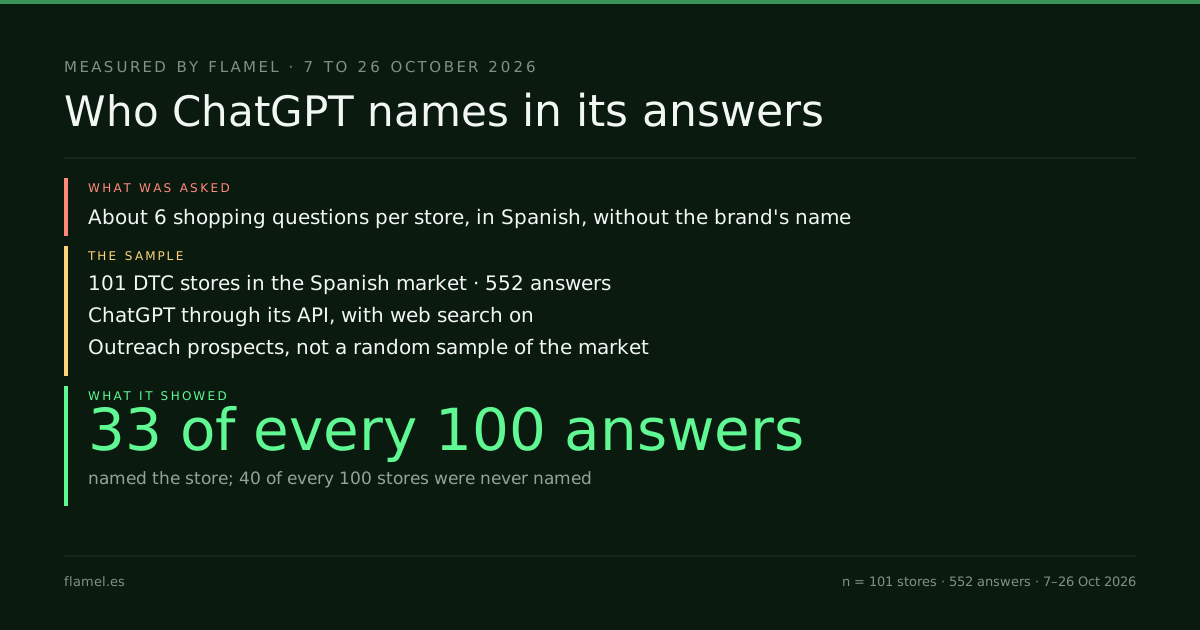
Flamel ran this count on 101 online stores in the Spanish market between 7 and 26 October 2026, through ChatGPT's API with web search on. Each store got about six shopping questions from its category, in Spanish, without the brand's name. 552 answers in all.
- ChatGPT named the store in 33 of every 100 answers to questions in its own category.
- 40 of every 100 stores did not appear in a single answer.
- 38 of every 100 were named in at least half of them.
- The sources it cited most were Spanish magazines and newspapers, each cited more often than any single store.
Two cautions. These are stores, not software. And they are not a random sample: they were prospects, and the questions were written to find gaps. Read them as one measured pattern, not as a market average. The pattern is the useful part: visibility splits into products that are named often and products that are never named, and what the assistant cites is mostly other people's pages.
The example product: 3 of 20
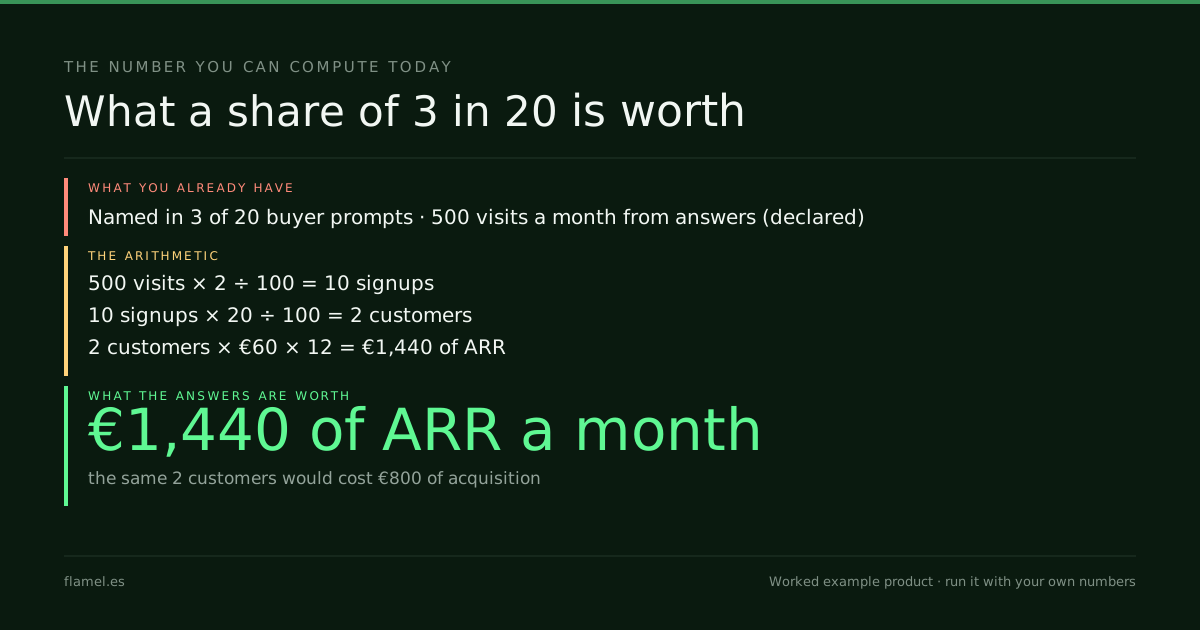
The worked product this blog uses: 1,100 paying customers at €60 a month, 2 of every 100 visitors signing up and 20 of every 100 signups paying. Acquisition costs €400 a customer. Declared for this example: it is named in 3 of 20 prompts, and those answers send 500 visits a month.
AI share       = 3 ÷ 20 = 15 of every 100 prompts
Signups        = 500 visits × 2 ÷ 100 = 10 a month
Customers      = 10 × 20 ÷ 100 = 2 a month
ARR added      = 2 × €60 × 12 = €1,440 every month
Same customers bought = 2 × €400 = €800 of acquisition a month
So a share of 3 in 20 is worth €1,440 of ARR every month, and €800 a month that paid acquisition would otherwise cost. The 17 prompts that name someone else are where the next customers go.
For scale, the same product loses 44 customers a month to churn. Two a month from answers cover 1 in 22 of them. Declared for the same example: if the share doubled to 6 of 20 and the visits doubled with it, the answers would bring 4 customers and €2,880 of ARR a month. That is the number to put next to the price of any tool, or of any work on the pages the assistant reads.
The Activation Audit runs the same count: it asks AI assistants about the category and shows whether they recommend the product, and who they recommend instead.
How to measure AI search visibility by hand
No tool is needed for the first reading. A spreadsheet and an afternoon are enough.
- Write 20 prompts in the buyer's words: five on the category, five on the job, five naming a competitor, five with a budget or a constraint.
- Run each one in the assistants buyers use, with web search on, in a fresh chat.
- Record three things per answer: whether the product is named, which products are named instead, and which pages are cited.
- Count the share, and repeat the same 20 prompts every month.
The third column matters most. The products named instead are the real competitive set. The cited pages show what the assistant reads.
Who owns the answer: both teams
Part of the answer is plain access. OpenAI's crawler page says that "Sites that are opted out of OAI-SearchBot will not be shown in ChatGPT search answers" (OpenAI). A robots.txt written years ago can hide the docs and the pricing page from the assistant. After a change, OpenAI notes it "can take ~24 hours" for its systems to adjust.
The rest is content, and here Google is direct: "There are no additional requirements to appear in AI Overviews or AI Mode, nor other special optimizations necessary" (Google Search Central). The assistant can only repeat what the pages say.
That splits the work. Marketing owns whether the site states who the product is for, in the words of a clear positioning statement. Product owns whether the docs and the pricing page answer the questions buyers ask. In a product-led growth motion those pages already do the selling.
There is a third owner, outside the company. In the store count, the assistant cited magazines and newspapers more often than any store's own site. For a software product, the cited-pages column shows which outside pages the assistant trusts in the category. Those pages need to describe the product correctly, and someone has to check that they do.
The AI search visibility number for your product
AI share  = prompts that name the product ÷ prompts tested
ARR added = visits from answers × signup rate × paid rate × monthly price × 12
On the worked product, 3 of 20 prompts bring €1,440 of ARR a month.
What to do by Monday: write the 20 prompts with someone from marketing and someone from product in the same room. Run them, count the share and list who is named instead. Then check robots.txt for OAI-SearchBot before anyone buys a tool.
The pages the assistant cites are also the pages buyers land on next. A UX audit reads those pages the way a buyer does.
Work through this with your own numbers
I sell [product] in the [category] category to [type of buyer]. Write 20 questions a buyer would type into an AI assistant when choosing a tool like mine: five about the category, five about the job to be done, five naming [main competitor], and five with a budget or constraint. After I run them, I will paste the answers. For each answer, record whether [product] is named, which products are named instead and which pages are cited. Then calculate AI share = prompts that name the product ÷ prompts tested. Finally, estimate ARR added = [monthly visits from AI answers] × [signup rate] × [paid rate] × [monthly price] × 12, and compare it with [CAC] × the customers it brings. Show every step of the arithmetic and list the three competitors named most often.FAQ
What is AI search visibility?
It is how often an AI assistant names a product when a buyer asks it what to use. It is counted as a share: prompts that name the product ÷ prompts tested. A product named in 3 of 20 buyer prompts has a share of 15 of every 100.
How do you measure AI search visibility?
Write 20 prompts in the buyer's words, run them in the assistants buyers use with web search on, and record whether the product is named, who is named instead and which pages are cited. Repeat the same prompts every month.
Do you need a tool to track AI search visibility?
Not for the first reading. A spreadsheet and 20 prompts give the share, the competitive set and the cited pages. A tool helps once the same prompts are tracked every month across many assistants.
How do you improve AI search visibility?
First, access: sites opted out of OpenAI's OAI-SearchBot are not shown in ChatGPT search answers. Then content: Google says there are no special optimizations for its AI features, so the pages have to answer the buyer's questions plainly.
The Activation Audit asks the assistants about your category: five business days, $500, and the map stays with you whether or not you hire anyone next.
Your store, five days.
$500. Zero commitment. Yours either way.
Made between
Barcelona and Bogotá.
What’s holding your store’s sales back, in minutes.
Free, no card. Shopify stores for now.