
Black Friday early access: who hears first
Black Friday early access is customer segmentation with a clock. What past buyers are worth on their own, against one campaign sent to the whole list.

Black Friday early access is customer segmentation with a clock. The customers who already bought hear first, before the offer opens to everyone. Most stores skip that step and send one campaign to the whole list at the same hour. The report then shows one conversion rate that describes nobody.
That blended rate costs twice. It hides what past buyers are worth, so nobody plans for them. And the offer gets designed for subscribers who rarely buy, then handed to customers who would have bought anyway, at the same depth of discount.
The sum below runs on the store this blog uses throughout, in the same Black Friday week as the posts on discounts and stock. It ends on the number to compute before the first email goes out.
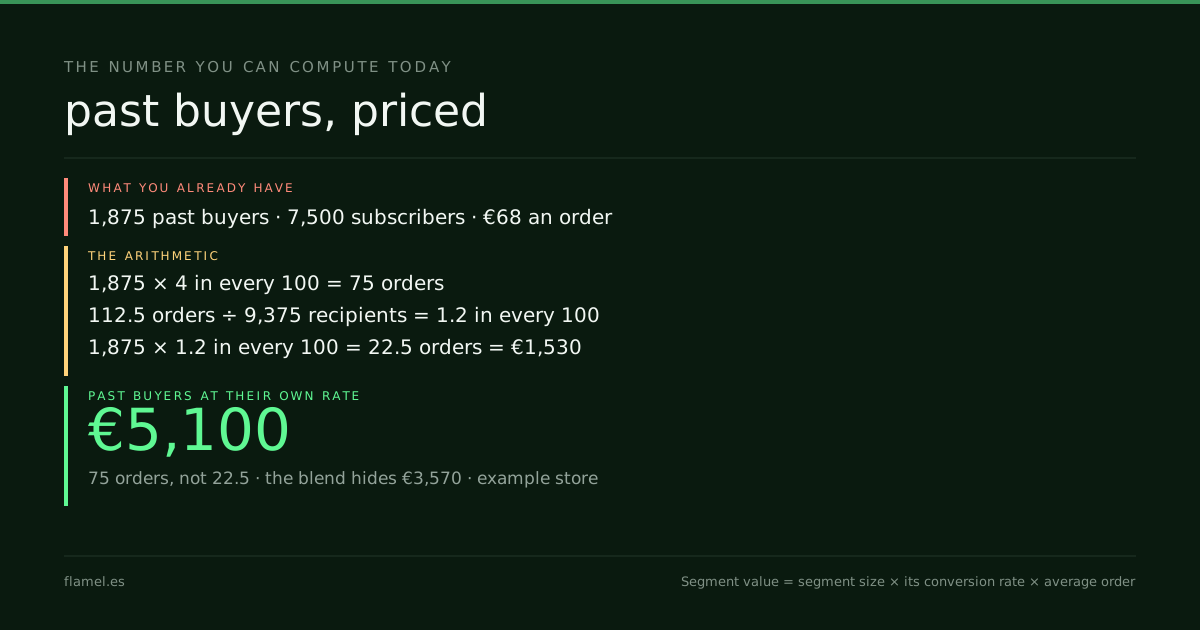
Black Friday early access gives past buyers their own window before the offer opens to everyone. On a list of 1,875 past buyers and 7,500 subscribers, past buyers bring 75 orders, €5,100, from one in five recipients. Priced at the list's blended 1.2 in every 100, they look worth €1,530.
Key takeaways
- Black Friday early access is customer segmentation with a clock: past buyers hear first, with their own window and their own number.
- One campaign to the whole list reports one blended conversion rate that describes neither past buyers nor subscribers.
- On the example store, one in five recipients brings two in three orders: 75 orders, €5,100, from 1,875 past buyers.
- Priced at the blended 1.2 in every 100, the same buyers look worth €1,530, less than a third of what they bring.
- Split last year's Black Friday orders into past buyers and subscribers, and price each segment at its own rate.
Why Black Friday early access is segmentation
Shopify's guide to ecommerce customer segmentation defines it in one line: it “divides people into smaller groups based on qualities they share.” Among its examples of what a segment changes is “showing early access options for VIP customers.” Early access is that idea with a date on it.
The quality that matters most in Black Friday week is simple: has this person bought before? A past buyer knows the product, the sizing and the delivery. A subscriber who never ordered signed up for a reason and has not acted on it yet. They are not the same audience. They do not answer an email at the same rate.
Polar Analytics puts the rule plainly. A segment is “a rule that any customer either matches or does not, evaluated against current data.” For early access the rule fits in one line: at least one order in the last twelve months. Everyone who matches hears first.
The worked example: two rates
Take the store this blog uses throughout: 300,000 sessions a year, converting 1 in every 100, at a €68 average order. That is 3,000 orders from 1,875 customers, the same base as the post on repeat purchase rate. Say all 1,875 are on the email list, next to 7,500 subscribers who have never ordered. The Black Friday week rates below are declared for the example, not a client's numbers.
Past buyers:   1,875 × 4 in every 100  = 75 orders    = €5,100
Subscribers:   7,500 × 1 in every 200  = 37.5 orders  = €2,550
Whole list:    9,375 recipients        = 112.5 orders = €7,650
One in five recipients brings two in three orders. The 75 orders are the same 75 that four points of repeat purchase rate are worth on this store: €5,100.
Now send the same campaign to everyone at once. The report shows one number:
Blended rate:  112.5 ÷ 9,375 = 1.2 in every 100
Past buyers at the blended rate:
               1,875 × 1.2 in every 100 = 22.5 orders = €1,530
Read through the blend, the past buyers look worth €1,530. They bring €5,100. The report is off by more than three times for the segment that matters most, and nothing in it says so.
Which segments a store already has in its data, and where its Black Friday traffic loses orders before any email matters, is what The Conversion Audit maps in five business days, for $500.

The customer segmentation ecommerce stores skip in November
Black Friday week is the busiest calendar of the year for a marketing team. One campaign, one discount code and one send time is the fastest way through it. The email platform reports one open rate and one conversion rate, and the week moves on.
The cost sits in the decisions taken on that blend. The discount depth gets set for a list that converts 1.2 in every 100. It has to be deep enough to move people who rarely buy. Then the same depth goes to the past buyers, who convert more than three times as often as the list.
Polar Analytics is blunt about the alternative: “Keeping your best customers out of a discount campaign protects margin more reliably than any offer you could send them.” Early access is the softer version. Past buyers are not left out. They get something else first: time.
Black Friday early access: time instead of depth
Early access gives past buyers first pick: the sizes, colors and best sellers before the offer opens to everyone. For a store that placed its buy inside a range, as in the post on Black Friday inventory planning, first pick matters. If stock runs short, who hears first decides who gets served.
It also opens a question worth testing: can a head start replace part of the discount? On the example store, a €68 order keeps €30.60 of margin at full price and €17.00 at 20 percent off, the figures behind the Black Friday discount strategy post.
Margin at 20 off:  €68 × 0.80 − €37.40 = €17.00
Margin at 10 off:  €68 × 0.90 − €37.40 = €23.80
Difference:        75 orders × €6.80   = €510
If early access at 10 off holds the past buyers' 75 orders, the store keeps €510 more margin in one week. That is a test, not a promise. Offer it to half the past buyers, keep the other half on the public offer, and compare orders per recipient.
Black Friday email marketing: the send order
Once the rule exists, Black Friday email marketing becomes a send order instead of one send:
- Repeat buyers first. Two or more orders. They hear a day or two before anyone else.
- One-time buyers next. One order in the last twelve months. Same early window, a different message: the reason to place a second order.
- Subscribers who never bought. The public launch, with an offer built for them.
- Everyone else. Paid media and the site banner, once stock and offer have been read on the first three.
Each segment gets its own line in the report: recipients, orders, orders per recipient and margin per order. The customer cohort analysis post reads customers by the launch that brought them in. The same split, kept after the peak, shows which Black Friday buyers came back.
The Black Friday early access number for your store
Segment value = segment size × its conversion rate × average order
Blend error   = segment value − segment size × list conversion rate × average order
On the example store: 1,875 × 4 in every 100 × €68 = €5,100, against €1,530 at the blended rate. The gap is €3,570 of orders that one number hides.
What to do by Monday: pull last year's Black Friday week. Split recipients into past buyers and subscribers who never ordered, and count orders for each. Divide orders by recipients in each segment. If the two rates differ by more than double, give past buyers their own window this year, and test whether a head start can replace part of the discount.
Work through this with your own numbers
You are planning Black Friday early access for an online store. Inputs: [past buyers on the email list, last 12 months], [subscribers who never ordered], [orders from each group in last year's Black Friday week], [average order value] and [gross margin per order at full price]. Calculate each group's conversion as orders ÷ recipients, and the list-wide blended rate. Price the past buyers at their own rate and at the blended rate, and show the gap in orders and revenue. Then calculate margin per order at the discount I plan and at a shallower one, and what the shallower discount would keep if past buyers' orders held. Propose a send order by segment. Do not assume the shallower discount holds: design a test on half the past buyers and say what result would justify it.FAQ
What is Black Friday early access?
Black Friday early access gives a segment of customers, usually past buyers, a window to shop the offer before it opens to everyone. The window runs a day or two ahead. Its value is first pick of stock and a separate read of how that segment converts.
Who should get Black Friday early access?
Customers who ordered in the last twelve months, starting with repeat buyers. They convert at a different rate from subscribers who never ordered. On the example store, 1,875 past buyers bring 75 orders, two in three of the list's Black Friday orders.
How do you segment an email list for Black Friday?
Start with one rule: has the person ordered in the last twelve months? Then split buyers into repeat and one-time, and keep subscribers who never ordered apart. Each segment gets its own send time, message and line in the report: recipients, orders and margin per order.
Should early access come with a bigger discount?
Not by default. A head start and first pick of stock may matter more to past buyers than extra depth. On a €68 order with a 45 percent margin, 10 percent off keeps €23.80 against €17.00 at 20 off. Test it on half the segment before relying on it.
Before the first Black Friday email goes out, know what each part of the list is worth. The Conversion Audit maps where the store loses orders and what to fix first: five business days, $500, and the map stays with you whether or not you hire anyone.
Your store, five days.
$500. Zero commitment. Yours either way.