
Black Friday discount strategy: orders a markdown needs
A Black Friday discount strategy starts with the orders a markdown needs to keep its margin. At 45 percent margin, 20 percent off needs 1.8 times.

A Black Friday discount strategy starts with one number: how many orders the markdown needs just to earn the same gross margin. The discount applies to every order in the promotion, including the ones that would have arrived at full price. At a 45 percent margin, 20 percent off needs 1.8 times the orders.
Most stores choose the depth the other way round. They look at what the market shows in late November and match it. That answers what shoppers expect to see. It does not answer what the store can afford to give.
The sum takes one line. It runs on the store this blog uses throughout: a €68 average order and a 45 percent gross margin. It ends on the number to compute before the promotion goes live, not after.
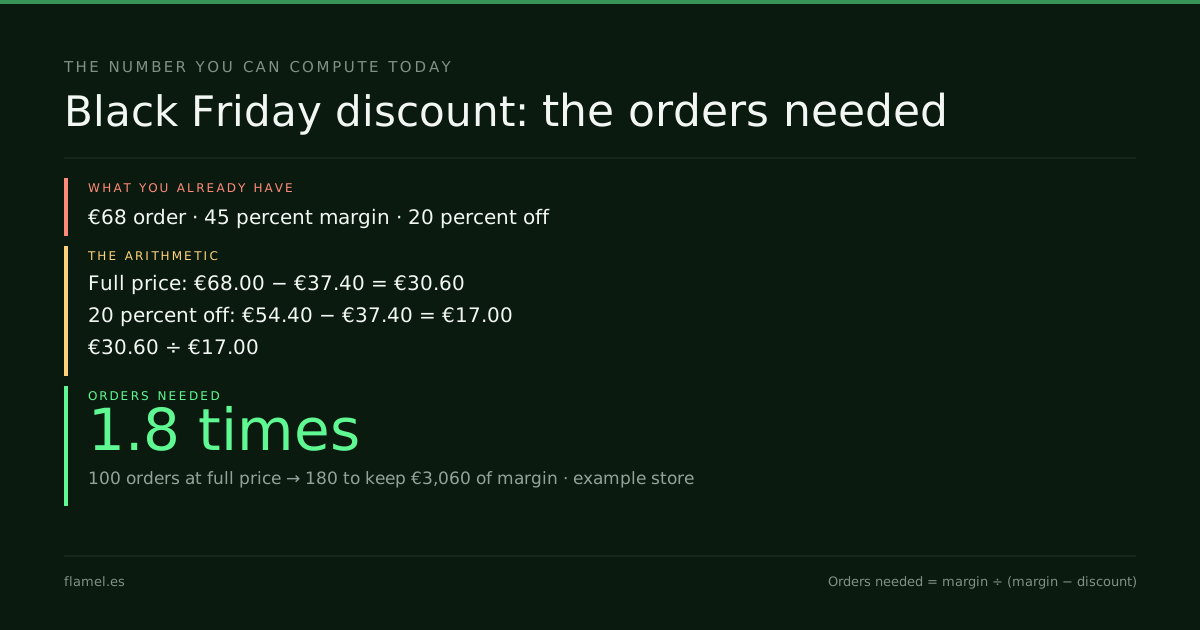
A Black Friday discount strategy should start from the orders a markdown needs to earn the same margin: margin ÷ (margin − discount). On a €68 order with a 45 percent margin, 20 percent off cuts the margin from €30.60 to €17.00, so the promotion needs 1.8 times the orders. At 30 percent off, it needs three times.
Key takeaways
- A discount cuts the margin on every order in the promotion, including the orders that would have come at full price.
- Orders needed to keep the same margin = margin ÷ (margin − discount), both as shares of the full price.
- On a €68 order at a 45 percent margin, 20 percent off needs 1.8 times the orders; 30 percent off needs three times.
- The curve is not linear: each extra point of discount costs more orders than the last.
- Multiply a normal week's orders by margin ÷ (margin − discount) for your planned depth, and ask whether that volume is realistic.
Why a Black Friday discount strategy starts with the margin
A discount is a price cut on every order in the window. The customer who was going to buy anyway pays less too. That is the part a promotion plan rarely prices.
The market sets loud expectations. Adobe's Cyber Monday 2025 release reports discounts peaking at 31 percent off listed price for electronics, 28 for toys and 25 for apparel. Those are the depths retailers offered. They say nothing about what each retailer kept at that depth.
A competitor's depth was set against its margin, not yours. A brand with a 70 percent margin can give 25 percent off and keep most of each order. A store at 45 percent gives away more than half of its margin at the same depth. So the first number of a discount strategy is the store's own: the margin per order before and after the markdown.
The same logic sets a free shipping threshold. What the store gives away is paid from margin, so margin decides how much it can give.
The formula: the orders a markdown needs to match
Write both numbers as shares of the full price: the gross margin and the discount. The orders a markdown needs to earn the same gross margin are:
Orders needed (multiple of full-price orders) = margin ÷ (margin − discount)The logic is short. At full price, each order keeps the margin. At a discount, the cost of the goods does not change, so each order keeps the margin minus the discount. The promotion has to sell enough of those thinner orders to add up to the same total.
Wayflyer's discount break-even calculator, built for Black Friday, runs the same sum. In its example, a margin of $60 a unit falls to $35 at 25 percent off. The store has to sell 1.71 times the units just to hold gross profit.
One thing the formula needs from you. Costs that do not shrink with the price, like shipping and packing per order, belong in the cost of each order. Take them out of the margin before you run the sum. A thinner margin makes every depth more expensive.

The worked example: 20 percent off
Take the store this blog uses throughout: a €68 average order, a 45 percent gross margin and 3,000 orders a year. It is a declared example, not a client's numbers.
Full price:       €68.00 − €37.40 cost = €30.60 margin per order
20 percent off:   €54.40 − €37.40 cost = €17.00 margin per order
Orders needed:    €30.60 ÷ €17.00 = 1.8 times
Say the store would take 100 orders in the promotion window at full price. At 20 percent off, it needs 180 orders to keep the same €3,060 of gross margin. Eighty of them have to be orders it would not have had otherwise.
Shallower or deeper, the curve bends fast:
| Discount | Margin left per order | Orders needed |
|---|---|---|
| 10 percent | €23.80 | 1.29 times |
| 15 percent | €20.40 | 1.5 times |
| 20 percent | €17.00 | 1.8 times |
| 25 percent | €13.60 | 2.25 times |
| 30 percent | €10.20 | 3 times |
| 40 percent | €3.40 | 9 times |
Going from 20 to 25 percent off costs 45 more orders per 100. Going from 25 to 30 costs 75 more. The apparel peak in Adobe's data, 25 percent off, asks this store for 2.25 times its orders. At 40 percent off, it keeps €3.40 an order and needs nine times the volume.
Which depth a store can carry depends on its real margin per product, not the blended one. That reading, and where the store already loses orders, is what The Conversion Audit maps in five business days, for $500.
The extra orders: who they are
The 80 extra orders in the example do not all pay for the discount. They come from two places.
- Borrowed orders. Customers who would have bought in December at full price buy now instead. The order was already the store's. The discount only moved its date and cut its margin.
- New orders. Customers who would not have bought at all, and returning customers who buy more than they would have. Only these pay for the markdown.
If much of the extra volume is borrowed from the weeks after, the real multiple is higher than the table says. A later post in this series separates the two with a baseline.
Depth is not the only lever. An offer that starts at a minimum basket, set above the current average order, asks for a bigger order in exchange for the discount. A flat cut on every item does not.
One case needs a different sum: stock that will not sell at full price. There, compare the discount with what that stock is worth if it stays on the shelf. The sell-through rate of the drop tells you how much of it there is.
A Black Friday discount strategy as an experiment
The logic of marketing experiments applies to a promotion: a date, one change, a number to read and a threshold set before the result.
For a Black Friday discount strategy, that is four lines written before launch:
- The orders the store expects in the window at full price, from the four weeks before.
- The depth, and the multiple it requires: margin ÷ (margin − discount).
- The order count that makes the promotion worth it, and the count that makes it a loss. On the example store at 20 percent off, anything under 180 orders for 100 expected loses margin.
- When to read it: after the window, and again a few weeks later, to see whether December paid for November.
If a depth's multiple is higher than any week the store has ever had, the depth is the wrong question. A shallower discount, an offer on one collection, or early access for past customers asks for fewer extra orders.
The number for your own store
Three inputs: your gross margin per order after shipping and packing, the depth you are considering, and the orders you expect in the window at full price.
Orders needed = expected full-price orders × margin ÷ (margin − discount)On the example store, 100 expected orders at a 45 percent margin and 20 percent off give 180. At 25 percent off, 225.
What to do by Monday: take your orders in a normal week from the four weeks before the promotion, your margin per order and the depth you plan. Run the sum for that depth and for one five points shallower. If the gap between the two is more orders than the store can reasonably win, start from the shallower one.
Work through this with your own numbers
You are reviewing a Black Friday promotion for an online store. Inputs: [average order value], [gross margin per order as a share of the price, after per-order shipping and packing], [discount depth under consideration] and [orders the store takes in a normal week, from the four weeks before the promotion]. Calculate the margin per order at full price and at the discount. Then calculate the multiple of orders needed to earn the same gross margin: margin ÷ (margin − discount). Multiply it by the normal-week orders to get the orders the promotion needs. Repeat for a depth five points shallower and five points deeper, and show the three in a table. Flag any depth that asks for more orders than the store has taken in its best week. Do not assume the extra orders are all new: list the data that would show how many were borrowed from the following weeks.FAQ
What is a good discount for Black Friday?
There is no universal good depth. The depth a store can afford depends on its margin. At a 45 percent gross margin, 20 percent off needs 1.8 times the orders to earn the same margin, and 30 percent off needs three times. Adobe's 2025 data shows apparel discounts peaking at 25 percent off listed price, which asks a store with that margin for 2.25 times its orders.
How do you calculate the break-even of a discount?
Divide the gross margin by the margin left after the discount, both as shares of the full price: margin ÷ (margin − discount). The result is the multiple of full-price orders the promotion needs to earn the same gross margin. On a €68 order with a 45 percent margin, 20 percent off leaves €17.00 of €30.60, so 1.8 times.
How many more orders do you need to cover a 20 percent discount?
It depends on the margin. At a 45 percent gross margin, 1.8 times the orders, or 80 more for every 100 the store would have taken at full price. At a 60 percent margin, 1.5 times. At a 30 percent margin, three times.
Should every store discount on Black Friday?
Not necessarily. If the multiple a depth requires is higher than any week the store has had, a shallower discount, an offer on one collection or early access for past customers asks for fewer extra orders. Stock that will not sell at full price follows a different sum: the discount against what that stock is worth if it stays unsold.
Before the promotion, know which products can carry the depth. The Conversion Audit maps where the store loses orders and what to fix first: five business days, $500, and the map stays with you whether or not you hire anyone.
Your store, five days.
$500. Zero commitment. Yours either way.