Bundle pricing: how to set it against the markdown
Bundle pricing from margin, not from the discount: the formula, a worked store against a Black Friday markdown, and product bundling examples.

Bundle pricing is selling two or more products together for one price, usually below what the pieces cost one by one. Set the price from margin: the bundle price minus the cost of its pieces. Compare it with the same pieces at full price and at the Black Friday markdown. On two €68 products, a bundle at 10 off keeps €47.60 of margin; a 20-off markdown keeps €34.00.
A bundle and a markdown both cut the price, but they pay for different things. The markdown cuts the margin on every order, including the orders that would have come at full price anyway. The bundle gives its discount only when the shopper takes the second product. The discount buys an extra unit, not an order the store already had.
Below: the formula, the worked store against the markdown, who the bundle has to reach to pay, product bundling examples, and two Shopify settings to check before the peak.
Bundle pricing sets one price for two or more products, below their separate prices. Price it from margin: bundle price minus the cost of the pieces. On two €68 products with 45 of every 100 euros as margin, a bundle at 10 off keeps €47.60 per order, against €34.00 at a 20-off markdown.
Key takeaways
- Bundle pricing starts from margin: the bundle price minus the cost of its pieces, compared with full price and with the markdown.
- On the worked store, a two-piece bundle at 10 off keeps €47.60 per order; a 20-off markdown keeps €34.00.
- The bundle needs 1.29 times the orders to match full-price margin; the markdown needs 1.8 times.
- A bundle pays when at least 44 of every 100 buyers came for a single product.
- This week: cost each planned bundle against the markdown and exclude bundles from sitewide codes.
What bundle pricing is, and isn't
Shopify's help center puts it plainly: "A bundle is a set of two or more related products, commonly offered at a discount" (Shopify Help). The discount is the part most stores set by feel.
A bundle is not a markdown with extra steps. A markdown is unconditional: everyone who buys gets it. A bundle is conditional: the shopper gets the lower price only by taking more. That condition protects the margin. On two €68 products, a 10-off bundle gives up €13.60, and only when the second product comes along. A 20-off markdown gives up the same €13.60 on every single product sold. The bundle only works if its price is set against the cost of its pieces.
The two offers also move different numbers. A markdown changes how many orders arrive. A bundle changes what each order carries, the store's average order value.
How to set bundle pricing from margin
Five steps, all with numbers the store already has. The worked store below runs them on two €68 products, each costing €37.40:
- Cost of the pieces. Unit cost of each product, from the catalog or the supplier invoice.
- Margin at full price. The pieces' full prices minus their cost. This is the line the bundle is measured against.
- Bundle margin. The bundle price minus the cost of the pieces.
- Markdown margin. The same pieces at the discount planned for Black Friday.
- Orders needed. The full-price margin divided by each offer's margin.
Bundle margin   = bundle price − cost of the pieces
Orders to match = margin at full price ÷ margin of the offer
The second line is the test the Black Friday discount strategy post runs on a single markdown. Here it runs on both offers side by side.
Bundle pricing vs the markdown, on a worked store
The worked store this blog uses sells a €68 average product, with 45 of every 100 euros as margin. Each product costs €37.40. Take two of them:
                   Price      Cost      Margin   Orders to match
Full price (2)     €136.00 − €74.80 =  €61.20      1.00
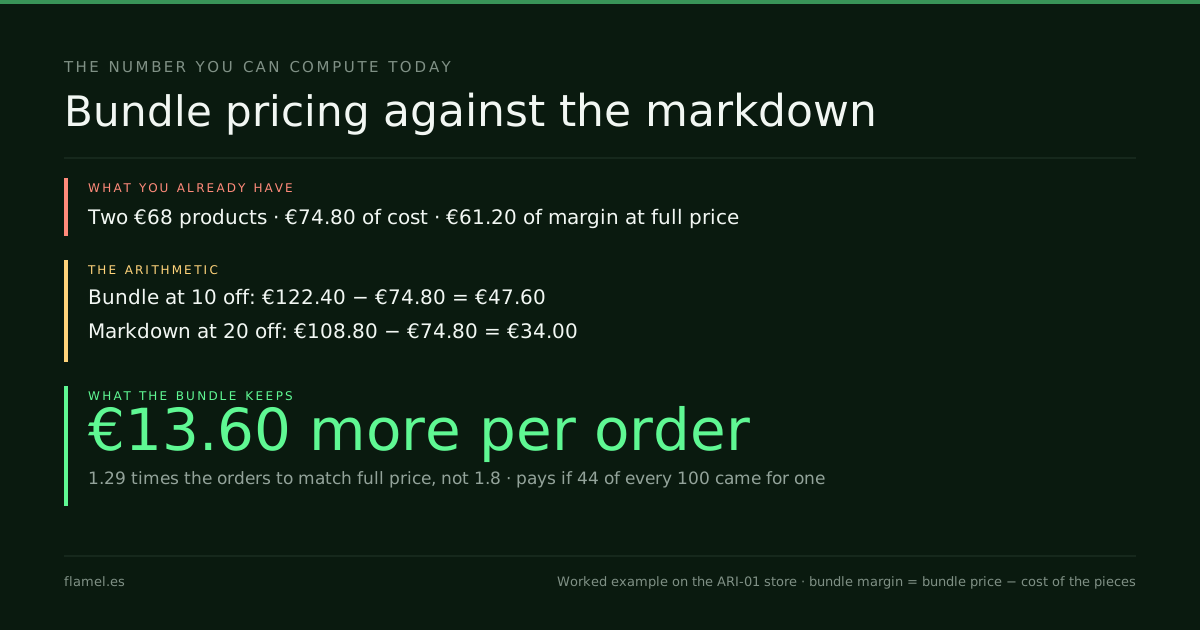
Bundle, 10 off     €122.40 − €74.80 =  €47.60      1.29
Markdown, 20 off   €108.80 − €74.80 =  €34.00      1.80

61.20 ÷ 47.60 ≈ 1.29     61.20 ÷ 34.00 = 1.80
The bundle keeps €13.60 more per order than the markdown. That is 40 more for every 100 euros the markdown leaves. To earn the full-price margin, the bundle needs 1.29 times the orders. The 20-off markdown needs 1.8 times: 80 extra orders for every 100 it would have sold anyway.

Who the bundle has to reach
The table compares two-piece orders with two-piece orders. Real shoppers differ. Some wanted one product and now take the bundle. Others wanted two anyway and now pay less.
- A shopper who came for one product earned €30.60 at full price. In the bundle: €47.60, so €17.00 more.
- A shopper who came for two earned €61.20. In the bundle: €47.60, so €13.60 given away.
The bundle pays when:
  share who came for one × €17.00  ≥  share who came for two × €13.60

Break-even share = 13.60 ÷ (17.00 + 13.60) = 13.60 ÷ 30.60 ≈ 44 of every 100
If at least 44 of every 100 bundle buyers came for a single product, the bundle earns more than it gives away. A markdown has no such filter. It pays everyone, on every order.
This is why the pairing matters more than the depth. A bundle of the two best sellers mostly discounts orders that were coming anyway. A bundle that pairs a best seller with a product people rarely add on their own clears the line.
Product bundling examples by format
Shopify's own app builds "fixed product bundles and multipacks right from your Shopify admin" (Shopify Help). Four formats cover most stores:
- Fixed bundle. Two or three complementary products at one price: a cleanser with its moisturizer, a pan with its lid. Best when one product sells well and its partner does not.
- Multipack. Several units of the same product: three pairs of socks, a case of six. Best for consumables people reorder.
- Size ladder. The same offer in several sizes, with the price per unit falling as the size grows. Redi Foods, a Shopify store Flamel works with (130,465 sessions in 22 months), sells its frozen lunches in kits of 5, 7 and 14. Its kit page shows, next to each size, what the shopper saves against the same lunches bought one by one: COP 46,000 on the five-lunch kit, COP 67,000 on seven and COP 137,000 on fourteen (Redi Foods). The price per lunch falls from COP 19,800 to COP 19,214.
- Mix and match. Any set number of products from a range, at one price. Flexible for the shopper, harder to cost. Set the price against the combination with the highest cost.
A bundle priced just above the free shipping threshold gives the shopper two reasons to take it. The threshold and the bundle should be set with the same margin sum.
Two Shopify settings to check before the peak
Shopify's bundles app has two behaviors that matter in November (Shopify Help).
The bundle price does not follow the markdown. Shopify says: "When the price of one of the bundled products updates, either manually or from price imports, the bundle price doesn't update." Mark both products 20 off for Black Friday and the 10-off bundle now costs €122.40, against €108.80 for the same two pieces bought separately. Nobody takes it, and every two-piece order lands at the markdown's €34.00.
Discount codes reach the bundle. Shopify notes that "When a discount is applied to a bundle, the discount calculates on the parent bundle product first." A sitewide 20-off code that also applies to the bundle stacks on its 10 off:
€122.40 × 0.80 = €97.92
€97.92 − €74.80 = €23.12 of margin
That is less than the markdown alone. Exclude bundles from sitewide codes, or make the bundle the Black Friday offer itself.
The bundle pricing number for your store
Bundle margin    = bundle price − cost of the pieces
Orders to match  = margin at full price ÷ bundle margin
Break-even share = margin given away ÷ (margin added + margin given away)
On the worked store, a two-piece bundle at 10 off keeps €47.60 per order against €34.00 at the 20-off markdown: €13.60 more. It needs 1.29 times the orders to match full-price margin, against 1.8 for the markdown.
What to do by Monday: write down the cost of the pieces in each bundle planned for Black Friday. Compute each bundle's margin against the planned markdown, and exclude the bundles from sitewide codes.
Work through this with your own numbers
Here are my store's numbers: product A sells at [price A] and costs [cost A]; product B sells at [price B] and costs [cost B]. I plan a bundle of A and B at [bundle price], and a Black Friday markdown of [discount depth] on both. Calculate: the margin of A and B together at full price; the bundle margin (bundle price minus the cost of both pieces); the margin of A and B together at the markdown; and, for the bundle and for the markdown, how many times the orders each needs to match the full-price margin (full-price margin divided by the offer's margin). Then, for shoppers who came only for product A, calculate the margin the bundle adds and, for shoppers who wanted both anyway, the margin it gives away, and the break-even share: margin given away divided by (margin added plus margin given away). Finally, recalculate the bundle margin with a [sitewide code depth] sitewide code applied on top. Show every step of the arithmetic.FAQ
What is bundle pricing?
Selling two or more products together for one price, usually below the sum of their separate prices. The lower price applies only when the shopper takes the whole bundle. A markdown, by contrast, applies to every order.
How do you calculate a bundle price?
Start from the cost of the pieces. Bundle margin is the bundle price minus that cost. Divide the margin of the same pieces at full price by the bundle margin: that is how many times the orders the bundle needs to earn the same.
Is a bundle better than a discount?
On margin per order, usually. Two €68 products in a bundle at 10 off keep €47.60, against €34.00 at 20 off. The bundle pays when at least 44 of every 100 buyers came for one product.
How big should a bundle discount be?
As small as still moves the shopper to the second product. At 10 off, the worked bundle needs 1.29 times the orders to match full-price margin. At 20 off, it needs 1.8 times, the same as the markdown.
Before the peak, the Conversion Audit maps where a store's orders and margin leave: five business days, $500, and the map stays with the store.
Your store, five days.
$500. Zero commitment. Yours either way.
Made between
Barcelona and Bogotá.
What’s holding your store’s sales back, in minutes.
Free, no card. Shopify stores for now.