ChatGPT shopping: how to get your store recommended
ChatGPT shopping recommends products from feeds, store pages and other sites. Four checks to get a store recommended, and what a missing mention costs.
ChatGPT shopping is the part of ChatGPT that answers "what should I buy" with products, prices and the stores that sell them. It picks from what it can read: the store's product feed, its pages and what other sites say about it. A store gets recommended when those three are complete and agree. The purchase then happens on the store's own site.
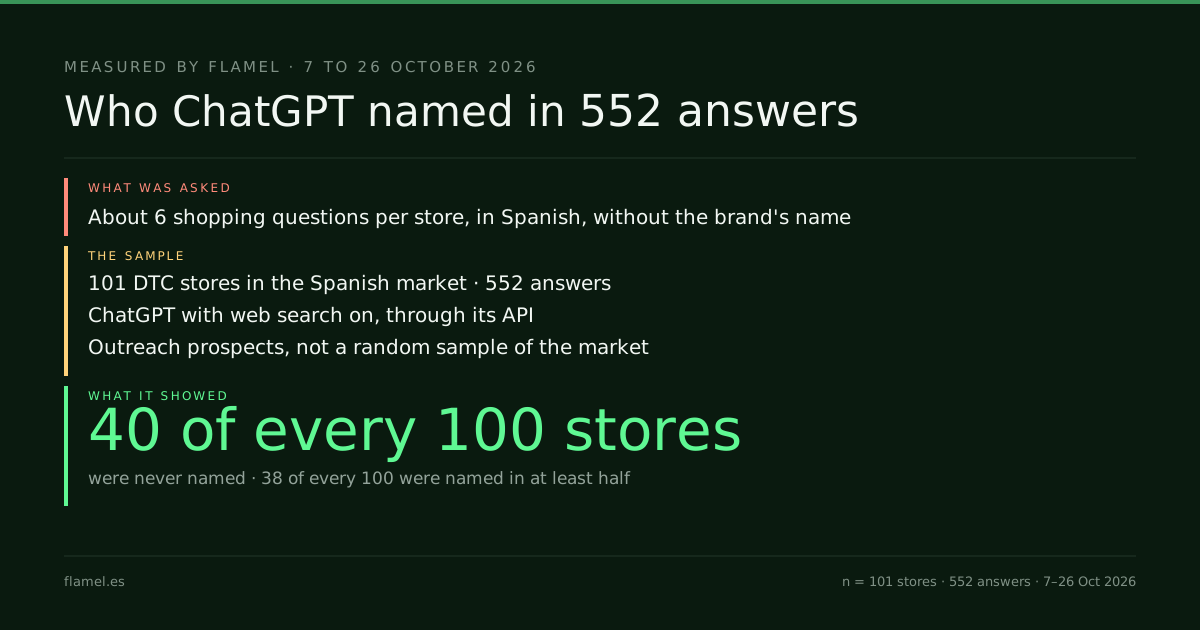
The feature is live for ChatGPT users in the U.S. Outside it, ChatGPT already answers shopping questions with web search, and it names some stores and leaves others out. In October, Flamel's outreach asked it about six shopping questions for each of 101 direct-to-consumer stores in the Spanish market. 40 of every 100 stores were not named in a single answer.
Below: what ChatGPT shopping reads, the four checks that get a store recommended, who was named in 552 answers, and what a missing mention costs on a worked store.
ChatGPT shopping recommends products from what it can read: product feeds, store pages and what other sites say. A store gets recommended when its feed is complete, its pages are open to OpenAI's search crawler and other sites name it. On a 50,000-session month, 2 sessions in 100 from assistants are 10 orders and €680.
Key takeaways
- ChatGPT shopping is live in the U.S. and recommends products from feeds, store pages and other sites. The purchase happens on the store's own site.
- OpenAI says Shopify and Etsy catalogs are already integrated. What decides the recommendation is what the catalog says: titles, descriptions, price, stock and reviews.
- In 552 ChatGPT answers about 101 stores, 40 of every 100 stores were never named, and magazines and newspapers were cited more than any store.
- On a 50,000-session month, 2 sessions in 100 from assistants at 1 order per 100 are 10 orders and €680 that go to whichever store is named.
- This week: ask ChatGPT three shopping questions from your category without your brand name, and count how often your store appears.
What ChatGPT shopping actually is
When a shopper asks ChatGPT what to buy, it can answer with products from merchants' catalogs and the stores that sell them. OpenAI's page for merchants says "Shopping is currently live for ChatGPT users in the U.S." and that OpenAI plans "to expand to more merchants and regions over time" (OpenAI).
The purchase does not happen inside ChatGPT. OpenAI says it is "moving away from a standalone Instant Checkout experience in ChatGPT", and that "purchases are completed on merchant-owned websites or apps" (OpenAI). The assistant decides which store gets the visit. The store's own checkout still has to close the order.
Those visits are still few, and they grow fast. Adobe measured traffic to U.S. retail sites from generative AI tools, counted as "shoppers clicking on a link to a retail site". In the 2025 holiday season it "increased by 693.4%" on the year before, and Adobe added that "the base of users remains modest" (Adobe).
What ChatGPT shopping reads to pick products
It reads three things. The store writes two of them.
The product feed. OpenAI asks merchants to "provide detailed information like images, pricing, and reviews" and to "sync pricing, availability, and updates" with their own systems (OpenAI). Its feed specification lists nine required fields: item ID, title, description, URL, brand, seller name, image, availability and price. Review count and star rating are optional (OpenAI feed specification). The same page warns: "Eligibility does not guarantee display."
For most direct-to-consumer stores the feed already exists. OpenAI's merchant page says: "If you sell through Shopify or Etsy, your catalog is already integrated, and no additional setup or application is required." So the question is not whether the catalog is connected. It is what the catalog says: a title that names the product the way a shopper asks for it, a description that answers the shopper's question, and stock that matches the site.
The store's pages. ChatGPT's search reads the web through its own crawler. OpenAI says OAI-SearchBot "is used to surface websites in search results in ChatGPT's search features", and that sites opted out of it "will not be shown in ChatGPT search answers" (OpenAI). One old robots.txt rule against bots can be enough to keep a store out.
What other sites say. This part the store does not write. In the October answers, the sources ChatGPT cited most were Spanish magazines and newspapers: vogue.es, elpais.com and hola.com. Each was cited more often than any single store.
Who ChatGPT names: 552 real answers
The October test ran on 101 direct-to-consumer stores in the Spanish market, from 7 to 26 October 2026. ChatGPT, with web search on, got about six shopping questions per store, in Spanish and without the brand name. That made 552 answers.
- A store was named in 33 of every 100 answers to questions in its own category.
- 40 of every 100 stores were not named in any answer.
- 38 of every 100 stores were named in at least half of them.
The middle is thin. Only 22 of every 100 stores sat in between: named sometimes, but in fewer than half the answers. Most stores are either part of the answer or absent from it.
The sample is not random. These are stores Flamel's outreach chose, and the questions were written to find gaps. It is a reading of 101 stores, not a market average. A store's own count takes an afternoon by hand: AI search visibility walks through it.
Preparing for ChatGPT shopping: four checks
None of the four is a new channel to buy. Each one is a question for whoever owns the catalog, the site or the brand.
- Is the feed complete? Every product carries its nine required fields, and the price and stock in the feed match the product page. A discount that ends on the site but not in the feed shows the shopper the wrong price.
- Can the crawler read the store? The robots.txt file does not shut out OAI-SearchBot. If it does, the store's pages cannot be shown in ChatGPT's search answers, however good they are.
- Does the product page answer the question? A shopper asks for "running shoes for flat feet", not for a product code. A page that says who the product is for, in plain words, gives an assistant something to quote. Product page optimization covers the questions that stop a purchase on the page. A shopper can now put the same questions to an assistant first.
- Does anyone else name the store? Press, reviews and lists. In the October answers, magazines and newspapers were cited more often than any store. A store that nobody else writes about has only its own pages to make its case.
The store controls the first three. Only the last one depends on other people, which makes it the slowest to change.
What a missing mention costs, worked out
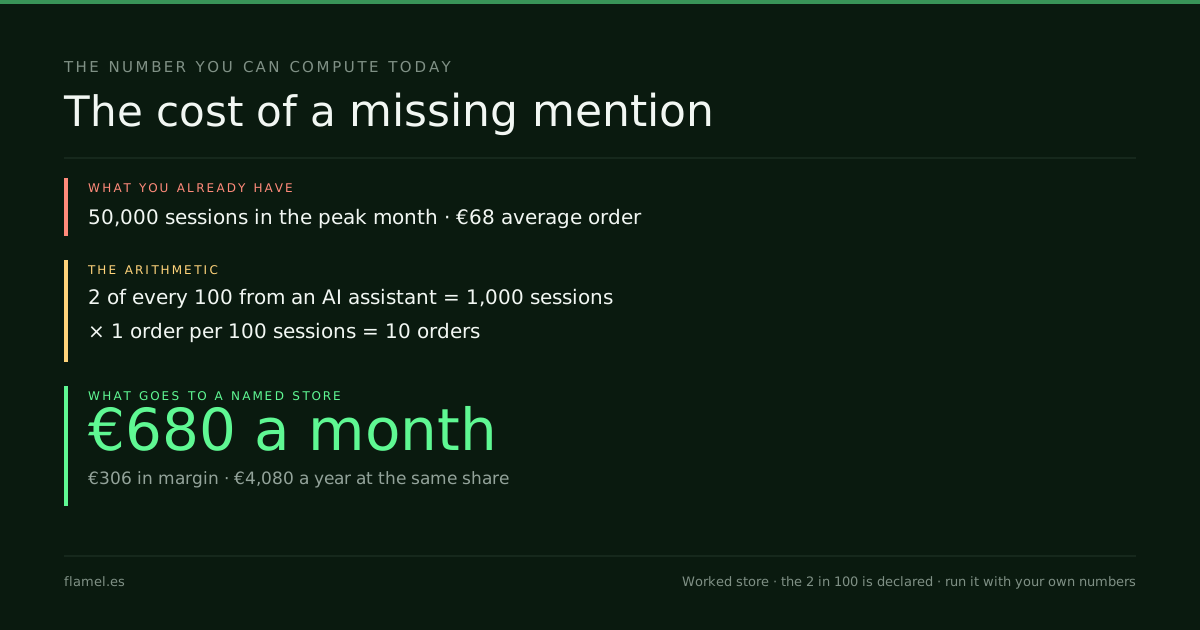
Take the worked store this blog uses: 300,000 sessions a year, a €68 average order, 1 order for every 100 sessions and 45 of every 100 euros as margin. Its peak month brings 50,000 sessions. Say, as a declared example, that 2 of every 100 of those sessions arrive from an AI assistant.
Sessions from assistants = 50,000 × 2 ÷ 100 = 1,000
Orders                   = 1,000 × 1 ÷ 100  = 10
Revenue                  = 10 × €68         = €680
Margin                   = €680 × 0.45      = €306
The 2 in 100 is declared, not measured: Adobe reports the growth, not the share. The point is where those 10 orders go. They go to a store that was named. A store that is never named, like 40 of every 100 in the October test, does not get to compete for them.
Over a year at the same share, the count is 300,000 × 2 ÷ 100 = 6,000 sessions, 60 orders, €4,080 of revenue and €1,836 of margin.
Once those shoppers arrive, converting them is the same job as for any other visit. Ecommerce conversion rate optimization maps where that revenue leaves after the click.
The ChatGPT shopping number for your store
Orders from assistants = monthly sessions × share from assistants × orders per session
Revenue at stake       = orders from assistants × average order
Margin at stake        = revenue at stake × margin
The share comes from the store's analytics: sessions referred by AI assistants, divided by all sessions. A share close to zero can mean the store is not being named. That is the first thing to check.
What to do by Monday: ask ChatGPT three questions a customer would ask in your category, without your brand name, and count how often your store appears. Then check robots.txt for OAI-SearchBot, and read five product titles in the catalog the way a shopper would.
Work through this with your own numbers
My online store gets [monthly sessions] sessions a month, [orders per 100 sessions] orders for every 100 sessions, an average order of [average order] and [margin per 100 euros] euros of margin for every 100 euros of revenue. [share from assistants] of every 100 sessions arrive from AI assistants. Calculate: sessions from assistants = monthly sessions × share ÷ 100; orders = those sessions × orders per 100 sessions ÷ 100; revenue = orders × average order; margin = revenue × margin ÷ 100. Then repeat the calculation for a full year. Then write five shopping questions that a customer in my category, [category], would ask an AI assistant without naming any brand, so I can ask them myself and count how often my store, [store name], is named. Show every step of the arithmetic.FAQ
Can I sell my products through ChatGPT?
In the U.S., products can appear in ChatGPT's shopping results, and the purchase is completed on the store's own site or app. OpenAI says Shopify and Etsy catalogs are already integrated. Other merchants apply to share a product feed.
Is ChatGPT shopping available outside the U.S.?
Not yet. OpenAI says shopping is currently live for ChatGPT users in the U.S. and plans to expand to more regions. Outside the U.S., ChatGPT still answers shopping questions with web search and names stores in those answers.
How does ChatGPT shopping choose products?
It reads the product feeds merchants share, the store's pages through OpenAI's search crawler, and what other sites say. The feed has nine required fields, from title and description to price and availability, and eligibility does not guarantee display.
Do I need a tool to see if ChatGPT recommends my store?
No. Ask the shopping questions a customer would ask in the category, without the brand name, and count the answers that name the store. In 552 answers about 101 stores, 40 of every 100 stores were never named.
See how the Conversion Audit checks whether AI assistants name your store: five business days, $500, and the map stays with the store.
Your store, five days.
$500. Zero commitment. Yours either way.
Made between
Barcelona and Bogotá.
What’s holding your store’s sales back, in minutes.
Free, no card. Shopify stores for now.