
Ecommerce growth agency: what the fee should weigh
What an ecommerce growth agency fee should weigh against online revenue: the ceiling from Gartner's 2025 survey, priced on a €204,000 store.

An ecommerce growth agency is worth its fee only while two things hold: the fee stays a small share of what the store sells online, and it pays for work measured over months, not for a monthly report. The Redi Foods case is read that way. The store moved off WooCommerce to Shopify, its weekly kit order went from fifteen stacked dropdowns to a three-step builder, and the result is measured on 130,465 sessions across 22 months.
The share is where most founders guess. A quote means nothing until it sits next to annual online revenue, and the market's own survey numbers say how much of that revenue the people side of marketing usually takes.
This post gives that ceiling, prices it on a worked store, and says when the right purchase is a diagnosis instead of a retainer.
An ecommerce growth agency fee should weigh no more than about €3.30 of every €100 the store sells online: the share a typical company spends on all its marketing people, staff and agencies together, in Gartner's 2025 survey. On a €204,000 store, that is about €560 a month. Above it, buy a diagnosis first.
Key takeaways
- Weigh an ecommerce growth agency fee as monthly fee × 12 ÷ annual online revenue, never as a monthly number on its own.
- Gartner's 2025 survey puts marketing at 7.7% of revenue, with labor and agencies taking 42.6% of that budget.
- That puts the ceiling near €3.30 of every €100 of revenue; agencies alone take about half of it.
- On a €204,000 store the ceiling is about €560 a month, and a €2,000 quote needs about €732,000 of revenue.
- Run the quote on your desk through the formula; above the line, buy a diagnosis of where the store loses orders.
Before the arithmetic: The Conversion Audit maps where a store loses orders in five business days, for $500, before any monthly fee is on the table.
What an ecommerce growth agency fee should buy
Most quotes for growth work are priced by the month. They buy a team, a calendar of tasks and a report. What a store needs is narrower. It needs someone to run one cycle at a time on the brand's own calendar, a launch, a season or a new product page, and to close each cycle with a written answer about its own customers.
That is why test velocity is the wrong thing to pay for. A store with a few hundred thousand sessions a year cannot finish many split tests. A conversion rate optimization agency's retainer keeps billing the months while the test barely moves. A growth fee is justified by one answer per cycle, not by tests launched.
The second thing a fee should buy is something that stays. The map, the record of each cycle and the measurement belong to the store, whether or not the agency stays for the next one.
A quick way to read a quote: find the line that says what happens at the end of a month. If it lists tasks delivered, the fee buys hours. If it names a question, a baseline and a decision, the fee buys a cycle. Only the second gets easier to judge as the months go by, because each record says whether the last cycle earned its share.
The ceiling, from a marketing budget
How much should that weigh? Gartner's 2025 CMO Spend Survey of 402 marketing leaders, as Chief Marketer reported it, puts marketing budgets at an average of 7.7% of total revenue. The same survey splits that budget. Labor takes about 22 of every 100 marketing dollars and agencies 20.7%, so the two together take 42.6%.
Read those two lines as the people side of marketing: everyone paid to think and do the work, inside the company and outside it. An outside growth team is a people cost, so its fee belongs inside that share. The comfortable zone is about half of it, roughly what agencies alone take.
Fee weight  = monthly fee × 12 ÷ annual online revenue
Ceiling     = 0.077 × 0.426 ≈ 0.0328  (about €3.30 of every €100)
Comfortable = 0.077 × 0.207 ≈ 0.0159  (about €1.60 of every €100)
A store that already pays for marketing staff or another agency has less room under the same line, not more. The line itself moves with the store: the formula is the same on any revenue, so the room grows as online revenue does.

The fee on a €204,000 store
The worked store this blog uses, as an example: 300,000 sessions a year, a €68 average order and 1 order for every 100 sessions. That makes 3,000 orders and €204,000 of online revenue a year.
Ceiling     = €204,000 × 0.0328 ≈ €6,690 a year, about €560 a month
Comfortable = €204,000 × 0.0159 ≈ €3,240 a year, about €270 a month
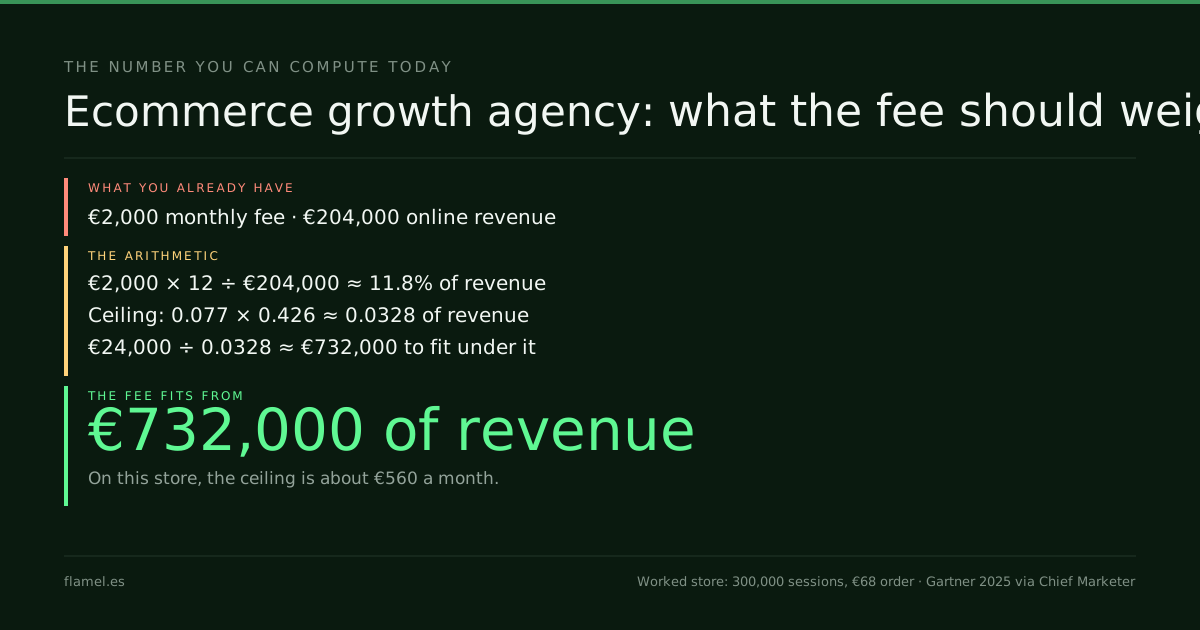
Now take a fee of €2,000 a month, as an example. That is €24,000 a year, 11.8% of this store, and more than three and a half times the ceiling. Solved for revenue, the same formula says where that quote starts to fit:
Revenue line = monthly fee × 12 ÷ 0.0328
€2,000 × 12 ÷ 0.0328 ≈ €732,000 of online revenue a year
For the comfortable zone, the same quote needs about €1.5M. In-house marketing vs agency ran this store against a growth hire, at about €58,200 a year. On €204,000 of revenue, both are fixed costs the store cannot carry yet.
What does fit is a one-off reading. A diagnosis at $500, about €460, costs less than one month of this store's ceiling, and it says where the first fee, when it comes, should be spent.
When not to hire an outside team
Three signs say the fee should wait, whatever the quote:
- The store is below the revenue line. The fee would take money the store needs for stock, ads and the next launch.
- Nobody inside can decide. A growth cycle needs one owner on the brand's side who approves the bet and reads the result.
- Nobody knows where the orders leave. Ecommerce conversion rate optimization shows the four places revenue leaves a store, and none of them is fixed by a retainer that starts guessing.
In all three cases, the right purchase is a diagnosis: a fixed price, a few days and a map. A UX audit shows what that reading covers and how to price what it finds.
The ecommerce growth agency test: five questions
Ask these of any quote before signing:
- What does the fee weigh? Monthly fee × 12 ÷ last year's online revenue, set against 0.0328.
- What closes a cycle? A number read from the store's own admin and a paragraph that says what changes.
- Who decides what comes next? The record of the last cycle, not the agency's calendar.
- How many tests can the traffic finish? If the answer is a few a year, the fee is paying for something else.
- What stays if the contract ends? The map, the record and the measurement should belong to the store.
The number for your own store
Fee weight   = monthly fee × 12 ÷ annual online revenue
Revenue line = monthly fee × 12 ÷ 0.0328
On the worked store, the ceiling is about €560 a month, and a €2,000 quote needs about €732,000 of online revenue to fit under it.
What to do by Monday: take the quote on your desk, multiply the monthly fee by 12 and divide by last year's online revenue. Above 0.0328, the store is not ready for that fee. Find where it loses orders first.
Work worth a fee is read over months on real sessions. Redi Foods is measured on 130,465 of them, across 22 months.
Work through this with your own numbers
I run an online store that sold [annual online revenue] last year. An ecommerce growth agency has quoted [monthly fee] a month. Calculate the fee's weight as monthly fee × 12 ÷ annual online revenue. Compare it with a ceiling of 0.0328 (marketing at 7.7% of revenue × labor and agencies at 42.6% of that budget, from Gartner's 2025 CMO Spend Survey) and with a comfortable line of 0.0159 (agencies alone, 20.7% of the budget). Then solve for the online revenue my store would need for this fee to fit under each line: monthly fee × 12 ÷ 0.0328, and ÷ 0.0159. Tell me whether my store is ready for this fee or should first find where it loses orders, and show every step of the arithmetic.FAQ
What does an ecommerce growth agency do?
It runs growth work for an online store from outside the team: it decides what to test, builds what the test needs and reads the result. The useful version works one cycle at a time on the brand's calendar and closes each cycle with a written answer the store keeps.
How much does an ecommerce growth agency cost?
Quotes are usually monthly, so the useful number is what the fee weighs: monthly fee × 12 ÷ annual online revenue. Against Gartner's 2025 survey, the ceiling is about €3.30 of every €100 of revenue. A €2,000 monthly fee needs about €732,000 of online revenue to fit under it.
When is an ecommerce growth agency worth it?
When the fee fits under the ceiling for the store's revenue, someone inside can approve each cycle, and the store already knows where it loses orders. If any of the three is missing, a fixed-price diagnosis comes before any monthly fee.
What is the difference between a growth agency and a marketing agency?
A marketing agency is usually measured by output: campaigns, assets and impressions. A growth agency should be measured by answers: what each cycle proved about the store's customers, read from its own admin. The fee weighs the same either way, so run both through the same formula.
The Conversion Audit maps where your store loses orders: five business days, $500, and the map stays with you whether or not you hire anyone next.
Your store, five days.
$500. Zero commitment. Yours either way.