
Flamel for CMOs: campaigns that get tested
Flamel for CMOs: what Flamel is, what it does inside a marketing team, how it differs from an agency that ships more campaigns, and who it is for.

Flamel for CMOs comes down to one change in how a marketing team works: every campaign ships with a question, and the answer is read from real customers before the next campaign is planned. Flamel is the growth partner for the creative industries, and with a CMO it works inside the marketing team, connecting campaigns to the website and the product.
The CMO this is written for runs a team that produces campaigns and content on schedule. What nobody owns is the test: which campaign worked, with which customers, and what happened to the people it brought once they reached the website and the product. The four answers below are the same ones Flamel gives everywhere, told from that chair.
Flamel is the growth partner for the creative industries. For a CMO, it works inside the marketing team so that every campaign ships with a question and a decision rule, and the answer is read from real customers before the next one. The first step is a map: five business days, $500.
Key takeaways
- Flamel is the growth partner for the creative industries and works inside marketing and product teams.
- For a CMO, every campaign ships with a question and a decision rule written before launch.
- Flamel is judged by written answers, not by the number of campaigns shipped.
- Tested ÷ shipped: a team with 12 campaigns and 0 tests scores 0.
- The first step is a map: five business days, $500, and it stays with you.
What Flamel is: a growth partner, not a campaign supplier
Flamel is the growth partner for the creative industries. It works with founders, CMOs and heads of product at companies that want to scale digitally, so that what makes each company unique is also what makes it grow. The definition, phrase by phrase is published on its own.
For a CMO, partner has a precise meaning. A supplier receives a brief and returns campaigns. A partner takes a seat in the team for the part of the work between a campaign and its result: deciding what the campaign is meant to prove, reading what it did and writing down what changes next. Stefan Thomke, writing in Harvard Business Review, puts the obstacle in the same place: companies struggle to scale experimentation “not because of technology but because of culture,” and the culture he describes is one where “data trumps opinions” (HBR).
Flamel for CMOs: what it does inside the team
It works inside the client's marketing and product teams: first it understands the challenge (a map in five business days, $500), then it experiments with real customers, then it runs one growth cycle per launch, season or release. From the CMO's chair, the three steps look like this:
- Understand. Before the next campaign, a map of where the people campaigns already bring stop: the landing page, the signup, the first session, the second week.
- Experiment. The next campaign ships with a hypothesis, one variable and a decision rule written before it goes live. Paid traffic is bought only to learn something by a date.
- Transform. One growth cycle per launch, season or release. Each cycle ends with a number read from the company's own tools and a paragraph in a record the team keeps.
Most of what a campaign is worth gets decided after the click. Ecommerce conversion rate optimization shows it for a store: the revenue leaves in four places, and none of them is the ad. In a SaaS product the same thing happens between signup and the first result, which is what a UX audit reads.
For a SaaS marketing team, that first map is The Activation Audit: where the people your campaigns bring stop between signup and the first result, in five business days, for $500.

What makes Flamel different from an agency that ships more campaigns
It works inside both teams, not next to them. It tests with real customers instead of offering opinions. It aims for what makes the business unique to be what makes it grow. The map stays with the client whether or not they hire anyone. And it buys traffic only to learn something by a date.
An agency that ships campaigns is measured by output: assets delivered, campaigns live, impressions bought. Flamel is measured by answers, and an answer needs the website and the product as much as the ad. Casey Winters makes the point in his essay on growth teams: “This is why marketing can't be in charge of all growth initiatives” (Casey Winters). Even a conversion rate optimization agency usually sells tests first, when what a team at this stage needs first is a reading of what already happened.
Volume is not the goal either. Booking.com runs some 25,000 tests a year, according to the same HBR article. A creative company does not need that volume. It needs the habit: no campaign without a question, and no question without a written answer.
Who Flamel is for: three chairs, one need each
Founders, CMOs and heads of product at companies in the creative industries that want to scale digitally, grouped by how their own customers buy: drops, catalog, subscription, season or commission.
Each chair arrives with its own need:
- Founders. The company already sells and is growing. They need someone to think about growth with them, without carrying the fixed cost of a team of their own.
- CMOs. The team produces campaigns and content, but nobody tests what works or connects marketing with the website and the product.
- Heads of product. The product has users, but nobody knows what makes them stay, or how to get product and marketing pushing the same way.
The way customers buy also sets the rhythm of the work. A company that sells in drops gets one cycle per drop, a subscription product one per release, a seasonal company one per season: four seasons, four cycles; twelve drops, twelve. The CMO does not have to invent a calendar for testing, because the business already has one.
For a CMO, the fit shows in 3 signs: campaigns are reported by what shipped, the website belongs to someone else, and last quarter's lessons live in a slide nobody reopened.
What Flamel does not do for a CMO
- Promise a number before reading the data. Flamel promises the map and the cycles that test it.
- Replace the team or its voice. The team keeps producing, with its own taste. Flamel adds the question before launch and the reading after it.
- Run campaigns that never end. Paid traffic answers 1 question, then stops.
- Do the fieldwork. Events, shoots and pop-ups stay with the company's team.
- Keep the record. It lives in the company's own tools and stays there.
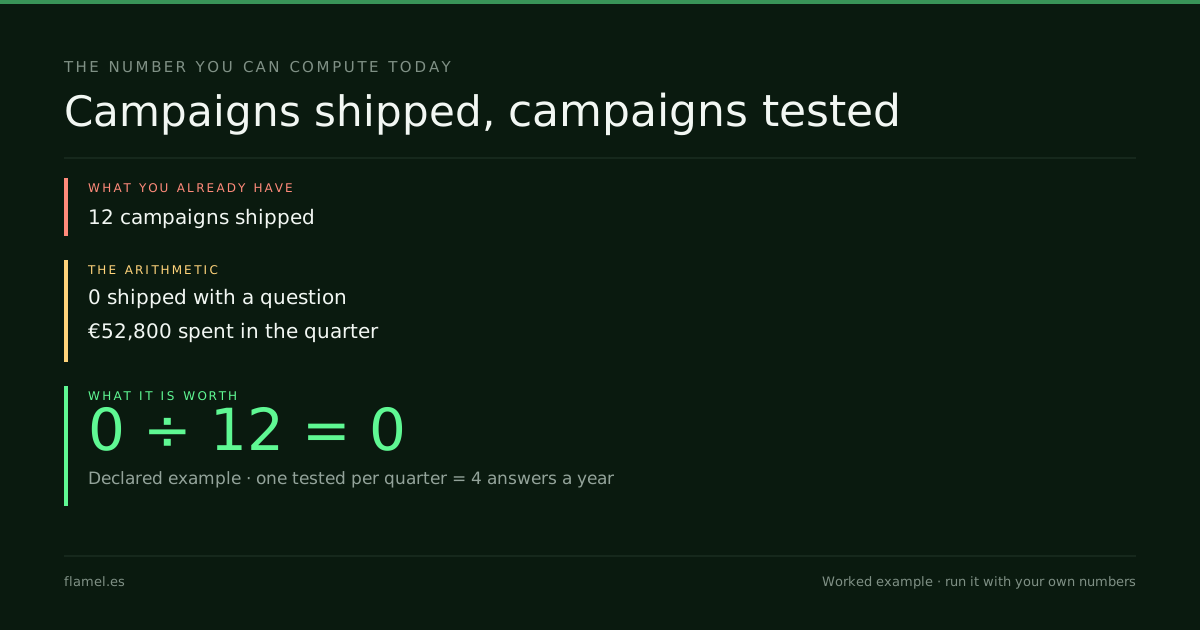
Tested ÷ shipped: the number to take
Tested ÷ shipped = campaigns run against real customers last quarter, each with a decision rule written before launch, ÷ campaigns shipped in the same quarter.
Take a declared example: a team that shipped 12 campaigns last quarter and tested none scores 0 ÷ 12 = 0. On the example product this blog uses for SaaS, marketing spends €17,600 a month to bring 44 new customers. That is €52,800 a quarter spread across those 12 campaigns, with 0 written answers about which of them brought customers who stay.
Count your own last quarter. If the result is 0, the next campaign is the place to start: one question, one decision rule, one number read before the following campaign is planned. One tested campaign per quarter already gives the team 4 written answers a year that it does not have today.
Work through this with your own numbers
I am the CMO of a [type of company] in the creative industries whose customers buy through [drops / a catalog / a subscription / seasons / commissions]. Last quarter my team shipped [number] campaigns and content pieces, spent [acquisition budget] and brought [new customers or signups]. For each campaign: [what it was meant to achieve, how it was measured, what was decided afterwards]. Calculate my tested ÷ shipped ratio, tell me which of last quarter's campaigns could have carried a testable question, and write the hypothesis, the single variable and the decision rule for the next campaign so its answer can be read from real customers before the following one is planned.FAQ
What is Flamel?
Flamel is the growth partner for the creative industries. It works with founders, CMOs and heads of product at companies that want to scale digitally, inside their marketing and product teams, so that what makes each company unique is also what makes it grow.
What does Flamel do for a CMO?
It works inside the marketing team: first a map of where the people campaigns bring stop (five business days, $500), then experiments with real customers, then one growth cycle per launch, season or release, each closed with a written answer.
How is Flamel different from a marketing agency?
An agency is usually measured by what it ships. Flamel works inside the marketing and product teams, tests with real customers instead of offering opinions, buys traffic only to learn something by a date, and leaves the map with the client whether or not they hire anyone.
Who does Flamel work with?
Founders, CMOs and heads of product at companies in the creative industries that want to scale digitally, grouped by how their own customers buy: drops, catalog, subscription, season or commission.
How much does Flamel cost?
The first step, the map, costs $500 and takes five business days. It is the only published price. What comes after depends on what the map finds.
If your team ships campaigns that nobody tests, The Activation Audit maps where the people they bring stop between signup and the first result. Five business days, $500, and the map stays with you whether or not you hire anyone next.
Your store, five days.
$500. Zero commitment. Yours either way.