
Fractional CMO or growth team: before you can hire one
A fractional CMO leads marketing part time. Before you hire one, check which seat is empty and what the decision nobody makes costs each month.

A fractional CMO is a senior marketing leader who works with a company part time, for a set number of hours a month, and owns what a full-time CMO would: the marketing plan, the budget, the team and the brand's positioning. For a creative brand that already sells, the useful question comes before the hire: which seat is actually empty.
Two seats get mixed up. One plans and leads marketing. The other decides what to test across the ads, the website and the product, then reads what worked and writes it down. A brand with one to three people in marketing often has someone covering parts of the first seat and nobody in the second. A fractional hire in the wrong seat doubles what the brand already has.
A fractional CMO is a senior marketing leader who works part time and owns the marketing plan, budget, team and positioning. A fractional growth team owns a different seat: it decides what to test across ads, website and product, runs one experiment per cycle and reads what worked. Check which seat is empty before hiring.
Key takeaways
- A fractional CMO leads marketing part time: plan, budget, team and positioning.
- A fractional growth team owns a different seat: what to test across ads, website and product, and what worked.
- Check which seat is empty on the last three launches, not on the plan.
- On the worked store, one finding worth a tenth of a point is €1,700 for every month nobody owns the decision.
- Without traction, neither seat comes first: a diagnosis does.
What a fractional CMO does, and who hires one
CMOx, a fractional CMO firm, defines the role plainly: “A fractional CMO is a senior marketing executive who works with a company on a part-time or contract basis.” The same page adds that “the responsibilities of a fractional CMO mirror those of a full-time CMO,” from leading the marketing team to managing brand positioning and hiring marketing staff, and its cost example assumes 40 hours a month (CMOx).
The usual buyer is a company that needs that leadership before it can carry the salary. Carter Murray, a recruiter, puts it directly: “For startups that are in their early stages, hiring a full-time CMO may not be a viable option” (Carter Murray). The same article names launches, market entry and periods of transition as other moments when a part-time leader makes sense.
For a creative brand, a fractional CMO fits when marketing itself has no owner: no plan beyond the next drop, a budget nobody defends, freelancers who each take briefs from a different person, and a positioning that changes with every campaign.
What a fractional growth team does in each cycle
A fractional growth team owns a different seat. Casey Winters, writing about what growth teams are for, draws the line against marketing in two sentences: “Growth teams don't create value. They make sure people experience the value that's already been created.” And a little further on: “This is why marketing can't be in charge of all growth initiatives” (Casey Winters). A fractional growth team is that function for part of the week: usually a strategist, a designer who can build and someone who reads the data.
In a creative brand, that system is the path the growth marketing definition splits into five moments: Appear, Attend, Recognize, Retain and Know. A growth team works that path one cycle at a time:
- One number. The figure the cycle is meant to move, read from the brand's own admin.
- One bet. A hypothesis on one moment, with a decision rule written before anything changes.
- One run. One variable, on the brand's own calendar: a drop, a season, a new product page. Paid traffic enters only when the question needs it, bought to learn something by a date.
- One record. A paragraph on what was expected, what happened and what changes next.
Marketing experiments shows one of those cycles for a brand that launches in drops, and a growth sprint walks through the same cycle week by week. It works with the people the brand already has instead of replacing them, which is why a growth partner for creative businesses is judged by what the brand's own team knows at the end of each cycle.
Fractional CMO or growth team: four questions
Four questions sort it out in an afternoon. Answer them for the last three launches, not for the plan.
- Is there a marketing plan with a budget someone defends? If not, the CMO seat is empty.
- Did anyone decide, before each launch, what it was meant to prove? If not, the growth seat is empty.
- Who owns the product page and the checkout? If the answer is the agency that built the site, or nobody, the growth seat is empty, because that is where most of the path gets decided.
- Is there a written record of what each launch taught? If the lessons live in someone's memory, the growth seat is empty.
The way the brand sells usually predicts the answer. A brand that sells in drops often has a strong creative lead and a launch calendar, so the CMO seat is covered in practice and the growth seat is the empty one. A catalog brand run by freelancers with no plan is often the reverse. A membership needs both seats at once, because the second month decides the revenue. A seasonal company can wait between seasons and should not pay for a full seat in the months it is quiet.
If you want the first decision in the empty seat priced on your own store before choosing anyone, The Conversion Audit maps it in five business days.

What neither seat should do for the brand
Whichever seat the brand fills, some work stays in-house, and some promises are a warning sign:
- A number promised before anyone has read the admin. A fractional lead can promise a plan and a cadence. A result decided in advance is a pitch.
- Campaigns that never end. A budget with no question attached grows by habit.
- The fieldwork. Pop-ups, shoots, events and the community belong to the brand's team, who know the customers face to face.
- The brand's taste. What makes the brand unique is the founders' call. The job is to make that the reason it grows, not to sand it down into whatever tests well this month.
- The record. It belongs in the brand's own tools and stays when the contract ends.
When it is still too early for either
Both seats assume the brand already sells beyond its first circle. In the same essay on growth teams, Winters is direct about the order: growth teams have a clear purpose, “and that purpose makes sense only if you have first found product-market fit.” He defines that fit by people coming back, not by revenue: “Product-market fit is retention that allows for sustained growth.”
Before traction, the question is whether strangers want the product at its price, and that is a diagnosis, not a hire. After traction, the order is the one a growth strategy sets: one number, a priced map of where it leaks, and the first bet.
The worked store: what an empty seat costs
The worked store this blog uses, as an example: 300,000 sessions a year, a €68 average order and 1 order for every 100 sessions, which makes 3,000 orders and €204,000 a year.
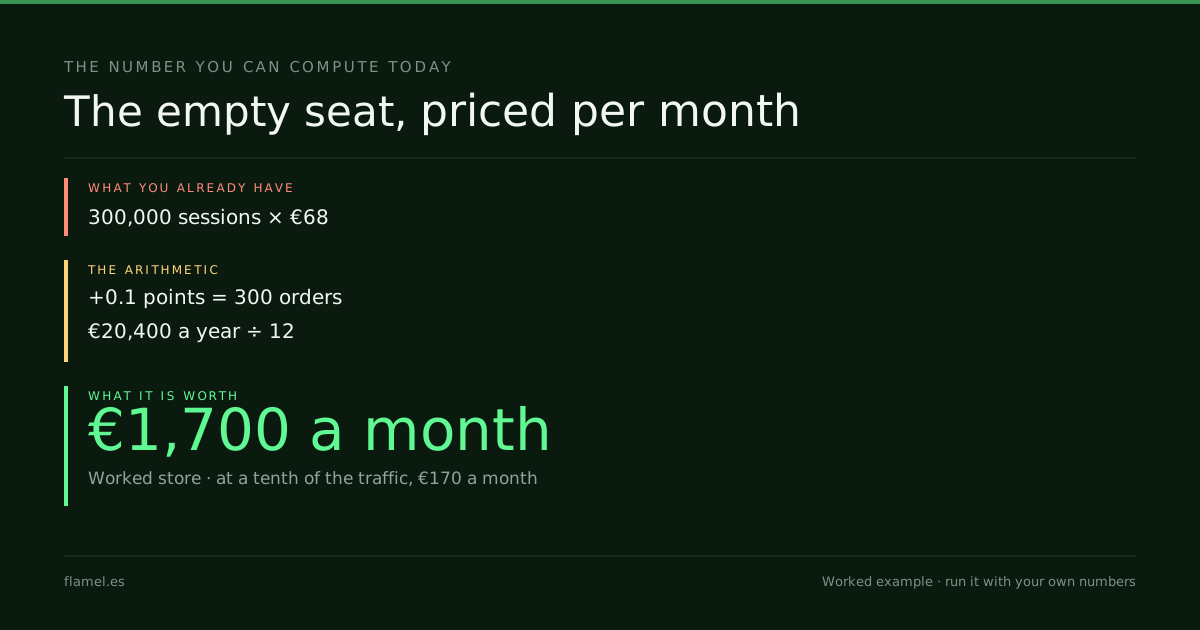
Say the empty growth seat hides one finding on the product page worth a tenth of a point of conversion rate, from 1.0 to 1.1 orders per 100 sessions. That is 300 more orders and €20,400 a year, or €1,700 for every month nobody owns the decision. Six months of waiting cost €10,200 of that finding alone.
Now the same store at a tenth of the traffic, 30,000 sessions a year. The same finding is worth 30 orders, €2,040 a year, €170 a month. At that size the first job is finding out whether more people want the product, and that is a diagnosis.
Monthly value of the empty seat: the number to take
Monthly value of the decision nobody is making = (a tenth of a point of conversion rate × annual sessions × average order) ÷ 12.
On the worked store: 0.001 × 300,000 × €68 = €20,400 a year, and €20,400 ÷ 12 = €1,700 a month. Run it with your own sessions and average order. If the result is in the thousands, the empty growth seat costs more each month than most founders assume, and a fractional growth team is the step before the first full-time hire. If it is in the low hundreds, start with the diagnosis and ask the question again after the next season.
Work through this with your own numbers
I run a creative brand that sells through [drops / a catalog / a membership / seasons]. My marketing team is [number of people and roles]. Last year I had [annual sessions] sessions, a [conversion rate] conversion rate and a [average order] average order. For my last three launches: [what was planned, who decided it, what was measured, what was written down]. Tell me whether the empty seat in my company is the one a fractional CMO fills (plan, budget, team, positioning) or the one a fractional growth team fills (what to test across ads, website and product, and what worked). Then calculate the monthly value of one finding worth a tenth of a point of conversion rate on my numbers, and tell me whether to hire for that seat now or start with a diagnosis.FAQ
What is a fractional CMO?
A fractional CMO is a senior marketing executive who works with a company part time or on contract. The role mirrors a full-time CMO: the marketing plan, the budget, the team and the brand's positioning, for a set number of hours a month instead of a full salary.
How many hours does a fractional CMO work?
It depends on the contract. Engagements are usually sold by hours or days a month, and one fractional CMO firm uses 40 hours a month in its cost example. Which decisions the role owns matters more than the hours.
What is the difference between a fractional CMO and a fractional growth team?
A fractional CMO leads marketing: plan, budget, team and positioning. A fractional growth team owns the loop across ads, website and product: one bet per cycle, a decision rule written first, a number read from the brand's admin and a written record.
When is it too early to hire a fractional CMO or a growth team?
When the brand still sells mostly to its first circle and does not know whether strangers want the product at its price. That question needs a diagnosis. Both seats assume the brand already has traction.
What does a fractional growth team do each month?
It runs one cycle per experiment: it picks the number, writes the bet and its decision rule, changes one variable on the brand's calendar, reads the result from the brand's admin and writes the paragraph that decides the next cycle.
Pricing the decision nobody is making on a store's own numbers, before anyone is hired for it, is what The Conversion Audit maps. Five business days, $500, and the map stays with you whether or not you hire anyone next.
Your store, five days.
$500. Zero commitment. Yours either way.