
Growth strategy: the five parts for a creative brand
A growth strategy for a creative brand has five parts: one number, a priced map of leaks, ranked bets, a cadence and a record. With the math.

A growth strategy is a written choice about where the next unit of effort goes and how the brand will know it worked. For a creative brand it has five parts: one number to grow, a map of where that number leaks with a price on each leak, a short list of ranked bets, a cadence the team can keep, and a record that decides what comes next.
Most brands that say they have no strategy have plenty of activity: a drop calendar, a newsletter, an ads budget, a redesign on the roadmap. What they lack is usually the first part and the last one. Without one number, every action can claim success. Without a record, every quarter starts from opinion.
A growth strategy is a written choice about where the next unit of effort goes and how the brand will know it worked. For a creative brand it has five parts: one number to grow, a priced map of where it leaks, ranked bets, a cadence of one experiment per cycle, and a record that picks the next cycle.
Key takeaways
- A growth strategy has five parts: one number, a priced map of leaks, ranked bets, a cadence and a record.
- A list of tactics usually has only the bets, and without the ranking.
- Rank bets by their annual value if they work, divided by the weeks needed to read them.
- On the worked store, a product-page bet scores €5,100 per week of reading; a post-purchase email, about €98.
- The record of each cycle decides the next one; without it, the loudest argument does.
What a growth strategy is, and what it is not
Shopify's guide gives the plain definition: “A growth strategy is a plan to expand your business by growing revenue, users, customers, products, market share, or even markets served” (Shopify). The same guide adds two warnings that matter more than the definition. A growth strategy is not a marketing strategy: “marketing is just one of many tools you can use to grow your business.” And “the most common challenge in a growth strategy is scaling before validating the market or product.”
A target is not a strategy either. KPMG opens its growth practice page with a blunt line: “The majority of companies fail to hit their growth targets” (KPMG). Most of those companies had a number. What was missing sat between the number and the work: where it leaks, what to try first, and how to know whether it worked.
For a creative brand that sells through drops, a catalog, a membership or seasons, the definition becomes practical. A growth strategy is the short document that decides which experiment runs next and why. Everything else is a calendar.
The growth strategy framework: five parts
The framework has five parts, and they only work together. Brian Balfour makes the same point about his Four Fits for growth: “you can't think about the four Fits in isolation because together they form an ecosystem for growth” (Brian Balfour). Change one part here and the others move with it.
- One number. What the strategy is trying to grow.
- A priced map. Where that number leaks, moment by moment, in money.
- Ranked bets. A short list of hypotheses, ordered by what each is worth and how fast it reads.
- A cadence. One experiment per cycle, at a pace the team can keep.
- A record. What each cycle proved, written down, deciding the next one.
A list of tactics usually has only the third part, and without the ranking.
Part 1: one number, with its OKRs underneath
The number is the one that moves only when customers get value and the brand earns from it. A north star metric is the usual name, with OKRs setting the quarter's targets for it and KPIs watching the inputs. For a catalog brand it might be the returning customers' share of revenue: on the worked store below, €76,500 of the €204,000 a year comes from repeat orders. For a membership, it might be active members at month 3. What matters is that there is only one, so a campaign that raises sessions while orders fall cannot be reported as a win.
Part 2: a map of where the number leaks, priced
The map reads the customer path through the five moments this blog uses for a creative brand: Appear, Attend, Recognize, Retain and Know. The growth marketing definition explains each one and which of them leads in each way of selling. The strategy adds one thing to that map: a price on each moment, calculated on the brand's own figures.
On the worked store this blog uses, a tenth of a point of conversion rate is worth 300 orders and €20,400 a year. One point of repeat purchase rate is worth 18.75 second orders, €1,275 a year. Neither number says what to do. Both say how much each moment can carry.

Part 3: bets, ranked by value per week of reading
A bet is a hypothesis tied to one moment: what will change, which number should move, and by how much for the bet to be worth it. The ranking needs two numbers per bet: what it is worth in a year if it works, and how many weeks it takes to read. A bet that reads in 4 weeks gives 3 answers before a bet that needs 13 weeks gives 1.
Part 4: a cadence of one experiment per cycle
Most creative brands do not have the sessions to finish split tests quickly, so the cadence follows the brand's own calendar: one experiment per cycle, one variable at a time, and a decision rule written before the change goes live. Marketing experiments shows what that looks like when the brand launches in drops. On the worked store, a split test that reads a lift from 1.0 % to 1.2 % takes about 3.4 months, so most cycles cannot wait for one. The cadence also caps the list. A team with 1 to 3 people in marketing runs one cycle at a time, so the strategy only needs as many bets as the next quarter can read.
Part 5: a record that picks the next cycle
Every cycle ends in a paragraph: what was expected, what happened, what changes. A quarter of 3 cycles leaves 3 paragraphs, and those 3 paragraphs are worth more than any dashboard the brand already has. That record is the Know moment in practice, and it is what turns the loop described in build measure learn into a strategy instead of a habit. Without it, next quarter's bets are chosen by whoever argues best in the meeting.
Two bets on the worked store, ranked
The worked store: 300,000 sessions a year, a €68 average order, a 45 % gross margin and a 1.0 % conversion rate, which makes 3,000 orders and €204,000 a year. At 1.6 orders per customer, that is 1,875 customers. Two bets compete for the next cycle, as an example.
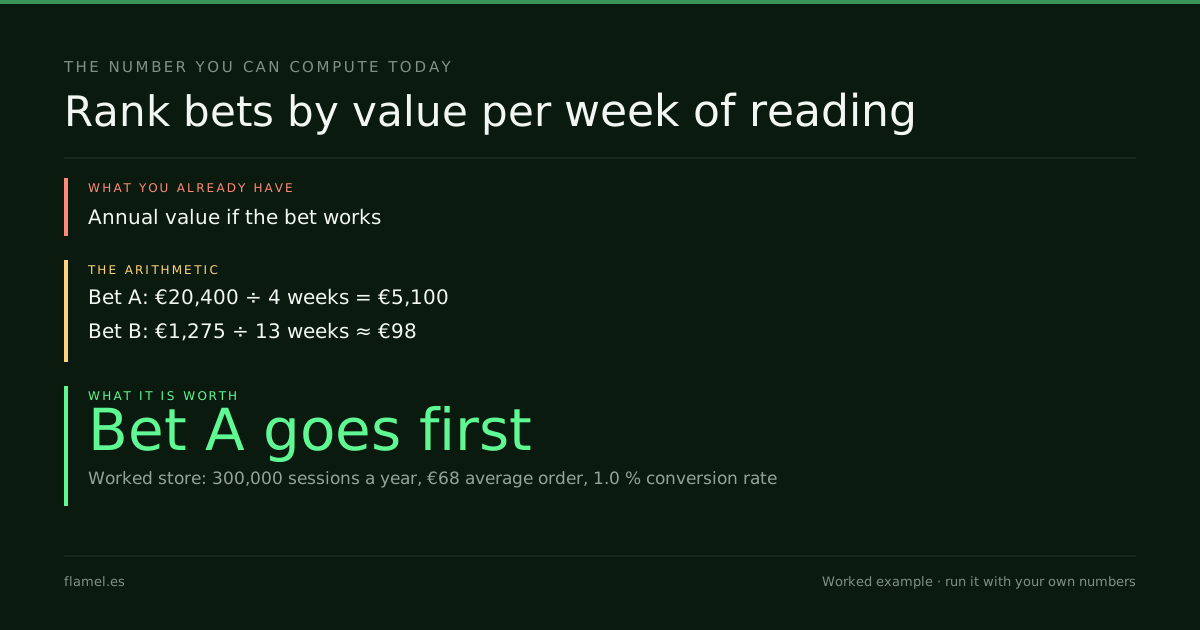
Bet A, Attend. Fit notes and photos on the size guide of the bestselling category. If the change lifts the whole store by a tenth of a point, it is worth 300 orders and €20,400 a year, €9,180 of it margin. It reads in four weeks against the four before: €5,100 of annual value per week of reading.
Bet B, Retain. A message at day 30 with care notes and the piece that completes the first order. If it lifts repeat purchase by one point, it is worth 18.75 second orders, €1,275 a year. It reads over about 13 weeks: a four-week cohort of first-time buyers plus their 60-day window. That is about €98 per week of reading.
Bet A goes first, at about 52 times the value per week of reading. Bet B stays on the list. It is a sound bet for a store whose product page already answers the fit question, and its result will be easier to read once Bet A's record is written.
Bet priority: the number to put in your plan
Bet priority = annual value if it works ÷ weeks needed to read it.
To run it on your own store, take the step you are betting on (a tenth of a point of conversion rate, one point of repeat purchase, a fixed number of extra sessions) and multiply it through your own sessions, orders and average order to get its annual value. Divide by the weeks the measure needs before you can trust it. On the worked store that is €20,400 ÷ 4 = €5,100 for Bet A and €1,275 ÷ 13 ≈ €98 for Bet B. Rank the bets by the result. The top of the list is the next cycle; the rest is the strategy's backlog, ranked again every time the record changes one of the numbers.
Work through this with your own numbers
I run a creative brand that sells through [drops / a catalog / a membership / seasons]. Last year I had [annual sessions] sessions, a [conversion rate] conversion rate, a [average order] average order, [orders per customer] orders per customer and a [gross margin] gross margin. The one number I want to grow is [north star metric]. These are the bets my team is considering: [list each bet, the moment it targets and the change it makes]. For each bet, estimate its annual value on my numbers if it works, the weeks the measure needs before I can trust it, and its value per week of reading. Rank the bets, tell me which one should be the next cycle, and write the decision rule I should agree before it goes live.FAQ
What is a growth strategy?
A growth strategy is a plan to expand a business, usually its revenue. In practice it is a written choice about where the next unit of effort goes and how the brand will know it worked: one number, a priced map of where it leaks, ranked bets, a cadence and a record.
What are the five parts of a growth strategy?
One number the brand is trying to grow; a map of where that number leaks, priced moment by moment; a short list of bets ranked by value; a cadence of one experiment per cycle; and a written record of what each cycle proved, which decides the next one.
What is the difference between a growth strategy and a marketing strategy?
A marketing strategy decides how to reach and persuade buyers. A growth strategy decides where the next piece of work goes across the whole path, including the product page, the second order and the product itself, and ranks those options by what they are worth.
How do you prioritize growth experiments?
Price each bet as its annual value if it works, then divide by the weeks the measure needs before it can be trusted. On the worked store, a product-page bet scores about €5,100 per week of reading and a post-purchase email about €98, so the product page goes first.
How often should a growth strategy change?
The ranking of bets changes after every cycle, because each record updates a number. The one number and the priced map change less often, usually once a quarter, or when the way the brand sells changes, for example from drops to a catalog.
Pricing each moment on a store's own numbers, so the first bet is the one worth most per week of reading, is part of what The Conversion Audit maps. Five business days, $500, and the map stays with you whether or not you hire anyone next.
Your store, five days.
$500. Zero commitment. Yours either way.