Freemium vs free trial: the break-even line
Freemium vs free trial, decided on one line: the free-to-paid rate at which a free plan matches a trial's ARR, worked on a €60-a-month SaaS product.

Freemium vs free trial is not a pricing preference. They are two bets on where a product's value becomes obvious: inside a deadline, or over months of free use. It is also the decision where marketing, which wants more signups, and product, which wants faster value and a lower cost to serve, pull in different directions.
Most teams settle it by copying what their category does. The better answer is one line both teams can read, built on the product's own numbers: how many signups each model brings, how many of them pay, and what a free user costs to keep.
This post builds that line, runs it on the example product this blog uses for SaaS, and shows what moves it.
Freemium vs free trial is decided by the break-even line: the free-to-paid conversion at which a free plan's ARR, minus the cost to serve free users, matches the trial's. A trial turning 1,000 signups into 200 customers at €60 a month makes €144,000 of ARR; with three times the signups, freemium needs about 7.4 of every 100.
Key takeaways
- Freemium vs free trial is two bets on where value becomes obvious: inside a deadline, or over months of free use.
- Trials convert more signups; freemium brings more signups and costs money to serve users who never pay.
- On a €60-a-month product, a trial turning 1,000 signups into 200 customers makes €144,000 of ARR.
- With three times the signups and €0.50 a month per free user, freemium needs about 7.4 of every 100 to match it.
- Run the break-even with your own trial conversion, signup gap and cost to serve before switching models.
Freemium vs free trial: two bets on value
A free trial gives full access for a fixed window, then asks for payment. It bets that the product proves itself before the deadline. A freemium plan gives a limited version for as long as the user wants. It bets that value keeps growing with use, and that some users will hit the limit and pay to remove it.
Each bet has a known cost. OpenView's 2022 benchmarks, as Amplitude reported them, found that companies with free trials typically see higher conversion rates than those with freemium experiences. OpenView's Kyle Poyar adds the other side: freemium companies typically have more website signups and more virality through product invites.
So the trial converts better and the free plan fills the funnel faster. Neither fact decides anything until both are put on the same line.
What each model trades away
Lenny Rachitsky's survey of more than 1,000 products puts numbers on the trade, measured as accounts paying within their first six months:
| Model | Good | Great |
|---|---|---|
| Free trial | 8 to 12 of every 100 signups | 15 to 25 of every 100 |
| Self-serve freemium | 3 to 5 of every 100 signups | 6 to 8 of every 100 |
The same survey reports that sign-up rates for free-trial products are materially lower: 5 of every 100 against 9 for freemium. On equal traffic, that is 1.8 freemium signups for every trial signup.
The trial trades away volume. The free plan trades away conversion and adds a cost the trial barely has: every free user who never pays still uses servers, storage and support. The freemium conversion rate is the metric for one side of this. The decision needs both sides at once.
The break-even line, as a formula
Compare one batch of trial signups with the freemium signups the same traffic would bring, over a year:
Trial ARR = trial signups × trial conversion × monthly price × 12

Freemium net = freemium signups × freemium conversion × monthly price × 12
             − free users kept × monthly cost to serve × 12

Break-even freemium conversion =
  (Trial ARR + freemium signups × cost to serve × 12)
  ÷ (freemium signups × (price × 12 + cost to serve × 12))
The break-even line is the free-to-paid conversion at which freemium matches the trial. Above it, the free plan earns more. Below it, the trial does.

Freemium vs free trial on the example product
The example product used across this blog's SaaS posts: a subscription tool for small creative businesses, with 1,100 customers paying €60 a month. It signs up 2 of every 100 visitors, and 20 of every 100 signups start paying.
Take 1,000 trial signups:
Trial: 1,000 signups × 20 of every 100 = 200 customers
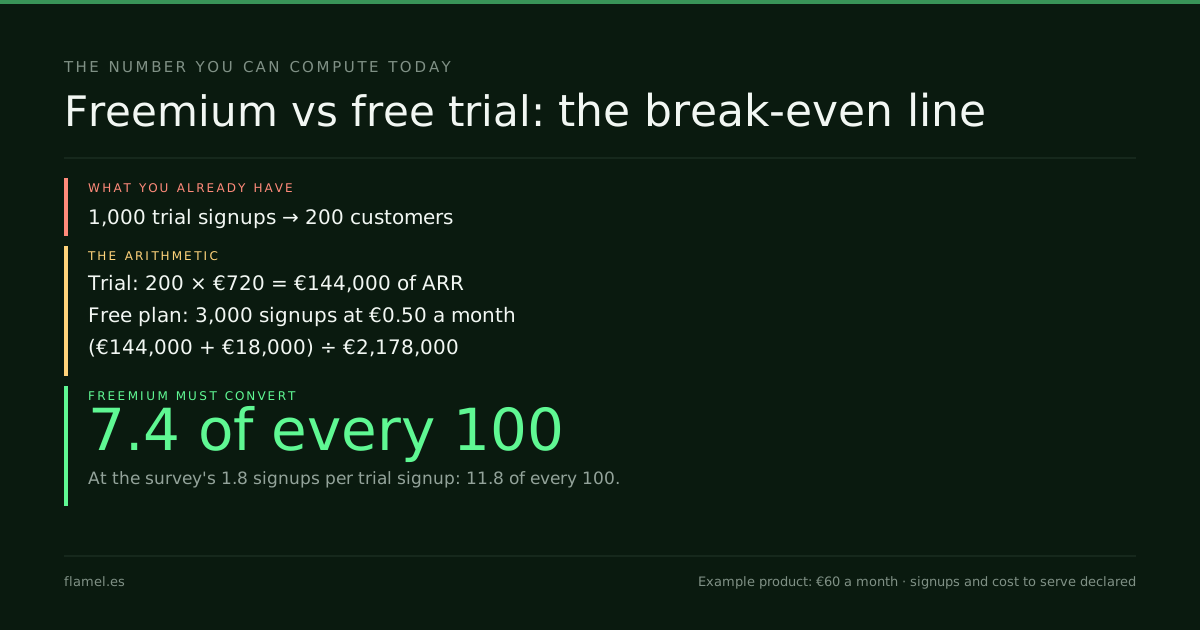
200 × €60 × 12 = €144,000 of ARR
Now suppose a free plan brought three times the signups, 3,000, and each free user cost €0.50 a month to serve. Both numbers are declared, not measured. Assume every free user who does not pay stays on the free plan all year, which is the most it can cost:
Break-even = (€144,000 + 3,000 × €0.50 × 12) ÷ (3,000 × (€720 + €6))
           = €162,000 ÷ €2,178,000
           ≈ 7.4 of every 100
At 7.4 of every 100, freemium makes about 223 paying customers, €160,560 of ARR, minus about €16,660 to serve the 2,777 who stay free. That nets roughly the same €144,000. The figures are run-rate, not cash, and churn hits both models alike here, so it does not move the line.
Mapping where a product's value becomes obvious, and how fast each signup gets there, is what The Activation Audit does in five business days.
What moves the line
The three-times assumption carries most of the weight. Here is the same break-even with other signup gaps, keeping €0.50 a month to serve:
| Free signups per trial signup | Freemium signups | Break-even conversion |
|---|---|---|
| 1.8 (Lenny's average gap) | 1,800 | 11.8 of every 100 |
| 2 | 2,000 | 10.7 of every 100 |
| 3 | 3,000 | 7.4 of every 100 |
| 5 | 5,000 | 4.8 of every 100 |
At the average gap in Lenny's survey, freemium would need 11.8 of every 100 signups to pay. That is above the 6 to 8 the survey calls great for self-serve freemium. At three times the signups, the line sits inside the great band. Only at five times does it fall to a rate that counts as good.
Cost to serve moves it less, but it moves. At three times the signups and €2 a month per free user, the line rises from 7.4 to 9.7 of every 100.
When freemium wins anyway
The line is a starting point, not a verdict. Three things push freemium above it in practice.
- Value grows with use. Poyar's rule of thumb: if a product increases in value the longer someone uses it, freemium tends to be a good option. A trial deadline cuts that growth short.
- Free users bring other users. Invites and shared work add signups that the trial never sees, which raises the real gap above the one assumed.
- Payers stay longer. If freemium payers churn less because they chose to pay after months of use, each one is worth more than a trial payer, and the line drops.
The opposite also holds. If the first useful result takes a week of setup, a 14-day trial ends before value shows, and time to value is the number to fix before choosing a model. How the free plan fits the paid tiers is a SaaS pricing strategy question, and the loop it feeds is what product led growth depends on.
The number for your own product
Break-even freemium conversion =
  (Trial ARR + freemium signups × cost to serve × 12)
  ÷ (freemium signups × (price × 12 + cost to serve × 12))
On the example product: 7.4 of every 100 at three times the signups, and 11.8 at Lenny's average gap.
What to do by Monday: take your last 1,000 trial signups and count how many paid. Estimate how many signups a free plan would bring from the same traffic, and what a free user costs you a month. Run the line. If the result sits above 8 of every 100, the top of the great band for self-serve freemium, the trial wins unless the free plan converts better than almost every product in the survey. Marketing owns the signup estimate, product owns the cost to serve, and the line is the number both of them sign.
Work through this with your own numbers
My SaaS product costs [monthly price] a month. Out of my last [number of trial signups] trial signups, [number who paid] became paying customers. I think a free plan would bring [number] signups for every trial signup from the same traffic, and a free user costs me about [monthly cost to serve] a month. Calculate the trial's ARR as paying customers × monthly price × 12. Then calculate the break-even freemium conversion as (trial ARR + freemium signups × cost to serve × 12) divided by (freemium signups × (price × 12 + cost to serve × 12)), assuming every free user who does not pay stays all year. Express the result as paying users per 100 signups and compare it with a good self-serve freemium rate of 3 to 5 and a great one of 6 to 8. Show every step, then rerun it with 1.8 signups per trial signup, and tell me which model my numbers favor.FAQ
Is a free trial or freemium better for SaaS?
Neither by default. Free trials typically convert more signups, and freemium typically brings more signups. Compare them on one line: the free-to-paid conversion at which a free plan's ARR, minus the cost of serving free users, matches the trial's. If your free plan cannot clear that rate, the trial wins.
What is a good conversion rate for a free trial vs freemium?
In Lenny Rachitsky's survey of more than 1,000 products, a free trial converting 8 to 12 of every 100 signups within six months is good and 15 to 25 is great. For self-serve freemium, 3 to 5 of every 100 is good and 6 to 8 is great.
How many more signups does freemium get than a free trial?
In Lenny Rachitsky's survey, the sign-up rate is 9 of every 100 for freemium products against 5 for free trials, or 1.8 freemium signups per trial signup on equal traffic. Products with strong invite loops can get more, which lowers the conversion freemium needs to break even.
How do you calculate the break-even between freemium and a free trial?
Divide the trial's ARR plus a year of serving every freemium signup by the freemium signups times a year of price plus a year of cost to serve. On a €60-a-month product, 200 trial customers from 1,000 signups and 3,000 free signups at €0.50 a month give about 7.4 of every 100.
Finding where a product's value becomes obvious, and how many signups get there under each model, is what The Activation Audit maps. Five business days, $500, and the map stays with you whether or not you hire anyone next.
Your store, five days.
$500. Zero commitment. Yours either way.