
Growth vs marketing, and where UX fits: who owns what
Growth vs marketing in a scaling brand: marketing brings visits, UX turns them into orders, growth picks which to test first. Both routes, priced.

Growth vs marketing is a question about ownership, not titles. Marketing brings people to the store. UX makes sure the purchase does not stall once they arrive. Growth decides what gets tested next and reads what worked. Each job owns one factor of the same revenue: sessions, conversion rate, and the order in which the two are worked on.
In a brand that is scaling, with one to three people in marketing, the three jobs often sit with the same person, or with nobody. The leak is rarely inside one job. It is in the handoffs: a campaign sends traffic to a page nobody checked, the orders do not come, and the result gets read as a marketing failure.
Growth vs marketing: marketing brings people to the store and is judged on visits and what they cost; UX removes friction so visits become orders; growth decides which of the two to work on next, runs the test and records what it changed. In a scaling brand one person often holds all three, so ownership matters more than titles.
Key takeaways
- Growth vs marketing is a question of ownership: marketing owns sessions, UX owns conversion, growth owns the order of work.
- UX sits between the two: marketing raises perceived value, UX lowers the effort of buying.
- In a scaling brand one person often holds all three jobs; the leak is in the handoffs, not inside one job.
- On the worked store, 30,000 more visits and a tenth of a point of conversion are each worth €20,400 a year, and €2,040 more together.
- Divide the marketing route's margin by its extra visits: above €0.31 a visit on that store, the first test belongs to UX.
Growth vs marketing: two jobs, one revenue
The distinction is older than most growth teams. In 2014, Brian Balfour described marketing organizations as focused on the top of the funnel, awareness and acquisition, and growth teams as reading the whole funnel, with a mission tied to "a metric that tells a more complete picture of the business." In his model, growth blends marketing, product and engineering around that one number.
Reforge drew the boundary from the other side in 2022. In Marketing is More Than Growth, Stephanie Kwok and Natalie Rothfels split a complete marketing function into brand, growth and product marketing, and warn that growth marketing "doesn't capture everything required for an airtight marketing strategy."
Both views hold, and neither settles who does what on Monday in a creative brand. For that, a simpler cut works: name the factor each job moves. Revenue in a store is sessions × conversion rate × average order. Marketing owns the first factor. UX owns the second. Growth owns neither: it owns the order in which they are worked on, and the record of what each change did. The growth marketing definition used across this blog says the same from the other side: the scope of what gets measured decides the job, not the title.
Where UX fits: the factor in the middle
UX is the job most often left out of the growth vs marketing debate, and it sits between the two. The Nielsen Norman Group draws the line in two sentences (UX & Marketing, 2023): "Marketing is about increasing the perceived value of a product through brand perception or special offerings that the company might have. UX is about decreasing the interaction cost."
The same article names where they collide: "Marketing elements may deteriorate the UX." A launch pop-up that covers the size guide. A discount banner that pushes the product photo below the fold. A newsletter form before the first scroll. Each one is marketing doing its job with UX's number. NN/g suggests aligning some KPIs between the two teams, and in a store there is one obvious candidate: orders from the traffic marketing brought.
UX here is not the visual identity. It is what happens between the click and the order: whether the product page answers the real doubt, whether the checkout asks for what it does not need. A UX design audit is the read of exactly that stretch.

UX and marketing: who owns which number
| Job | Moment it serves | Factor it owns | Number it answers for | What it does not own |
|---|---|---|---|---|
| Marketing | Appear | Sessions | New visitors by channel, and what each one costs | Whether the page they land on converts |
| UX | Attend | Conversion | Orders ÷ sessions on the pages the traffic lands on, and checkout completion | How many people arrive |
| Growth | Know | The order of work | The one number the current cycle is meant to move, and the written record of what moved it | Producing the campaign or the page |
The moments are the five this blog uses for a creative brand: Appear, Attend, Recognize, Retain and Know. Recognize and Retain, the second order, belong to whoever owns the experience after delivery, the stretch ecommerce customer experience covers. On the worked store below, 40 of every 100 customers come back for a second order, and in many scaling brands nobody owns that row yet.
When one person holds all three, or nobody does
With one to three people in marketing, the table above usually has the same name in every row. That is not the problem. The problem is that each job ends up judged with another job's number. Three handoffs where that shows:
- Campaign to page. A launch campaign brings 30,000 visits to a collection page that loads its photos last on phones. Conversion drops, and the campaign takes the blame.
- Page to report. The product page changes in the same week as a newsletter push. Orders rise, and nobody can say which change did it. One variable per cycle is the rule that marketing experiments on a launch calendar depend on.
- Report to decision. Monday's report lists sessions, revenue and followers. Nothing in it says which factor gets the next piece of work, so the next piece of work is another campaign.
How the brand earns changes which handoff hurts most. A drop brand lives on Appear: the waitlist fills, and the drop page has to hold on launch day. A catalog brand lives on Attend: the product page sells every day of the year. A membership lives after the first payment. The owner of each factor can be the same person. What changes is that the person knows which job they are doing when they read a number.
Two routes to the same €20,400
Here is the arithmetic on the store this blog uses for its examples: 300,000 sessions a year, a €68 average order, a 1.0 % conversion rate and a 45 % gross margin. That is 3,000 orders and €204,000 of revenue.
Revenue = sessions × conversion rate × average order

Marketing route: 330,000 × 1.0 % × €68 = 3,300 orders   (+300, +€20,400)
UX route:        300,000 × 1.1 % × €68 = 3,300 orders   (+300, +€20,400)
Both together:   330,000 × 1.1 % × €68 = 3,630 orders   (+630, +€42,840)
The two routes are worth exactly the same: 30,000 more visits, or a tenth of a point more conversion, the figure the ecommerce conversion rate post works out per tenth of a point. Done together, they are worth €2,040 more than the two separately, because the new visits land on the better page. That €2,040 is the value of the handoff working.
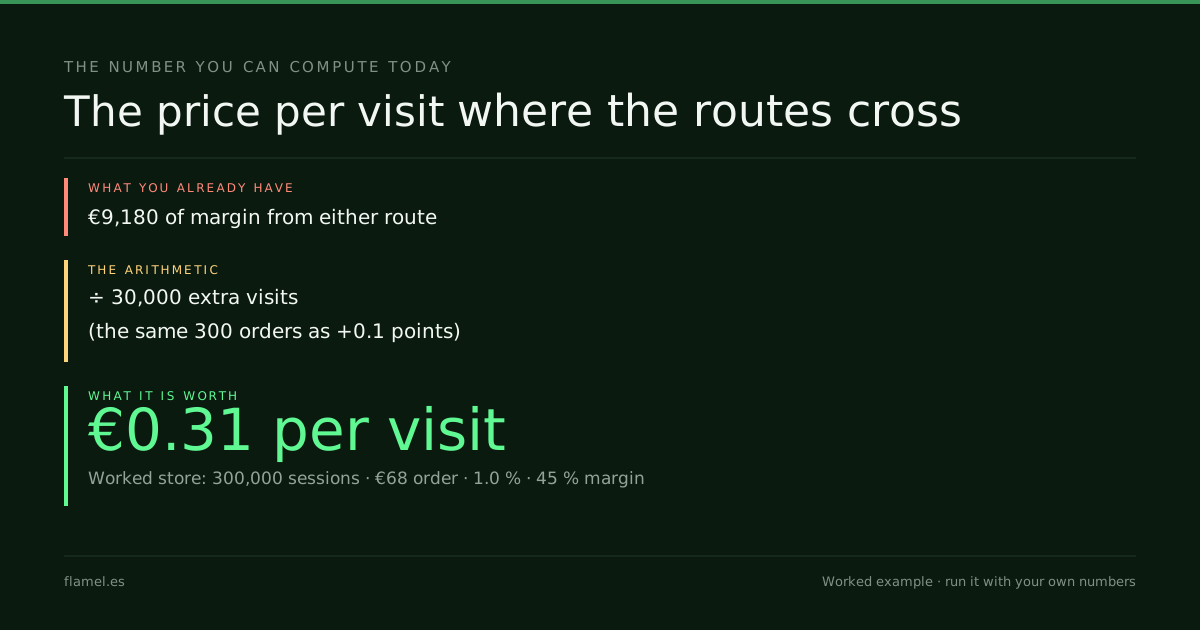
At a 45 % margin, either route leaves €9,180 a year. What separates them is cost, and that decision is the one growth owns.
The price per visit where the routes cross
Growth's question is not which route is better. It is which one is cheaper for this brand, now. One number answers it:
Break-even cost per extra visit = margin of the marketing route ÷ extra visits
                                = €9,180 ÷ 30,000 = €0.31
If the brand pays less than €0.31 for each extra visit, buying the 30,000 visits pays back on the year's orders at today's conversion. If it pays more, the marketing route costs more margin than it brings, and the first test belongs to UX: a fix that costs less than €9,180 and moves conversion a tenth of a point pays back within the year. The figure counts the year's orders only; buyers who come back later raise both routes alike.
What to do this week:
- Write who owns sessions, who owns conversion and who decides the order of work, by name. If the same name is on all three lines, write which number that person reads first on Monday.
- Price a tenth of a point of conversion: annual sessions × 0.001 × average order.
- Divide that tenth's margin by the visits marketing would need to bring the same orders. Compare that price per visit with what the brand paid last quarter. The cheaper route gets the first test.
Work through this with your own numbers
I run a creative brand that sells through [drops / a catalog / a membership / seasons]. Last year I had [annual sessions] sessions, a [conversion rate] conversion rate, a [average order] average order and a [gross margin] gross margin, and I paid about [cost per visit] for each visit from paid channels. The people working on marketing, the website and growth are [names and roles]. Tell me who should own sessions, who should own conversion and who should decide the order of work, and flag any handoff where one job is judged with another job's number. Then calculate what a tenth of a point of conversion is worth, how many extra visits would bring the same orders, and the most I can pay per extra visit for that route to pay back within the year. Say which route should get the first test and why.FAQ
What is the difference between growth and marketing?
Marketing brings people to the brand and is judged on reach, visits and what they cost. Growth decides which part of the path from first visit to second order gets the next piece of work, tests it and records what changed. Marketing owns a factor; growth owns the order in which the factors are worked on.
Is growth marketing part of marketing?
In Reforge's model, yes: a complete marketing function has brand, growth and product marketing. In practice the label matters less than the scope. Someone who reads visits only is doing marketing; someone who also reads the conversion rate, the second order and margin is doing growth, whatever the title.
How do UX and marketing work together?
By sharing one number: orders from the traffic marketing brings. Marketing raises perceived value and brings visits; UX lowers the effort of buying once people arrive. When a campaign tactic such as a pop-up hurts the page, the shared number shows it within the week.
Who should own growth in a scaling brand?
One named person, even if that person also runs marketing. What matters is that someone decides which factor gets the next test, reads the result and writes it down. With one to three people in marketing, that can be one day a week of someone's job rather than a new hire.
Should a store buy more traffic or improve its conversion rate first?
Price both. On a store with 300,000 sessions a year and a €68 average order, 30,000 more visits and a tenth of a point more conversion are each worth €20,400 a year. Divide the margin by the extra visits to get the most a visit can cost; above that price, conversion goes first.
Pricing both routes on a store's own numbers, and naming which factor gets the first test, is part of what The Conversion Audit maps. Five business days, $500, and the map stays with you whether or not you hire anyone next.
Your store, five days.
$500. Zero commitment. Yours either way.