Jobs to be done examples: one job, two teams' brief
Jobs to be done examples, from the milkshake to a SaaS product: two customers on one plan, two jobs, two churn rates, and what the right job is worth.

Jobs to be done examples all show the same idea: a customer does not buy a product, they hire it to make progress in a specific situation. For a SaaS product, the most useful examples are your own. Two customers on the same plan can be hiring it for different jobs, and they rarely stay for the same length of time.
That difference is where product and marketing drift apart. Marketing measures signups and brings in whoever converts fastest. Product measures usage and designs onboarding for whoever it pictures. Neither team owns the number that joins the two, which is how long each kind of customer stays. Naming the job gives both teams the same brief.
Jobs to be done examples show that customers hire a product to make progress in a specific situation. In a SaaS product, two customers on the same plan can hire it for different jobs and churn at different rates. Naming each job gives product its onboarding brief and marketing its campaign brief, and shows which job is worth acquiring.
Key takeaways
- Customers hire a product to make progress in a specific situation; the job belongs to the situation, not to the customer type.
- In the milkshake example, one product was hired for two jobs, and a design for the average served neither.
- On the example SaaS product, academies lose 2 of every 100 a month and photographers 7, behind an average of 4.
- The job gives product its onboarding brief and marketing its campaign brief, so both teams work on the customers who stay.
- Moving 10 new customers a month from the short job to the long one is worth €17,143 of lifetime margin per month of acquisition.
What jobs to be done means
The Christensen Institute, named after Clayton Christensen, who made the idea popular, puts it in one line: "People don't simply buy or pick products or services; they pull them into their lives to make progress." It calls these jobs because "people 'hire' products or services when 'jobs' arise in their lives," the way someone hires a contractor to build a house.
Three details make the idea practical:
- A job belongs to a situation, not to a customer type. The same person can hire a product for one job on Monday and a different one in December.
- A job has more than one dimension. The Institute names functional, social and emotional dimensions: getting the task done, how it looks to others and how it feels.
- A job can be done by something that is not your competitor. A spreadsheet, a WhatsApp group or an assistant can be hired for the same job.
The classic example: one milkshake, two jobs
The best-known of all jobs to be done examples comes from a fast-food chain that wanted to sell more milkshakes, as Harvard Business School's Working Knowledge tells it. A researcher looked at who bought them and when, and found that 4 in every 10 milkshakes were bought first thing in the morning, by commuters who ordered them to go.
Those commuters were not buying a dessert. They "faced a long, boring commute and needed something to keep that extra hand busy," and they wanted something that would keep hunger away until noon. Understanding that job, the article says, the company could respond with a thicker morning shake that lasted the whole drive. The same shake was also hired later in the day for a different job, a treat for a child, and that job asked for something else.
Same product, same price, two jobs. A campaign or a recipe built for the average of the two serves neither.

Jobs to be done examples in one SaaS product
Take the product used across this blog's SaaS posts: a subscription tool for creative businesses such as studios, academies and photographers, with 1,100 paying customers at €60 a month, €66,000 of monthly recurring revenue. It loses 4 of every 100 customers a month, 44 in all, and marketing brings in about 44 new ones, so the product stays flat.
Two of its customers, on the same plan, can be hiring it for different jobs (the split and the churn by job are a declared example):
| Job A | Job B | |
|---|---|---|
| Who hires it | An academy of dance, music or art | A photographer |
| The job | Run a term: enrollments, schedules and monthly payments in one place, without chasing anyone | Deliver a client gallery and get paid once a shoot is done |
| When it arises | Every week of the term | In bursts, around shoots and seasons |
| Customers | 660 | 440 |
| Lost each month | 2 of every 100 | 7 of every 100 |
The average churn of 4 of every 100 hides two very different products: 13 academies leave each month and 31 photographers do, the same 44. The academy runs its term inside the product, so leaving means rebuilding the term somewhere else. The photographer needs it a few weeks a year, and between seasons there is nothing to come back for.
One job, two teams' brief
Once the jobs have names, each team can read its own work against them.
Product's brief is the first time the job gets done. For an academy, that is the first week of term running without a payment to chase; for a photographer, the first gallery delivered and paid. The time to value post measures how long it takes a new customer to reach that moment, and it only means something once you know which moment you are timing.
Marketing's brief is the situation that creates the job. An academy looks for a tool in the weeks before a term starts; a photographer, when the backlog of client galleries piles up. A positioning statement that names who the product is for becomes concrete when it names the job and the moment.
Without a shared job, both teams can hit their targets while the product stays flat. Photographers sign up fast during a campaign, so marketing's numbers look good. Onboarding is designed around the academy, so product's activation looks fine for the customers who stay. The churn report then blames whoever is closest to it. The product-market fit survey asks who would miss the product; the job explains why they would.
What the right job is worth
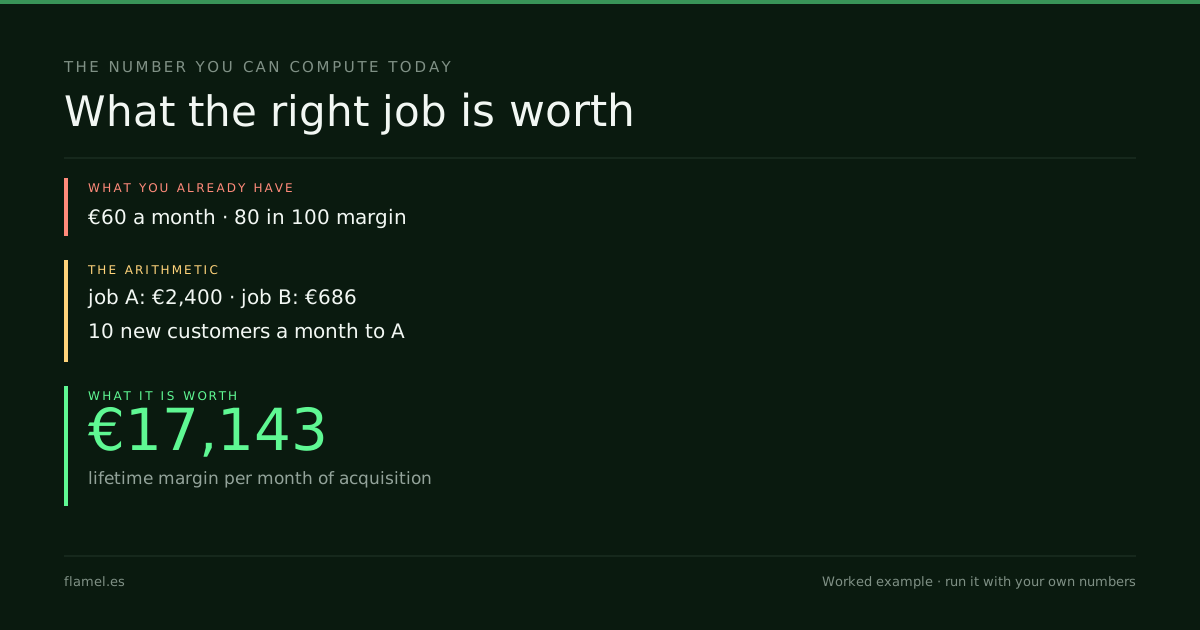
Lifetime value by job = ARPU × gross margin ÷ monthly churnThe example product charges €60 a month at a gross margin of 80 in every 100 (declared), so each customer leaves €48 of margin a month. The price and the customer base are the ones worked out in the SaaS pricing strategy post.
- Job A loses 2 of every 100 a month: €48 ÷ 0.02 = €2,400 of lifetime margin per customer.
- Job B loses 7 of every 100 a month: €48 ÷ 0.07 = €686.
Each academy is worth about 3.5 photographers. Now say marketing points part of the next campaign at the situation that creates job A, and 10 of the month's 44 new customers arrive with that job instead of job B. That is 10 × (€2,400 − €686) = €17,143 of lifetime margin, for each month of acquisition, without one more signup and without changing the price.
What to do this week: take 20 customers who cancelled in the last quarter and 20 who have stayed more than a year. Write, in one sentence each, the job they hired the product for, in their words where you have them. Count the jobs on each side. The job that stays is the brief for your next onboarding change and your next campaign.
Work through this with your own numbers
My SaaS product charges [monthly price] at a gross margin of [margin, as a share of revenue] and has [paying customers] paying customers. Here are one-sentence descriptions of why [number] customers who cancelled and [number] who have stayed more than a year started using it: [paste them]. Group them into jobs, each written as a situation, the progress wanted and how the customer knows it is done. For each job, estimate monthly churn from the two lists, calculate lifetime margin as price times margin divided by monthly churn, and tell me which job my onboarding and my next campaign should be built around, and what moving 10 new customers a month from the worst job to the best one would be worth.FAQ
What is an example of jobs to be done?
The best known is the milkshake: a fast-food chain found that many of its milkshakes were bought early in the morning by commuters, who hired them to make a long drive less boring and to stay full until noon. In a SaaS product, an academy may hire a scheduling tool to run a whole term, while a photographer hires the same tool to deliver a gallery after a shoot.
What is the jobs to be done framework?
It is a way of understanding demand by asking what progress a customer is trying to make in a specific situation, instead of who the customer is. The job has functional, social and emotional dimensions, and anything that gets it done competes for it, including spreadsheets, messaging apps or doing nothing.
How do you write a job statement?
Describe the situation, the progress the customer wants and how they will know it is done, in their words: when a term is about to start, I want enrollments and payments in one place, so the term begins without chasing anyone. Avoid naming your product or its features in the statement.
Why does jobs to be done matter for churn?
Because customers hiring a product for different jobs leave at different rates. An average churn figure blends them. Splitting churn by job shows which customers stay, what each one is worth over its lifetime and which job marketing and onboarding should be built around.
Naming the jobs your customers hire the product for, and setting each one next to who actually stays, is part of what The Activation Audit maps. Five business days, $500, and the map stays with you whether or not you hire anyone next.
Your store, five days.
$500. Zero commitment. Yours either way.