
Product qualified lead (PQL): usage as the signal
A product qualified lead is a signup whose usage says they will likely pay. How to set the threshold, and what following up only PQLs is worth in ARR.

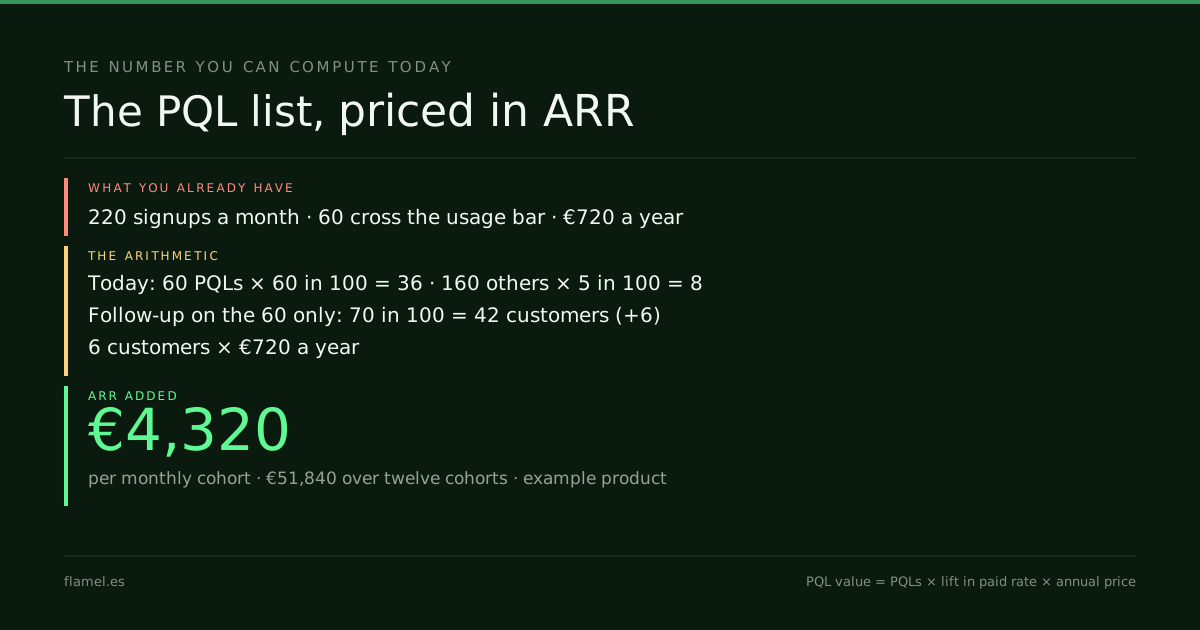
A product qualified lead (PQL) is a signup whose usage in the product already says they are likely to pay. Marketing qualifies leads by form fields and campaign source; product qualifies them by behavior. On a product with 220 signups a month, 60 cross the usage threshold. Following up only those, and lifting their paid rate from 60 to 70 in every 100, adds €4,320 of ARR per monthly cohort.
The PQL is the one definition both teams can share. It tells whoever follows up, a founder, a customer success hire or a sales rep, where to spend the week.
A product qualified lead (PQL) is a signup whose product usage signals they are likely to pay. On 220 monthly signups at €60 a month, 60 cross the usage threshold; lifting their paid rate from 60 to 70 in every 100 adds 6 customers, €4,320 of ARR per monthly cohort.
Key takeaways
- A product qualified lead is a signup whose usage already signals they are likely to pay; marketing qualifies by profile, product by behavior.
- Set the threshold from the action that, in the product's own history, came before paying.
- A higher bar gives fewer PQLs who pay more often; Tunguz put sales-called PQLs at about 25 to 30 in every 100.
- On 220 signups at €60 a month, lifting 60 PQLs from 60 to 70 in every 100 adds €4,320 of ARR.
- Compare last quarter's paid rate for signups who did the key action against those who did not.
What a product qualified lead actually is
Tomasz Tunguz described the PQL in 2013 as a potential customer who has used a product and reached pre-defined triggers that signal a strong likelihood of paying. His hypothetical example: at Expensify, a user who uploads 10 receipts and invites one friend is a PQL, and goes to sales.
Two lines from that post still hold. Each product will have a different definition, because each product measures engagement differently. And the best definitions are informed by conversion correlation data: the trigger is the action that, in the product's own history, came before paying.
PQL vs MQL: two teams, one list
In the same post, marketing qualifies leads through online advertising, branding, content, email and other channels. That marketing qualified lead (MQL) is scored on who the person is and what they read: job title, company size, the guide they downloaded. A PQL is scored on what they did inside the product.
When each team keeps its own score, the follow-up splits across two lists and nobody can say which one predicts paying. In product-led growth, the product does part of the selling. The PQL is the moment it hands the account to a person, and both teams can check that moment against who actually paid.

Setting the threshold from usage
The threshold starts from the action that predicts staying: the first real result a customer gets, which is what time to value measures. Look back at last quarter's signups. Split them into those who completed that action in their first two weeks and those who did not. Compare how many of each group paid. Where the gap is widest, that action is the PQL.
The bar decides the rate. Tunguz wrote that when the sales team calls PQLs, they typically convert at about 25 to 30 in every 100. A higher bar gives fewer PQLs who pay more often; a lower one gives more PQLs and a thinner list. Most signups reach the bar, or miss it, during onboarding, so that is where product's work on the PQL happens.
The worked example: 60 of 220
The example product this blog uses for SaaS: a subscription tool for creative businesses at €60 a month (€720 a year). It gets 220 signups a month, and 20 in every 100 pay: 44 customers, as in SaaS conversion rate. It is declared, not a client's numbers.
Declare a high bar: 60 of the 220 signups cross it.
PQLs:        60 signups × 60 in every 100 = 36 customers
Others:     160 signups ×  5 in every 100 =  8 customers
Total:                                      44 customers a month
Now the follow-up stops spreading across all 220 and goes to the 60. If that lifts their paid rate from 60 to 70 in every 100, and the other 160 keep paying at 5 in every 100 through the product alone:
PQLs:        60 × 70 in every 100 = 42 customers (+6)
6 customers × €720 = €4,320 of ARR per monthly cohort
Twelve cohorts make €51,840 of ARR in a year, before churn. The 6 customers move signup to paid from 44 to 50 of 220, about 2.7 points, at €1,584 of ARR a point.
The product qualified lead number for your product
PQL value = PQLs a month × lift in their paid rate × annual priceOn the example product: 60 × 0.10 × €720 = €4,320.
What to do by Monday: pull last quarter's signups, mark who completed the key action in their first two weeks, and compare the paid rate of both groups. If the gap is wide, put both teams' follow-up on that list.
Work through this with your own numbers
You are reviewing how a SaaS product qualifies its signups. Inputs: [signups last quarter], [the key action I think predicts paying], [how many signups completed it in their first two weeks], [how many of those paid], [how many of the rest paid] and [annual price per customer]. Calculate the paid rate of signups who completed the action and of those who did not, and say whether the gap is wide enough to use the action as a product qualified lead threshold. Then calculate the ARR added per monthly cohort if following up only the PQLs lifts their paid rate by [a lift I think is realistic], assuming the rest keep paying at their current rate. List two other actions worth testing as thresholds and the data that would confirm each. Do not recommend a threshold without naming the comparison that supports it.FAQ
What is the difference between a PQL and an MQL?
A marketing qualified lead is scored on who the person is and what they read, such as job title or a downloaded guide. A product qualified lead is scored on what they did inside the product. The PQL threshold is the action that, in the product's own history, came before paying.
How do you identify a product qualified lead?
Take last quarter's signups and split them by whether they completed one key action in their first two weeks. Compare the paid rate of each group. The action with the widest gap becomes the PQL threshold, and the follow-up goes to the signups who cross it.
What is a good PQL conversion rate?
Tomasz Tunguz wrote in 2013 that PQLs called by a sales team typically convert at about 25 to 30 in every 100. The rate depends on the bar: a higher threshold gives fewer PQLs who pay more often. Compare your PQLs with your other signups before comparing with another product.
Who owns product qualified leads, marketing or product?
Both. Product owns the threshold and the onboarding that gets signups to it. Marketing and whoever follows up own what happens after. The shared number is how many PQLs pay, checked every month against the signups who did not qualify.
Finding the action that predicts paying is part of what The Activation Audit maps, from signup to week two. Five business days, $500, and the map stays with you whether or not you hire anyone.
Your store, five days.
$500. Zero commitment. Yours either way.