
SaaS conversion rate: two rates, two owners
SaaS conversion rate is two rates multiplied: visitor to signup and signup to paid. Split it, price a point of each and see which team moves first.

SaaS conversion rate is the share of website visitors who become paying customers. It is two rates multiplied: visitor to signup, which marketing owns, and signup to paid, which product owns. On a product with 11,000 visits a month, 2 in every 100 sign up and 20 in every 100 of those pay: 44 customers.
Reported as one number, nobody can tell which half moved. Split, the same number shows which rate is cheaper to improve this cycle, and which team has to do it.
SaaS conversion rate = visitor-to-signup rate × signup-to-paid rate. Marketing owns the first; product owns the second. On 11,000 monthly visits, 2 signups per 100 visits and 20 paying customers per 100 signups give 44 customers. One more signup per 100 visits adds 22 customers: €15,840 of ARR before churn.
Key takeaways
- SaaS conversion rate is visitor-to-signup multiplied by signup-to-paid; one number hides which half moved.
- Marketing owns the first rate and product owns the second, so each needs its own owner and monthly target.
- On 11,000 visits a month, one more signup per 100 visits adds 22 customers: €15,840 of ARR before churn.
- One more paying customer per 100 signups adds 2.2 customers, €1,584 of ARR; a tenth more on either rate adds 4.4.
- Write last month's visits, signups and new customers in one row, and price a lift of one tenth on each rate.
What SaaS conversion rate is made of
SaaS conversion rate = (signups ÷ visits) × (paying customers ÷ signups)The first rate measures the website and the offer: does a visitor create an account? The second measures the product: does someone who signed up reach enough value to pay? The signup is the hand-off. Before it, the work belongs to marketing. After it, it belongs to onboarding and the product team.
ChartMogul's SaaS Conversion Report (February 2026, 200 software products) shows why the split matters. For every 1,000 website visitors, free trial products see 45 signups and 3.6 paying customers. Trials that require a credit card see 35 signups and 10.5 paying customers. Against the average trial, the card lowers marketing's rate and almost quadruples product's. Read as one number, the overall rate roughly tripled. Read as two, each team knows which part is theirs.
The worked example: 44 customers
The example product this blog uses for SaaS: a subscription tool for creative businesses at €60 a month (€720 a year), with 11,000 website visits a month. It is declared, not a client's numbers.
11,000 visits × 2 in every 100   = 220 signups
220 signups × 20 in every 100    = 44 paying customers a month
SaaS conversion rate             = 44 ÷ 11,000 = 0.4 in every 100 visits
Now move each rate by one point:
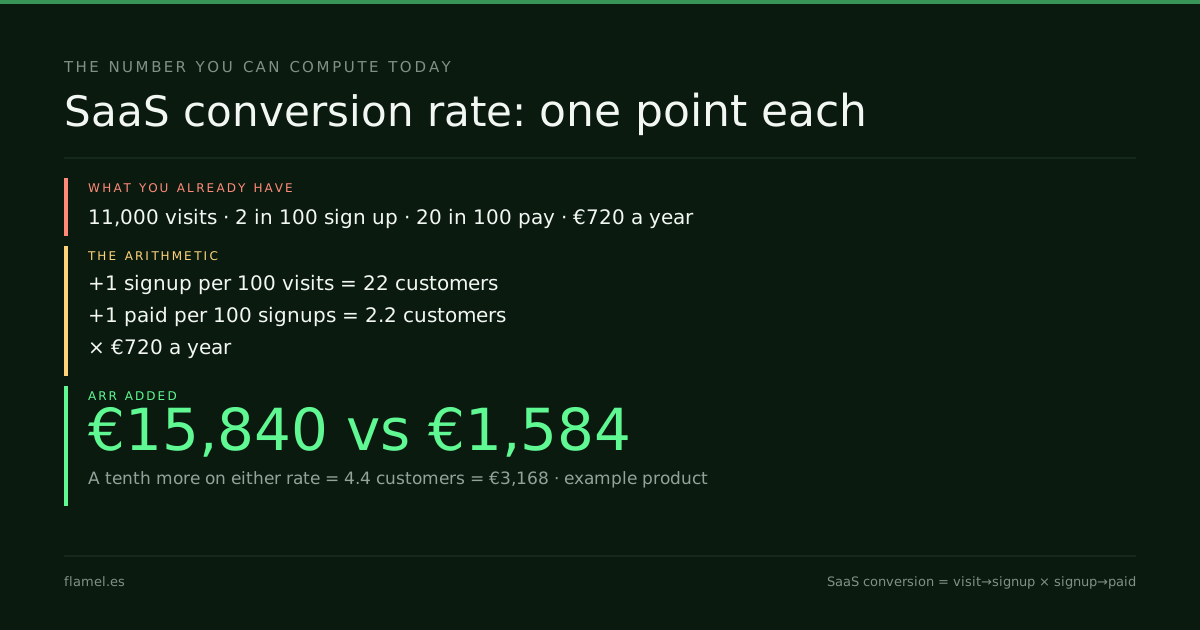
- One more signup per 100 visits: 3 in every 100 = 330 signups. At 20 in every 100, that is 66 customers, 22 more. 22 × €720 = €15,840 of ARR from each month's visits, before churn.
- One more paying customer per 100 signups: 21 in every 100 of 220 = 46.2 customers, 2.2 more. 2.2 × €720 = €1,584 of ARR.
The first looks ten times better. It is not a fair race. Going from 2 to 3 signups per 100 visits lifts marketing's rate by half. Going from 20 to 21 lifts product's rate by a twentieth.

Same lift, same customers
Because the SaaS conversion rate is a product of two rates, the same relative lift on either one moves the same number of customers. A tenth more on each:
Visitor to signup 2 → 2.2 in every 100:  242 signups × 0.20 = 48.4 customers (+4.4)
Signup to paid 20 → 22 in every 100:     220 signups × 0.22 = 48.4 customers (+4.4)
Both add 4.4 customers a month: €3,168 of ARR. So the choice is not which number looks bigger. It is which tenth is cheaper to win this cycle. If most signups never reach first value, product's rate is the cheaper one. If the site turns away visitors who already fit the product, marketing's is.
SaaS conversion rate, owner by owner
In a product-led growth model the product does part of the selling, and the hand-off blurs. The split still holds. Give each rate one owner, a monthly number and a target. Report the product of the two as the result both teams share.
On the example product, that is two lines in the monthly report: marketing at 2 in every 100 visits, product at 20 in every 100 signups, and 44 customers as the shared result. A month where signups rise to 260 while customers stay at 44 is not a marketing win. Product's rate fell to about 17 in every 100, and the gain on one side hid the loss on the other.
The number for your own product
ARR from one more signup per 100 visits          = monthly visits ÷ 100 × signup-to-paid × annual price
ARR from one more paying customer per 100 signups = monthly signups ÷ 100 × annual price
On the example product: 110 × 0.20 × €720 = €15,840, and 2.2 × €720 = €1,584.
What to do by Monday: write last month's visits, signups and new paying customers in one row. Compute both rates, then price a lift of one tenth on each. The cheaper tenth goes to the team that owns it.
Work through this with your own numbers
You are reviewing the conversion of a SaaS product. Inputs: [website visits last month], [signups last month], [new paying customers last month] and [annual price per customer]. Calculate visitor-to-signup, signup-to-paid and the overall SaaS conversion rate. Then calculate the ARR added by one more signup per 100 visits and by one more paying customer per 100 signups. Then calculate the customers and ARR added by a lift of one tenth on each rate, and confirm they are equal. For each rate, list the two most likely places where people stop and the team that owns them. Do not recommend a change without naming the data that would confirm it.FAQ
What is a good SaaS conversion rate?
There is no single good rate: it depends on the model. ChartMogul's 2026 report counts, per 1,000 website visitors, 3.6 paying customers for free trial products and 10.5 for trials that require a credit card. Compare your own two rates month against month before comparing their product with another company's.
How do you calculate SaaS conversion rate?
Divide new paying customers by website visits over the same period, or multiply visitor-to-signup by signup-to-paid: the result is the same. On 11,000 visits, 220 signups and 44 paying customers, the rate is 0.4 in every 100 visits: 2 in every 100 sign up, and 20 in every 100 of those pay.
What is the difference between visitor-to-signup and signup-to-paid?
Visitor-to-signup measures the website and the offer: how many visitors create an account. Signup-to-paid measures the product: how many of those accounts reach enough value to pay. The first is marketing's number and the second is product's. The same relative lift on either moves the same number of customers.
Who owns SaaS conversion rate, marketing or product?
Both, one rate each. Marketing owns visitor-to-signup and product owns signup-to-paid. The overall rate is the result they share. Reported only as one number, a drop in one half can hide behind a gain in the other.
Knowing where signups stop before they pay is what The Activation Audit maps, from signup to week two, ranked by what each stop costs. Five business days, $500, and the map stays with you whether or not you hire anyone.
Your store, five days.
$500. Zero commitment. Yours either way.