Renewal email: when to send it, what it's worth
When to send a renewal email to annual SaaS customers, what it must say, the rules in France and Germany, and what 10 points of renewal are worth.

A renewal email reaches an annual customer before the card is charged again. It decides whether the renewal feels like a surprise or like the obvious next year. Send the first one about 60 days before the renewal date, with what the customer did with the product that year. Send the last one a week before the charge.
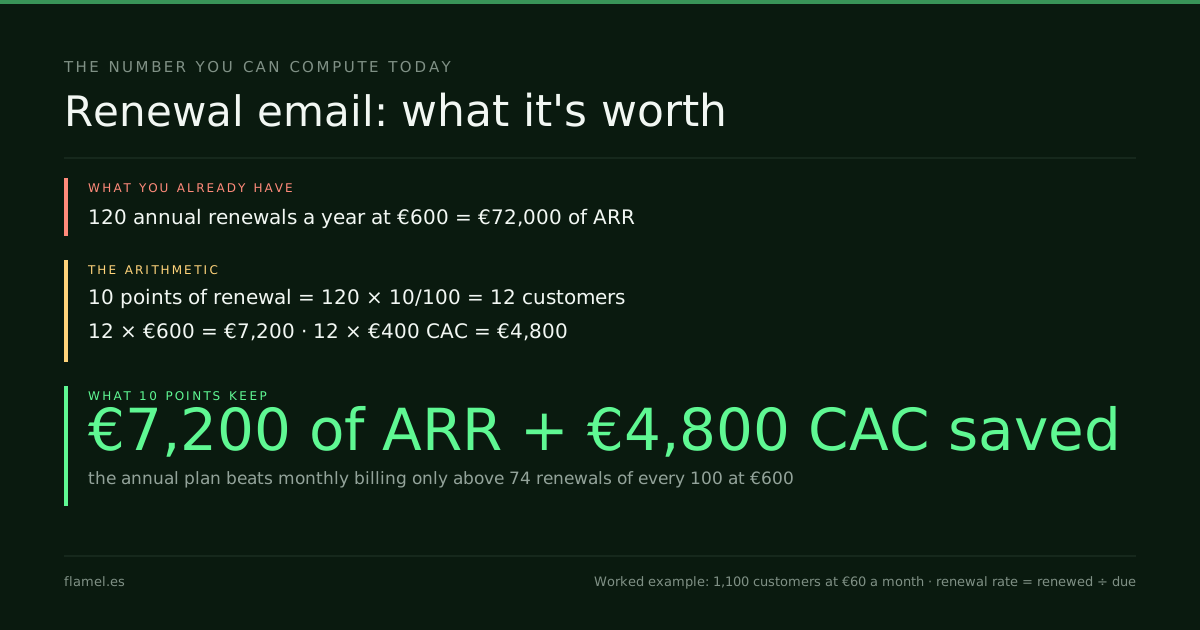
Marketing writes the renewal email, but it only works if product can show what the customer did with the year. Its value is set by the renewal rate the annual discount needed to pay off. On the example product, every 10 points of renewal are 12 customers: €7,200 of ARR and €4,800 of acquisition not spent.
Below: the renewal rate formula, what renewals are worth on the example product, the three emails and when each goes, the rules in France and Germany, and who owns what.
Send a renewal email about 60 days before an annual plan renews, a second at 30 days with the last day to cancel, and a payment reminder 7 days before the charge. On a product with 120 renewals a year at €600, each 10 points of renewal are worth €7,200 of ARR.
Key takeaways
- A renewal email decides whether an annual renewal feels like a surprise. Send the first about 60 days out, with the customer's year in numbers.
- On the example product, 10 points of renewal on 120 renewals a year are 12 customers: €7,200 of ARR and €4,800 of acquisition.
- The annual plan keeps more ARR than monthly billing only if at least 74 of every 100 renew at €600, or 61 at €720.
- France and Germany set rules for consumer renewals; check them if any customers buy as individuals.
- This week: list the annual customers renewing in the next 90 days and check who got a renewal email.
Renewal rate: the formula behind the email
The renewal email moves one number. Write it down before writing the email:
Renewal rate = annual customers who renewed
               ÷ annual customers whose term ended in the period × 100
Count only customers whose term ended in the period. A customer who canceled mid-term is churn, not a failed renewal. Read the rate by month of renewal, not as one yearly average: a bad month hides inside a good year.
What a renewal is worth on the example product
The product this blog's SaaS posts use has 1,100 customers at €60 a month and loses 4 of every 100 each month. The annual vs monthly subscription post sold its annual plan with two months free: €600 a year instead of €720. Ten of the 44 new customers each month take it.
A year later, those customers start reaching their renewal date:
Renewals due a year       = 10 a month × 12 = 120
ARR up for renewal        = 120 × €600      = €72,000

Each 10 points of renewal = 120 × 10/100    = 12 customers
ARR kept                  = 12 × €600       = €7,200
Acquisition not spent     = 12 × €400 CAC   = €4,800
The annual plan also has a floor. On monthly billing, the same 10 customers would reach month 12 with 6.13 still paying: €4,412 of ARR. The annual cohort keeps more only if enough of it renews:
Renewing at €600:  4,412 ÷ (10 × €600) = 0.74 → 74 of every 100
Renewing at €720:  4,412 ÷ (10 × €720) = 0.61 → 61 of every 100
Below that line, the two free months were given away. Say the renewal emails move the rate from 70 to 80 of every 100 (declared for the example). At 70, the annual plan loses to monthly billing. At 80, it wins, and the year keeps 12 more customers: €7,200 of ARR and €4,800 of acquisition not spent.
If the renewal rate is not written down yet, the Activation Audit maps what makes customers stay in five business days, for $500, and the map stays with you.

When to send the renewal email: three dates
One email is a notice. Three, each with its own job, make the renewal a decision the customer saw coming:
- 60 days before renewal: the year in review. What the customer did with the product: projects, active seats, the feature used most. Then the renewal date, the price and how to cancel. Product supplies the numbers; marketing writes the email.
- 30 days before: the decision date. The renewal date, the amount and the last day to cancel, said plainly. For an account the customer health score flags, this is the day for a call, not another email.
- 7 days before the charge: the payment reminder. The amount, the card on file and a link to update it.
Stripe Billing can send the third one. Its docs say: "Under Email notifications and customer management, turn on Send emails about upcoming renewals." Stripe sends it "before the current renewal period ends based on the days configured" in its settings, and only for subscriptions "with a collection_method of charge_automatically" (Stripe Docs). Plans paid by invoice need their own reminder.
If the charge fails anyway, the renewal becomes involuntary churn, with its own recovery. If the customer leaves, a win-back campaign starts from the exit reason.
The renewal email in Europe
If any customers buy as individuals rather than as businesses, a renewal that surprises them is also a legal problem. Two examples from the 27 member states:
France. Article L215-1 of the consumer code says the provider informs the consumer "par lettre nominative ou courrier électronique dédiés", "au plus tôt trois mois et au plus tard un mois avant le terme de la période autorisant le rejet de la reconduction" (Légifrance). In English: a dedicated letter or email, no earlier than three months and no later than one month before the last day to refuse the renewal. It must show "dans un encadré apparent, la date limite de non-reconduction": the deadline, in a visible box. Without that notice, the consumer can end the contract free of charge at any time after the renewal date.
Germany. Section 309 No. 9 of the civil code (BGB) voids standard terms that bind the customer to a tacit extension, "es sei denn das Vertragsverhältnis wird nur auf unbestimmte Zeit verlängert" (gesetze-im-internet.de). In English: unless the contract is extended only for an indefinite period, and the customer can cancel it at any time with at most one month's notice. Section 310 takes standard terms used "gegenüber einem Unternehmer", against a business, out of that rule (gesetze-im-internet.de).
For a consumer in Germany, an annual plan cannot roll into a second locked year in silence. The renewal email is where a second year is asked for on purpose.
Who owns the renewal email: both teams
Marketing owns the words and the dates. Product owns the year in numbers: the usage data the first email needs. A renewal email without usage only says a charge is coming. With usage, it says what the next year buys.
Read the renewal rate each month next to the health score. An account flagged 60 days out still has time for a conversation. An account flagged 7 days out gets a payment reminder and little else.
The renewal email number for your product
Renewal rate        = renewed ÷ due × 100
Value of 10 points  = renewals due × 10/100 × annual price
                      + the same customers × CAC
Floor               = ARR the monthly cohort keeps at month 12
                      ÷ ARR if every annual customer renewed
On the example product, every 10 points of renewal on 120 renewals a year are 12 customers: €7,200 of ARR and €4,800 of acquisition not spent. Below 74 renewals of every 100 at €600, the annual plan's two free months were given away.
What to do by Monday: list the annual customers renewing in the next 90 days, with their renewal date and last day to cancel. Check which of them got a renewal email, and when.
Work through this with your own numbers
Here are my SaaS numbers: [annual customers whose term ends each year], [annual plan price], [list price if the renewal drops the discount], [current renewal rate], [target renewal rate], [customer acquisition cost], and [ARR the same customers would keep at month 12 on monthly billing]. Calculate: the customers gained by moving from the current to the target renewal rate; the ARR those customers keep and the acquisition cost not spent replacing them; and the floor renewal rate at which the annual plan keeps more ARR than monthly billing (monthly ARR at month 12 divided by the ARR if every annual customer renewed), at the annual price and at list price. Then, from this list of customers with [renewal date] and [last day to cancel], give me the send date of each renewal email: 60 days before renewal, 30 days before, and 7 days before the charge. Show every step of the arithmetic.FAQ
When should you send a renewal email?
The first about 60 days before the renewal date, a second at 30 days with the last day to cancel, and a payment reminder about 7 days before the charge. In France, the consumer notice goes between three months and one month before the deadline to refuse renewal.
What should a renewal email include?
The renewal date, the amount, the last day to cancel and how to do it, and what the customer did with the product that year. The payment reminder adds the card on file and a link to update it.
How do you calculate renewal rate?
Divide the annual customers who renewed by the annual customers whose term ended in the same period, and multiply by 100. Customers who canceled mid-term count as churn, not as failed renewals.
Can Stripe send renewal reminder emails?
Yes. Stripe Billing has a setting to send emails about upcoming renewals a set number of days before the period ends. It only sends them for subscriptions charged automatically, not for plans paid by invoice.
The Activation Audit maps what makes customers stay: five business days, $500, and the map stays with you whether or not you hire anyone.
Your store, five days.
$500. Zero commitment. Yours either way.
Made between
Barcelona and Bogotá.
What’s holding your store’s sales back, in minutes.
Free, no card. Shopify stores for now.