Win back campaign: 4 examples, by exit reason
A win back campaign works when the reason a customer left has changed. Four examples by exit reason, and what bringing back 16 accounts is worth.

A win back campaign writes to customers who already left. It works when they have a reason to come back, and that reason is almost always a change: a release that fixed what they left over, a plan that fits, a first week that now works. So the list belongs to marketing, but the reason belongs to product.
Most examples in circulation are emails: a subject line, a discount, a friendly nudge. The email is the last step. The first step is knowing why each account left and what has changed since.
Priced against acquisition, a returning customer is the cheapest one a product can get. There is no ad to pay for, and the account already knows the product.
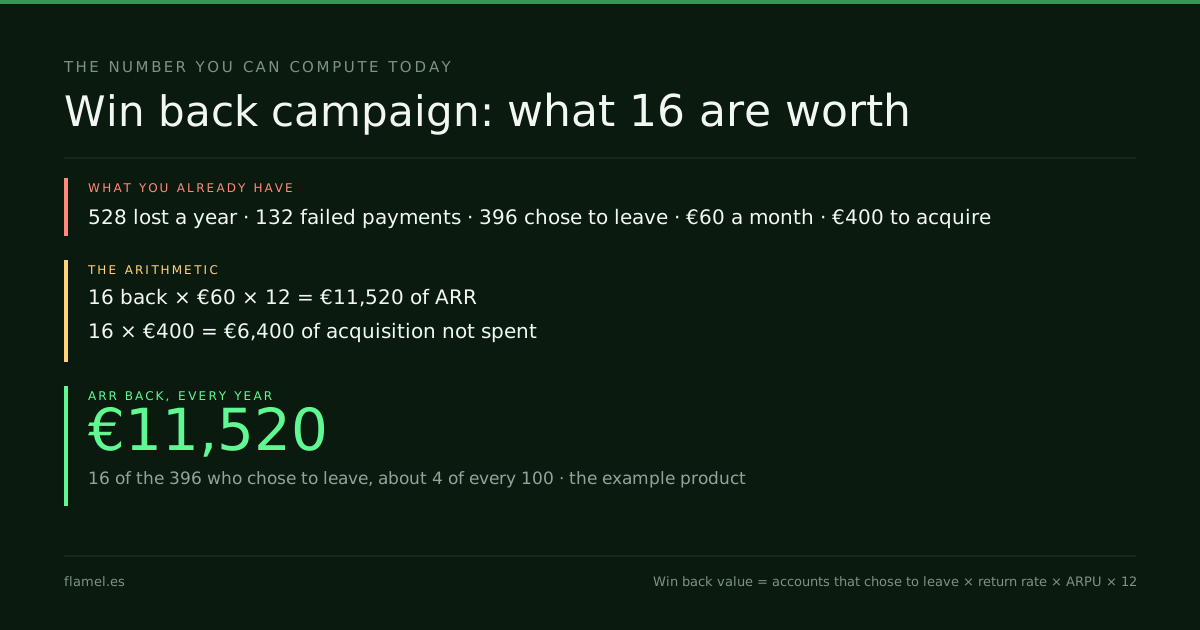
A win back campaign writes to customers who left, and works only when the reason they left has changed. On a product with 1,100 customers at €60 a month, bringing back 16 of the 396 who chose to leave last year adds €11,520 of ARR and saves €6,400 of acquisition.
Key takeaways
- A win back campaign works only when the reason a customer left has changed: a release, a plan or an onboarding.
- Split the lost list first: failed payments need a card update, not a campaign.
- Four examples by exit reason: a missing feature, the price, never activated, and moved to a competitor.
- On 1,100 customers at €60, bringing back 16 of 396 adds €11,520 of ARR and saves €6,400 of acquisition.
- Export last year's cancellations, group them by exit reason and write only to the groups where something changed.
Before the win back campaign: the exit reason
Every canceled account carries a reason, even when nobody asked for it. Some products ask at the cancel button. Others find it in the last support tickets, the usage log or the notes from the last call. Without it, a win back campaign sends the same message to everyone, and the only lever left is a discount.
Start by splitting the list. Payments that failed are not a win back job. Those customers never decided to leave, and involuntary churn has its own fix: a retry, a card update and the bank's check.
What is left are the accounts that chose to go. Group them by reason, then hold each group against one question: what has changed since they left? If the answer is nothing, there is no campaign for that group yet. There is a product lesson.
1. The missing feature: now shipped
Who gets it: accounts that left saying the product could not do one thing they needed.
What changed: a release that does it.
The message: one line on what shipped, a short clip of it working, and a link back into their own account. No discount. The reason they left is gone, and a discount would say the problem was the price.
Product names the release and the accounts it answers. Marketing writes and sends. After they return, the feature adoption rate of that one feature among them says whether the campaign brought back users or just logins.
2. The price: a plan that fits
Who gets it: accounts that left over price, often because they used one part of the product and paid for all of it.
What changed: a smaller plan, a usage tier or a yearly option.
The message: the new plan, priced on what that account actually used before it left.
The trap is the opposite case. If nothing changed in the pricing, a time-limited discount brings them back at a price they already said was too high, and they leave again when it ends. Annual vs monthly subscription shows how to price a yearly offer without paying for it twice.

3. Never activated: a new first week
Who gets it: accounts that canceled in their first weeks, often before they reached the result the product promises.
What changed: an onboarding that gets to that first result faster.
The message: an invitation to start again, with the shorter path laid out in three steps.
These accounts never saw the product work. Writing to them about features misses the point; showing them the path does not. Time to value is the number to compare before and after the new onboarding.
4. Moved to a competitor: the way back
Who gets it: accounts that switched to another tool.
What changed: a release that closed the gap they left over, or something the other tool still cannot do.
The message: the gap, closed, and a clear path to bring their data back.
In the EU that path has fewer locks than it used to. The Data Act applies since 12 September 2025. The European Commission's Data Act explainer says providers of Platform and Software as a Service "must make open interfaces available and, at a minimum, export data in a commonly used and machine-readable format". It adds that the Act "will also entirely remove switching charges, including charges for data egress (i.e. charges for data transit), from 12 January 2027."
That cuts both ways. Leaving gets cheaper, and so does coming back. A win back message to a European account that switched can offer to import its data from the other tool, so returning does not mean starting from zero.
What a win back campaign is worth
Take the product this blog's SaaS posts use: 1,100 paying customers at €60 a month, €66,000 of MRR. Every month 4 of every 100 cancel, 44 customers. Replacing them costs €17,600 of acquisition a month, €400 per new paying customer, the customer acquisition cost of the example.
Of those 44, 11 a month are failed payments, the split the involuntary churn example declares. Over a year:
Accounts lost in the last year     44 × 12          = 528
  failed payments                  11 × 12          = 132   (a card update, not a campaign)
  chose to leave                   528 − 132        = 396
Brought back by the four campaigns                  = 16    (about 4 of every 100 who chose to leave)
ARR back                           16 × €60 × 12    = €11,520
Acquisition not spent              16 × €400        = €6,400
The 16 is declared for the example, not a client's. It is also the figure to price the campaigns against. Any campaign that costs less than €6,400 a year, in time and in whatever it offers, has paid for itself before the ARR is counted.
The order matters. On the same product, recovering 6 failed payments a month keeps €4,320 of ARR every month. The failed payments come first. The win back campaign comes after, for the accounts that chose to go.
If you don't know why your accounts leave, the Activation Audit maps where customers drop off and which exit reasons a release could fix.
Who owns a win back campaign: both halves
Marketing owns the list, the timing and the message. Product owns the reason: the release, the plan or the onboarding that changed. A campaign with only one owner fails in one of two ways. Marketing alone sends a discount to everyone. Product alone ships the fix and never tells the people who left over it.
The meeting that joins them is short. Once a month, product brings the releases that shipped, marketing brings the exit reasons, and both mark which groups now have a reason to return.
The returns show up in two numbers the product already reads. They lower the net loss in the SaaS churn rate, and the ones who stay past their first renewal raise the customer retention rate.
The win back campaign number for your product
Win back value      = accounts that chose to leave × return rate × ARPU × 12
Acquisition saved   = accounts brought back × acquisition cost per customer
On the example product, 16 of 396 accounts back is €11,520 of ARR and €6,400 of acquisition not spent.
What to do by Monday: export last year's cancellations. Take out the failed payments. Group the rest by exit reason, and next to each group write what has changed since. Write only to the groups where something did.
Work through this with your own numbers
I run a SaaS product with [number of paying customers] customers paying [ARPU] a month on average. Last year [accounts lost] accounts canceled, of which [failed payments] were failed payments. My acquisition cost is [acquisition cost] per new paying customer. Here are the exit reasons I have, grouped: [paste the groups and their counts], and here is what has changed in the product since: [paste releases, plans and onboarding changes]. Take the failed payments out of the list. For each remaining group, say whether something has changed that answers its reason, and draft a one-line message only for the groups where it has. Then calculate the win back value as accounts that chose to leave × return rate × ARPU × 12 for return rates of 2, 4 and 6 of every 100, and the acquisition saved as accounts brought back × acquisition cost. Show every step.FAQ
What is a win back campaign?
A win back campaign is a set of messages to customers who canceled, asking them to return. In SaaS it works when something has changed since they left, such as a release, a plan or an onboarding, and it writes only to the accounts that change answers.
What is an example of a win back campaign?
An account left because the product lacked one feature. The feature ships, and the account gets one message: what shipped, a short clip of it working and a link back into its own account. No discount, because price was not the reason it left.
When should you send a win back email?
When the reason the account left has changed, not on a fixed date after cancellation. A message sent before anything changed can only offer a discount, which brings back accounts at a price they already rejected.
How do you measure a win back campaign?
Count the accounts that return and multiply by ARPU × 12 for the ARR back, then by the acquisition cost per customer for what the product did not have to spend. On the example product, 16 accounts are €11,520 of ARR and €6,400 of acquisition.
The Activation Audit maps where your customers leave: five business days, $500, and the map stays with you whether or not you hire anyone next.
Your store, five days.
$500. Zero commitment. Yours either way.
Made between
Barcelona and Bogotá.
What’s holding your store’s sales back, in minutes.
Free, no card. Shopify stores for now.