SaaS pricing page: the page both teams write
A SaaS pricing page is where marketing's words meet product's plans. What one more signup per 100 visits is worth: €4,320 of ARR a month.

A SaaS pricing page is the one page both teams write. Marketing chooses the words. Product chooses the plans, the limits and what each one includes. It is where a buyer decides whether the product is for them, so a vague plan name or a hidden limit costs signups that marketing already paid for.
Most teams edit it from one side at a time. Marketing tests a headline. Product changes a limit in the billing settings. Nobody reads the whole page the way a buyer does, top to bottom, trying to find their own plan.
The sum below runs on the example product this blog uses for SaaS, which is flat: marketing brings 44 customers a month and churn takes 44. It ends on what one more signup per 100 pricing page visits is worth in ARR.
A SaaS pricing page is where marketing's words meet product's plans, and where a buyer decides if the product fits. On a product with 3,000 pricing page visits a month, one more signup per 100 visits brings 30 signups, 6 customers and €4,320 of ARR a month.
Key takeaways
- A SaaS pricing page is written by two teams: marketing chooses the words, product chooses the plans and limits.
- Plan names should let buyers find themselves in a second: Solo, Studio, Academy instead of Basic, Pro, Business.
- On 3,000 monthly visits, one more signup per 100 brings 30 signups and 6 customers: €4,320 of ARR a month.
- AI assistants answer from public pages: a pricing page their crawler cannot read leaves the answer to someone else's page.
- Divide three months of signups through the pricing page by its visits, then read the page as each kind of buyer.
What a SaaS pricing page has to answer
A buyer arrives with three questions. Which plan is mine? What will it cost me at my size? What happens when I click? Every line on the page should answer one of them.
The first question belongs to product. Patrick McKenzie, who works on Stripe Atlas, puts it plainly in Stripe's guide to pricing low-touch SaaS: “Lite / Standard / Premium are weak names for SaaS plans because they don't help a user make an instant decision on which plan is right for them.” He asks for plan names “that help users bucket themselves.”
In a tool for creative businesses, that is concrete. A photographer, a studio with three teachers and an academy with 400 students are three buyers. Names like Solo, Studio and Academy let each one find their row in a second. Basic, Pro and Business make them read every line.
The second question belongs to both teams. The same guide says: “You should only include the most salient details on your pricing page. If there is a difference between plans that is not salient to your customers or to you, it should not be a difference between plans.” Product decides which limits exist. Marketing decides which ones the page shows. A limit the page hides still reaches the buyer, later, as a surprise.
The SaaS pricing page example: 3,000 visits
The example product has 1,100 paying customers at €60 a month (€720 a year). It gets 11,000 visits a month. Two in every 100 visitors sign up, 220 a month, and 20 in every 100 signups pay: 44 new customers. All of it is declared, not a client's numbers.
Now declare the pricing page. 3,000 of the 11,000 monthly visits reach it, and 4 in every 100 of those visitors sign up. That is 120 of the 220 signups. The page is where more than half of the month's signups decide.
Pricing page visits:   3,000 a month
Signups today:         3,000 × 4 in every 100 = 120
One more per 100:      3,000 × 5 in every 100 = 150
Extra signups:         150 − 120              = 30
Extra customers:       30 × 20 in every 100   = 6
ARR added:             6 × €720               = €4,320 a month
The flat line tilts. 50 customers arrive and 44 leave, so the product grows by 6 a month. Bought through marketing at €400 each, those 6 customers would cost €2,400 a month.
The figure fits the post on SaaS conversion rate: one more signup per 100 visits across all 11,000 visits is worth €15,840 of ARR. The pricing page holds 3,000 of those visits, so its share is €4,320.
Where buyers stall between the pricing page and their first session, and what AI assistants say about the category, is what The Activation Audit maps in five business days, for $500.

SaaS pricing page examples: three repairs
The Stripe guide reviews real pricing pages, case by case. Three of its repairs show how the page splits between the two teams.
- Too many plans (product). On one page McKenzie counts 8 plans and recommends condensing them to 3, plus a line inviting enterprise buyers to get in touch. 8 plans ask the buyer to forecast their own usage. 3 let them pick a bucket.
- Weak names (both). Generic tier names make the buyer read the feature list to find themselves. Names built on who the buyer is do that work in the header.
- The wrong button (marketing). On another page he notes: “Nobody can ‘Choose plan’ on Enterprise/Agency.” A plan that needs a conversation should have a contact button, not a checkout one.
None of the three is a design change. Each is a decision one team makes and the other has to show. That is why the page drifts when only one team reviews it.
The price itself is a separate decision, covered in SaaS pricing strategy. This page is about whether a buyer can read it.
The pricing page the assistant reads
A buyer can now ask an AI assistant which of 3 or 4 tools to use before visiting any site. The assistant's answer about plans and prices comes from public pages, the pricing page among them, if it can read it.
OpenAI's documentation on its crawlers says OAI-SearchBot “is used to surface websites in search results in ChatGPT's search features,” and that “sites that are opted out of OAI-SearchBot will not be shown in ChatGPT search answers.” A pricing page blocked from that crawler leaves the answer to someone else's page: a review site, an old comparison, a competitor.
This is the newest place where the two teams meet. Marketing controls what crawlers may read. Product controls whether the plans on the page are current. An assistant that quotes last year's limits is quoting a page nobody owned.
The SaaS pricing page after the click
The page's job does not end at the signup button. A plan name promises something, and the buyer checks that promise in the first session. If Studio promises class scheduling and scheduling takes three days to set up, the signup the page won is lost in onboarding. On the example product, 176 of the 220 monthly signups never pay, and the pricing page won each of them once. The post on time to value measures that gap.
A free plan or a trial is also a line on the pricing page, and it changes who signs up. In product-led growth, the free plan is the first step of the funnel. On the pricing page, it is a promise about what the paid plans add.
The SaaS pricing page number for your product
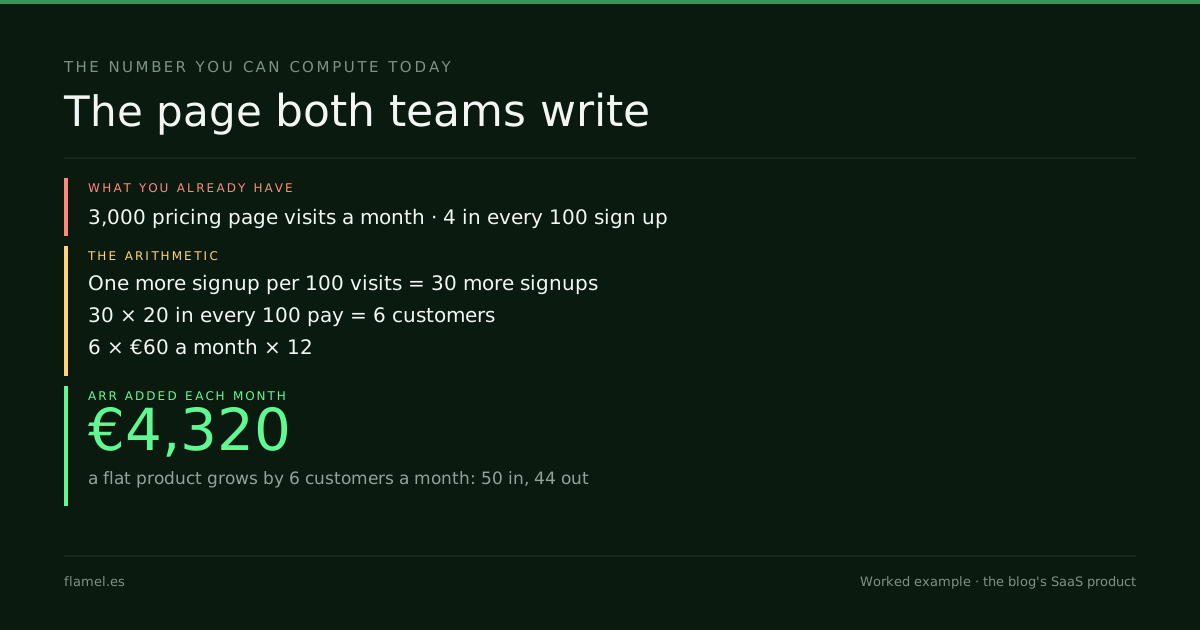
Pricing page value = monthly visits × extra signups per 100 visits
                     × signup-to-paid × monthly price × 12
On the example product: 3,000 × 1 in every 100 × 20 in every 100 × €60 × 12 = €4,320 of ARR for each month's signups.
What to do by Monday: pull three months of pricing page visits and the signups that passed through the page. Divide one by the other. Then read the page as each of your three most common buyers, and ask two AI assistants what the product costs. Every answer that is wrong names a line one team owns.
Work through this with your own numbers
You are reviewing a SaaS pricing page with its product and marketing leads. Inputs: [monthly pricing page visits], [signups per month that passed through the pricing page], [share of signups that become paying customers] and [average monthly price per customer]. Calculate today's signup rate on the page as signups ÷ visits. Then calculate what one more signup per 100 visits is worth: visits × 0.01 × signup-to-paid × monthly price × 12, as ARR added per month of signups. Show each step. Then list the plans on the page and, for each, say who the buyer is, which limit decides between this plan and the next, and whether the page states that limit. Flag every line that one team owns and the other has not reviewed.FAQ
What should a SaaS pricing page include?
Plans named for who buys them, the limits that change a buyer's choice, the price at the buyer's size, and a clear next step for each plan. Details that do not change the choice belong elsewhere. A plan that needs a conversation gets a contact button.
How many plans should a SaaS pricing page have?
Few enough that a buyer finds their own in a second, plus a way for larger buyers to get in touch. In Stripe's guide to pricing low-touch SaaS, a page with eight plans is condensed to three, because more plans ask buyers to forecast their own usage.
Who should own the SaaS pricing page?
Both teams. Product owns the plans, limits and what each one includes. Marketing owns the words, the order and what crawlers can read. One shared review, read as a buyer, catches the gaps neither team sees alone.
How do you measure a pricing page?
Signups that passed through the page divided by its visits, then signups to paid. On a product with 3,000 pricing page visits a month and 20 in every 100 signups paying, one more signup per 100 visits is worth €4,320 of ARR a month.
Before the next change to plans or copy, read the page the way a buyer and an AI assistant read it. The Activation Audit maps where buyers stall in five business days, for $500, and the map stays with you whether or not you hire anyone.
Your store, five days.
$500. Zero commitment. Yours either way.