Black Friday promotion ideas: 4 days, 4 offers
Black Friday promotion ideas as four offers, one per day from Friday to Monday, each read on its own margin, with a worked store and European data.

Most Black Friday promotion ideas are ideas for one long promotion: the same discount from Friday to Monday. The template comes from the United States, where Cyber Monday is the biggest online shopping day of the year. A European store's weekend has another shape. One discount on four days gives the same margin away to four different crowds.
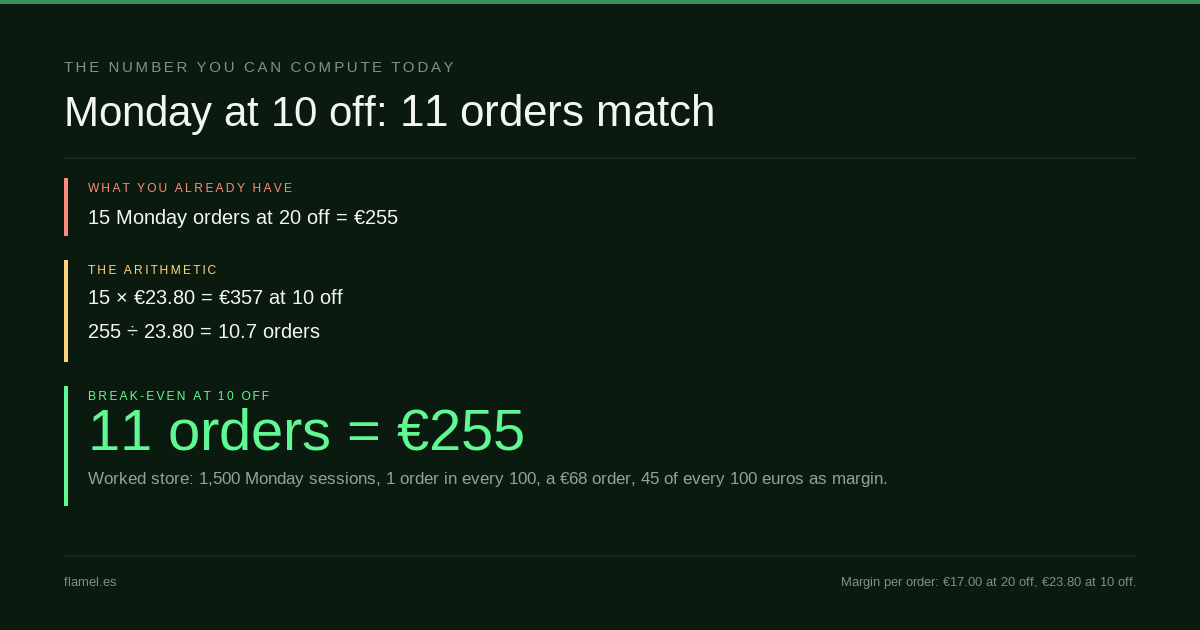
The better idea is four offers, one per day, each read on its own margin. On the worked store this blog uses, Monday at 10 off instead of 20 off keeps €102 more on the same 15 orders. With only 11 orders it still earns as much. That makes Monday the cheapest test of the weekend.
Below: why one discount is the wrong template in Europe, the four offers day by day, how to read them, and the number to run on your own store.
Black Friday promotion ideas work better as four offers, one per day from Friday to Monday, each read on its own margin. On a worked store at 1 order per 100 sessions, a 20-off Monday earns €255 on 15 orders; at 10 off it earns €357, and 11 orders already match €255.
Key takeaways
- Black Friday promotion ideas usually mean one discount from Friday to Monday. Four days bring four crowds: give each day its own offer and read its own margin.
- Cyber Monday is the biggest online day in the United States. In Adyen's 2025 data, Black Friday ran at 4.47 times a typical Friday in Spain.
- Friday carries the depth: at 20 off an order keeps €17.00 instead of €30.60, so Friday needs 1.8 times the orders to match full price.
- Monday is the test: at 10 off, 15 orders keep €357 against €255 at 20 off, and 11 orders already match.
- Before Friday: write the four offers, one per day, with planned orders and margin per order next to each.
Black Friday promotion ideas: one offer, four crowds
The usual plan runs one code from Friday to Monday. It is built for the United States. There, Adobe counted $14.25 billion of online spending on Cyber Monday 2025 against $11.8 billion on Black Friday, and calls Cyber Monday "the biggest online shopping day of all time" (Adobe).
European payment data has another shape. Adyen compared its transaction volume on Black Friday 2025, from Thursday noon to Saturday morning CET, with the average of the five Fridays before. Black Friday ran at 6.11 times a typical Friday in Denmark and 4.47 times in Spain, against 2.80 times in the United States (Adyen). The online peak hour fell on Friday evening in Germany and the UK, and on Sunday at 8 p.m. in France.
Adyen does not report Cyber Monday on its own, and no European payments source found for this comparison does. So a European store should not assume Monday is its biggest day. It should plan Monday as the smaller day and measure it.
Four days also bring four crowds. Friday brings the most visitors, many of them there for the depth. Past buyers would often have bought anyway. By Monday, most visitors have already seen the offer. One discount for all of them cuts the same margin from every order, including the orders it did not need to win.
1. Friday: the deep offer, priced first
Friday carries the depth because it carries the crowd. The worked store has 300,000 sessions a year, 1 order in every 100 sessions, a €68 average order and 45 of every 100 euros as margin. Its declared Black Friday week brings 12,000 sessions. Friday takes a quarter: 3,000 sessions and 30 orders.
At 20 off:       30 × €17.00 = €510 of margin
At full price:   30 × €30.60 = €918 of margin
To match €918:   918 ÷ 17.00 = 54 orders, 1.8 times
That 1.8 times is the price of the depth, worked in the Black Friday discount strategy post. The idea for Friday is to choose the depth backwards, from the orders the day can realistically win, not from the banner a competitor shows.
2. Saturday: a bundle instead of depth
Saturday's offer can raise the order instead of cutting the price. Two products sold together at 10 off keep more margin than the same two at 20 off. On the worked store, a two-product order keeps €61.20 of margin at full price, €47.60 as a 10-off bundle and €34.00 at 20 off.
Bundle, 10 off:    61.20 ÷ 47.60 = 1.29 times the orders to match full price
Markdown, 20 off:  61.20 ÷ 34.00 = 1.80 times
The full calculation and the settings to check are in the post on bundle pricing. For Saturday, the idea is simple: the same visitor, a bigger basket, and half the discount on every euro sold.

3. Sunday: past buyers at 10 off
Sunday is the day to write to the customers who bought from the store before and have not bought this weekend. They know the products. They do not need the deepest offer to come back. In France, Adyen's online peak hour fell on Sunday at 8 p.m., so for a store that sells there, Sunday evening is not a quiet slot.
At 10 off, a €68 order sells for €61.20 and keeps €23.80 of margin, against €17.00 at 20 off: €6.80 more per order. The post on Black Friday early access runs the same test before Friday, with time instead of depth. Offer 10 off to half the past buyers, keep the other half on the public offer, and compare orders per recipient.
4. Cyber Monday: the shallower test
Monday is the smallest of the four days in the declared base: half of Friday, 1,500 sessions and 15 orders. That makes it the cheapest place to test a smaller discount.
| Monday at 20 off | Monday at 10 off | |
|---|---|---|
| Orders (1 in every 100 sessions) | 15 | 15 |
| Order value | €54.40 | €61.20 |
| Margin per order | €17.00 | €23.80 |
| Margin of the day | €255 | €357 |
| Orders to earn €255 | 15 | 11 |
Same orders:   15 × €23.80 = €357, €102 more than 15 × €17.00 = €255
Break-even:    255 ÷ 23.80 = 10.7, so 11 orders
At 10 off, Monday can lose 4 of its 15 orders and still earn the same margin. If it keeps 11 or more, the deeper discount was giving margin away on Monday. If it falls below, the store has learned the price of depth on its own traffic, on its smallest day.
If the weekend cannot be read day by day, the Conversion Audit maps where a store's orders and margin leave in five business days.
Reading the four offers on Tuesday
Read each day against its own plan, not against the weekend's total. Four rows: sessions, orders, order value and margin of the day. Then one more number decides whether the weekend paid: the orders that would have arrived anyway.
Some Friday orders were coming at full price. Some were pulled forward from December. The post on promotion incrementality counts both on the same store: of 120 orders in the promotion week, 36 were new. A weekend that looks good on Tuesday can still lose margin by mid-December.
The Black Friday promotion ideas number for your store
Margin per order   = full price × (1 − discount) − cost of the products
Margin of the day  = orders × margin per order
Orders to match    = margin to match ÷ margin per order at the new offer
On the worked store, Friday at 20 off keeps €510 and Monday €255. At 10 off, Monday keeps €357 on the same 15 orders, and 11 orders already match €255.
What to do before Friday: write four offers, one per day, each with its planned orders and margin per order next to it. Mark Monday as the test, and decide now what result would change next year's plan.
Work through this with your own numbers
Here are my store's numbers: average order value [€], cost of the products in an average order [€], and conversion rate [orders per 100 sessions]. My planned sessions are [Friday], [Saturday], [Sunday] and [Monday], and my planned discounts are [Friday depth], [Saturday offer], [Sunday offer] and [Monday depth]. For each day, calculate the orders (sessions × conversion rate), the order value after the discount, the margin per order (order value after discount − cost) and the margin of the day (orders × margin per order). Then, for Monday, calculate how many orders a shallower discount needs to earn the same margin as the deeper one (margin of the day at the deeper discount ÷ margin per order at the shallower one), rounded up. Show every step of the arithmetic in a table, one row per day.FAQ
What is the difference between Black Friday and Cyber Monday?
Black Friday is the Friday after Thanksgiving and Cyber Monday the Monday after it. In the United States, Cyber Monday is the bigger online day: $14.25 billion against $11.8 billion in 2025, per Adobe. In European payment data the Black Friday surge is larger than in the United States, and no European source reports Monday on its own.
Should a store run the same discount on Black Friday and Cyber Monday?
Not by default. The two days bring different crowds and different traffic. On the worked store, Monday at 10 off instead of 20 off keeps €357 instead of €255 on 15 orders, and 11 orders already match €255.
How deep should a Black Friday discount be?
Start from the orders the day can win. At 20 off, a €68 order with 45 of every 100 euros as margin keeps €17.00 instead of €30.60, so the promotion needs 1.8 times the orders to earn the same margin.
When is Cyber Monday in 2026?
Monday, November 30, 2026. Black Friday falls on Friday, November 27, the day after Thanksgiving, so the four days of the weekend run from November 27 to November 30.
Before Friday, the Conversion Audit maps where a store's orders and margin leave: five business days, $500, and the map stays with the store.
Your store, five days.
$500. Zero commitment. Yours either way.

Made between
Barcelona and Bogotá.
What’s holding your store’s sales back, in minutes.
Free, no card. Shopify stores for now.