Blended CAC vs paid CAC: which one to budget on
Blended CAC vs paid CAC: the two formulas, a worked SaaS product split by channel, and why next year's budget should price new ad spend at paid CAC.

Blended CAC divides all acquisition spend by all new customers. Paid CAC divides only paid media by the customers paid media brought. Most budgets are planned on blended CAC, and that overstates what extra paid spend will buy: the free channels that pull the blended number down do not grow with the ad budget.
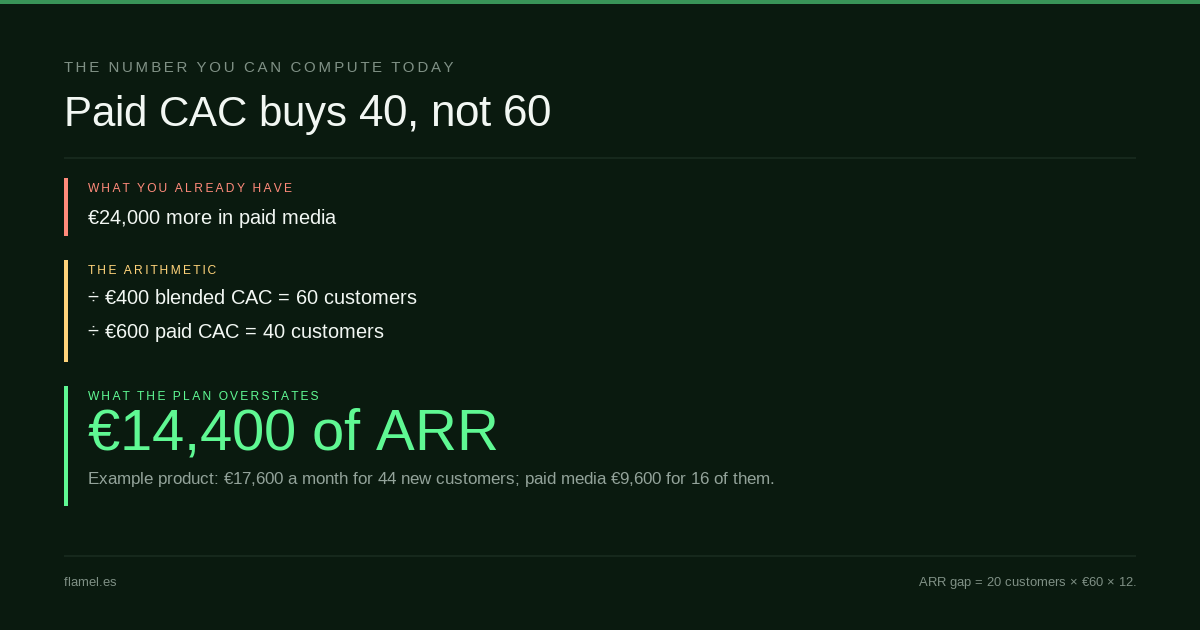
On the example product this blog's SaaS posts use, blended CAC is €400 and paid CAC is €600. Adding €24,000 to paid media buys 40 customers, not the 60 the blended number promises. The 2027 plan overstates ARR by €14,400.
Below: the two formulas, the example product split by channel, what the gap does to next year's plan, the case where the free channel does scale, why paid CAC is partly modeled in Europe, and the number to run on your own product.
Blended CAC is all acquisition spend divided by all new customers; paid CAC is paid media divided by the customers it brought. Budget new ad spend on paid CAC. On a product with €400 blended and €600 paid CAC, €24,000 more in ads buys 40 customers, not 60.
Key takeaways
- Blended CAC divides all acquisition spend by all new customers. Paid CAC divides paid media by the customers paid media brought.
- Price extra ad spend at paid CAC: the free channels that lower the blended number do not grow with the ad budget.
- On the example product, blended CAC is €400 and paid CAC €600: €24,000 more in ads buys 40 customers, not 60.
- In the European Economic Area, part of Google's ad conversions are modeled under consent mode. Count paid customers from your own signup and billing records.
- Before the budget meeting: split last year's new customers and spend by channel, and price each new euro of ads at paid CAC.
Blended CAC vs paid CAC: two formulas
Blended CAC = all acquisition spend ÷ all new customers
Paid CAC    = paid media spend ÷ new customers from paid media
Blended CAC counts everything it takes to win customers: ads, the marketing team, content and tools. It divides that by every new customer, whatever brought them: search, a referral, a colleague's recommendation or an ad. It answers one question: what the whole acquisition machine costs per customer.
Paid CAC counts only the money spent on ads and the customers those ads brought. It answers another question: what the next euro of ads is likely to buy.
Neither number is wrong. The mistake is answering the second question with the first. Blended CAC is pulled down by customers who cost no media at all, and those customers do not multiply when the ad budget does. On the example product below, the same month gives €400 blended and €600 paid.
The example product, split by channel
The example product has 1,100 paying customers at €60 a month. It gets 11,000 visits and 220 signups a month, and 20 in every 100 signups pay: 44 new customers, as worked in the post on SaaS conversion rate. Marketing spends €17,600 a month to win them, so its customer acquisition cost is €400.
That €400 is blended. Split it with a declared mix:
Paid media          €9,600 ÷ 16 customers = €600
Team and content    €8,000 ÷ 28 customers ≈ €286
Blended            €17,600 ÷ 44 customers = €400
Paid media brings 16 of the 44 customers and takes more than half of the money. Team and content bring the other 28 for less. The blended €400 sits between two very different costs.
What blended CAC promises a 2027 plan
Say the plan for 2027 adds €24,000 to paid media, €2,000 a month. Priced at blended CAC, it buys 60 customers. Priced at paid CAC, it buys 40.
| Priced at blended CAC | Priced at paid CAC | |
|---|---|---|
| Cost per customer | €400 | €600 |
| Customers from €24,000 more in ads | 60 | 40 |
| ARR they add (× €720) | €43,200 | €28,800 |
The plan counts 20 customers and €14,400 of ARR that the channel does not bring. And the blended number moves too. Next year the product spends €235,200 for 568 new customers, so blended CAC rises from €400 to about €414:
Spend:      €17,600 × 12 + €24,000 = €235,200
Customers:  44 × 12 + 40          = 568
Blended:    235,200 ÷ 568         ≈ €414
The €600 is also an average. If the next euro of ads buys less than the average euro did, the gap is wider. The post on the SaaS marketing budget flags the same trap: paid channels usually cost more per customer than the blended number.
Every customer that churn takes back is one more the plan has to buy at the paid price. The Activation Audit maps what makes customers stay in five business days, before the budget is signed.

When the free channel does scale
There is one case where the cheap part of blended CAC grows with the business. A growth loop brings new users through the product's own use. In the post on growth loops, the same example product adds 13.2 customers a month that way, and blended CAC falls from €400 to about €308 on the same spend.
That is a reason to fund the loop, not a reason to price ads at €308. The loop grows with usage. Ads grow with the ad budget. Each line of the plan gets the CAC of the channel that will deliver it.
The same split changes the LTV:CAC ratio. For the same customer lifetime value, the ratio on paid CAC is 1.5 times lower than on blended CAC (600 ÷ 400). A ratio that clears its target on blended CAC can miss it on the channel the budget is about to grow.
Paid CAC in Europe is partly modeled
For ads shown to people in the European Economic Area, Google told advertisers in January 2024 that they "need to send verifiable consent signal(s) to Google" to preserve campaign performance there, with action needed before March 2024 (Google Ads Help).
When a user does not consent, in basic consent mode "no data is transferred to Google at all", and Google's conversion modeling "is then based on a general model" (Google Ads Help). Part of the conversions an ad account reports in Europe are estimated, not observed.
So the customers in the paid CAC formula should come from the product's own records: the source field on the signup form, the campaign tags stored with each account, the billing system. Use the ad platform to split customers inside paid media, not to count them.
How to calculate CAC by channel
Three counts, over the same months:
- Spend by line. Ads by platform. The marketing team, content and tools as one line. Agency fees go with the channel the agency runs.
- New paying customers by source. From the product's own records, counted when they first pay, not when they sign up. Customers with no known source are counted apart, never inside paid media.
- Each line divided by its customers. The lines must add back to the blended number: spend to the total spend, customers to the total customers. If they do not, one of the counts is wrong. On the example product: €9,600 + €8,000 = €17,600, and 16 + 28 = 44 customers.
A quarter of data is enough to start. A product with a strong season should use the same months of last year.
The blended CAC number for your product
Blended CAC  = all acquisition spend ÷ all new customers
Paid CAC     = paid media spend ÷ new customers from paid media
ARR gap      = (new ad spend ÷ blended CAC − new ad spend ÷ paid CAC)
               × monthly revenue per customer × 12
On the example product: (24,000 ÷ 400 − 24,000 ÷ 600) × €60 × 12 = 20 × €720 = €14,400 of ARR the plan should not count.
What to do before the budget meeting: split last year's new customers and spend by channel, from your own records, and price every new euro of ads at paid CAC.
Work through this with your own numbers
Here are my product's numbers for the last 12 months: total acquisition spend [€], of which paid media [€]; new paying customers [number], of which from paid media [number], counted from my own signup or billing records; and monthly revenue per customer [€]. Calculate my blended CAC (all acquisition spend ÷ all new customers) and my paid CAC (paid media spend ÷ new customers from paid media). My plan adds [€] of paid media next year. Calculate how many customers that buys at blended CAC and at paid CAC, the gap between the two, and the ARR of that gap (customers × monthly revenue per customer × 12). Then recalculate next year's blended CAC with the extra spend and the customers bought at paid CAC. Show every step of the arithmetic.FAQ
What is blended CAC?
Blended CAC is total customer acquisition spend divided by all new customers in the same period, from every channel. On a product spending €17,600 a month for 44 new customers, it is €400.
What is the difference between blended CAC and paid CAC?
Blended CAC divides all acquisition spend by all new customers. Paid CAC divides paid media spend by the customers paid media brought. On the example product they are €400 and €600.
Which CAC should a budget use?
Price new ad spend at paid CAC, and every other line at its own channel's cost. Blended CAC says what the whole acquisition machine costs per customer, not what the next euro of ads will buy.
Should LTV:CAC use blended or paid CAC?
Both, for different questions. Blended says whether acquisition as a whole pays back. Paid says whether the channel the budget is about to grow pays back. On the example product, the paid ratio is 1.5 times lower.
The Activation Audit maps what makes customers stay: five business days, $500, and the map stays with you whether or not you hire anyone.
Your store, five days.
$500. Zero commitment. Yours either way.

Made between
Barcelona and Bogotá.
What’s holding your store’s sales back, in minutes.
Free, no card. Shopify stores for now.