Customer education: the course that keeps accounts
Customer education is the training that gets customers to value with a product. What a course is worth in retention, and how to read it honestly.

Customer education is the training a software company gives its customers so they reach value with the product, and keep reaching it: courses, an academy, webinars, help content with a path through it. It is usually written by marketing. The job it does belongs to product: onboarding. A course is worth what it does to retention, and that can be read in the billing data.
Many tools sold to creative businesses already teach. A booking platform runs video lessons for studios, a gallery app has a course on selling prints, a course platform has an academy for course creators. The open question is rarely whether to teach. It is which lessons lead customers to the moment that makes them keep paying, and which ones nobody needs.
Customer education is the training a company gives customers so they get value from its product: courses, an academy, webinars and guided help. Its value is measured in retention: customers who finish × the churn gap between them and everyone else × ARPU × 12 gives the ARR the course keeps, as an upper bound.
Key takeaways
- Customer education is the training that gets customers to value with a product; marketing usually writes it, and the job it does is onboarding.
- A course is worth what it does to retention: who finishes, whether they stay longer, and which lessons lead to the moment customers keep paying for.
- Education value (ARR) = customers who finish × churn gap × ARPU × 12.
- On the example product, 100 graduates who lose 2 a month instead of 5 keep €2,160 of ARR, but that is a ceiling: graduates chose the course.
- Before trusting any gap, check that the churn of graduates and non-graduates adds up to the overall rate.
What customer education is, and who writes it
Articulate defines customer education as "a comprehensive strategy to give your customers the knowledge and skills they need to go from first-time users to loyal advocates as quickly as possible." Gainsight puts it more plainly: "a proactive approach to empowering your customers with the knowledge and tools they need to succeed with your product or service."
Both definitions end in the same place: success with the product. That is onboarding's job. In most SaaS teams, though, the course lives in marketing's calendar. It is planned as content, promoted as content and measured as content: enrollments, views, completion. None of those numbers says whether a single customer stayed longer. A course can report 400 enrollments in a quarter while the product keeps losing 4 of every 100 customers a month.
That split is the gap the course can close. Marketing already writes the lessons. Product already knows where new accounts get stuck, the stretch between signup and first value that time to value measures. When the two teams read the same number, the course stops being content and becomes part of SaaS onboarding.
Customer education, measured in retention
A course is worth what it does to the customers who take it. Three questions, in this order:
- Who finishes it. Not who enrolls: who completes the lessons that matter, counted from the product's own event data.
- Whether they stay longer. The monthly churn of the customers who finished, against the churn of everyone else, over the same months.
- Which lessons lead to the moment that keeps people paying. The aha moment is the action after which customers stop leaving. A lesson that reliably comes before it earns its place. A lesson that nobody who stays ever opens can be cut.
The first two questions give the course a price:
Education value (ARR) = customers who finish × churn gap × ARPU × 12The churn gap is how many fewer of every 100 leave each month among those who finished. The third question decides what goes into the next version of the course.
The format matters as much as the lessons. In a 2023 article on onboarding tutorials, Page Laubheimer of the Nielsen Norman Group notes that "users frequently skip them," and that guidance shown out of context "is hard to remember when the user needs it." NN/g recommends help triggered by a signal that the user needs it at that moment. For a course, that means the lesson that leads to the key action works better linked from the screen where the action happens than parked in an academy nobody opens.

The course, worked on one product
Take the product used across this blog's SaaS posts: a subscription tool for creative businesses such as studios, academies and photographers, with 1,100 paying customers at €60 a month, the base worked out in the SaaS pricing strategy post. It loses 4 of every 100 customers a month, 44 in all, and its customer retention rate is the line every course has to beat.
The split below is a declared example, not a benchmark:
| Group | Customers | Lose each month | Leave each month |
|---|---|---|---|
| Finished the course | about 367 (1 in 3) | 2 of every 100 | about 7 |
| Did not finish | about 733 | 5 of every 100 | about 37 |
| Whole base | 1,100 | 4 of every 100 | 44 |
The two rates have to add up to the base. With these rates, one customer in three has to finish for the whole product to lose 4 of every 100. That check matters more than it looks: a course report that shows a wide gap without matching the overall churn is reading a different set of customers.
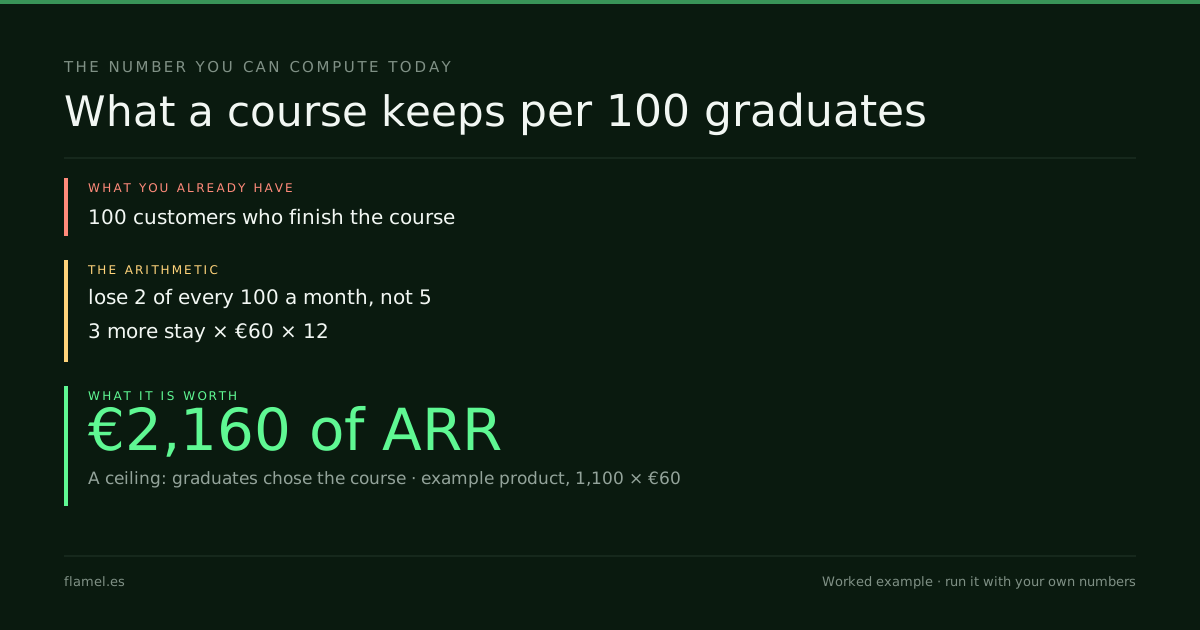
Now the value. Every 100 customers who finish lose 2 a month instead of 5, so 3 more of them stay each month:
3 customers × €60 × 12 = €2,160 of ARR per 100 graduatesThat holds for every month the gap holds. On the roughly 367 customers who finish today, it is about 11 customers a month, or €7,920 of ARR.
Why that figure is a ceiling, not a result
The customers who finish a course are not a random third of the base. They are the ones who already had the time, the motivation and the use case to sit through it, and many of them would have stayed anyway. Part of the gap is the course; part of it is who chose to take it. Read straight, €2,160 per 100 graduates is the most the course can be worth, not what it is worth.
Three ways to read it more honestly, from cheapest to cleanest:
- Compare like with like. Match graduates with customers who signed up in the same month, on the same plan, with similar use in their first week. The gap that survives is closer to the course's own effect.
- Read before and after. When a lesson is added to onboarding for every new account, compare the churn of the cohort before it with the cohort after it.
- Hold some accounts out. Invite half of one month's new accounts to the course and leave the other half uninvited, then compare the two halves after three months. Only this reads the course alone.
If the gap shrinks from 3 to 1 of every 100 once the groups are matched, the course is worth €720 of ARR per 100 graduates a month, a third of the ceiling. That is still a number product and marketing can plan against.
What to do before the next lesson
- Count graduates from product events, not enrollments, and split last quarter's churn into finished and did not finish.
- Check that the two rates add up to the overall churn. If they do not, the groups are wrong.
- Multiply graduates × gap × ARPU × 12 and treat the result as the ceiling. Then list the lessons that the customers who stay actually opened, and the ones nobody did.
The number to bring to the next planning meeting is the ARR per 100 graduates. If it is close to zero once the groups are matched, the course is content and can be planned as content. If it holds, the course is onboarding, and product should own which lessons it contains.
Work through this with your own numbers
I run a subscription software product with [number] paying customers at [ARPU] a month and an overall monthly churn of [rate]. My product has a customer course or academy, and [number] customers finished it last quarter. Their monthly churn was [rate] and the churn of customers who did not finish was [rate]. Check that the two rates add up to the overall churn and tell me what the gap would be if they do not. Then calculate the ARR the course keeps per 100 graduates (graduates × churn gap × ARPU × 12), explain why that figure is an upper bound, and propose the cheapest way to read the course's real effect with the data I have: matched cohorts, a before-and-after on one lesson, or a holdout of new accounts. List which lessons I should look at first: [lesson titles].FAQ
What is customer education?
Customer education is the training a company gives its customers so they reach value with its product and keep reaching it: courses, an academy, webinars and guided help content. In software it usually does onboarding's job, even when marketing writes it.
What is a customer education program?
A planned set of lessons, usually a course or an academy, built around what a customer has to learn to get value from the product. It differs from a help center in that it has an order: lessons that lead to the moment the product starts paying off for the customer.
How do you measure customer education?
In retention, not in views. Count the customers who finished the lessons that matter, compare their monthly churn with everyone else's over the same months, and multiply the gap by the number who finished, ARPU and 12. Because graduates choose to take the course, treat the result as a ceiling.
Is customer education marketing or product?
Both. Marketing usually writes and promotes the lessons; the job they do is onboarding, which product owns. The course works when both teams read the same number: the churn of the customers who finished it, against everyone else's.
What is a customer academy?
A branded set of courses that a software company runs for its customers, often free and sometimes with certificates. It is one format of customer education, and its value is read the same way: in the retention of the customers who complete it.
Reading which lessons lead customers to the moment they keep paying for, and pricing the course in retention on your own billing data, is part of what The Activation Audit maps. Five business days, $500, and the map stays with you whether or not you hire anyone next.
Your store, five days.
$500. Zero commitment. Yours either way.