Design thinking for business: empathy meets the number
Design thinking for business finds the doubt only your customer has. Growth turns it into a dated test and a number. What one answered doubt is worth.

Design thinking for business is a way of finding the doubt only your customer has before you decide what to change, build or launch. It starts by watching and listening to the people who bought and the ones who almost did. Growth is what happens next: it turns that doubt into a test with a date and a number, and reads whether answering it changed what people did.
A creative brand usually has one half without the other. A workshop fills a wall with sticky notes about how customers feel, and nothing on the store changes. Or a dashboard shows the conversion rate slipping by a tenth of a point, and nobody can say which question the page failed to answer. Empathy without the number is an opinion; the number without empathy optimizes a guess.
Design thinking for business is a human-centered way to find the doubt that stops a customer from buying, by watching and listening to buyers and near-buyers. Growth turns that doubt into a dated test with a number. Design thinking names the problem; growth measures what answering it is worth and decides what to keep.
Key takeaways
- Design thinking finds the doubt only your customer has; growth turns it into a test with a date and a number.
- Empathy without the number is an opinion; the number without empathy optimizes a guess.
- MyDollHair rebuilt its store around one customer question, which shade matches my hair, and conversion went 4.8 times higher in two years.
- Each creative revenue mechanism hides its own doubt: drops, catalog, membership and seasons block the order for different reasons.
- On the worked store, one answered doubt worth a tenth of a conversion point is €20,400 a year with no new traffic.
What design thinking for business actually means
IDEO, the design firm most associated with the term, defines it in the words of Tim Brown as "a human-centered approach to innovation that draws from the designer's toolkit to integrate the needs of people, the possibilities of technology, and the requirements for business success." Three tests at once: what people want, what can be built and what the business can sustain.
Nielsen Norman Group's Design Thinking 101 splits the work into six phases: empathize, define, ideate, prototype, test and implement. The first is where the doubt comes from: research "to develop knowledge about what your users do, say, think, and feel."
For a business, the third test is the one that matters. A creative brand does not need design thinking to produce more ideas; its calendar is already full of them. It needs it to find out which question stands between a visitor and an order, and that question is rarely the one the team assumed.
Where design thinking stops and growth begins
The six phases end with a prototype tested on a handful of people. That is enough to know a doubt is real. It is not enough to know what answering it is worth across 25,000 visits a month, the traffic of the store used across this blog, or whether it is the doubt to fix first. That is the growth half of the work, and the two halves ask different questions:
| Design thinking | Growth | |
|---|---|---|
| Question | What is stopping this person? | How many does it stop, and what is that worth? |
| Evidence | Interviews, observation, messages, returns | Sessions, orders, repeat orders |
| Sample | A handful of people, in depth | Every visit, in aggregate |
| Output | A doubt, in the customer's words | A test with a date and a decision |
| Failure mode | Insights nobody acts on | A dashboard that optimizes a guess |
Neither half replaces the other. Growth on its own tests button colors because it can measure them. Design thinking on its own redesigns the page because the interviews were convincing, and never learns whether it worked. In growth marketing for creative businesses, this is the Know moment feeding the next cycle: what the brand learned decides what it tests next.
The doubt only your customer has
MyDollHair sells hair extensions, ponytails and wigs in Colombia. Hair is bought by color, and every purchase turned on one question the customer could not answer alone: which shade matches my hair? On the old store the answer lived in a WhatsApp thread, so every order cost a conversation.
That is the kind of doubt design thinking finds. No benchmark lists it, and it only shows up by reading what customers ask before they buy. The store was rebuilt around it: the question became a tool on its store, where a customer uploads a photo, gets a shade read and a match among what is in stock, with color selectors on the product page.
The growth half is the measurement. Over two years and 666,590 sessions, the conversion rate went 4.8 times higher, from 0.4 to 1.8 orders for every 100 sessions. The tool did not come from a checklist. It came from one question heard often enough to be worth answering.
Doubts by revenue mechanism
Every creative brand has its own version of the shade question. Where it hides depends on how the brand earns its revenue:
| Mechanism | The doubt that blocks the order | Where to hear it |
|---|---|---|
| Drops | Will it look like the photos, and is it worth buying before I know? | DMs and comments in launch week |
| Catalog | Which one is for me: size, shade, fit or finish | Questions before ordering, return notes |
| Membership | Will I use it enough to pay every month? | Cancellation reasons, first-month support |
| Seasons | Will it arrive in time, and can I change it after? | Messages in the weeks before the date |
None of these comes from a dashboard. A dashboard shows that people leave the product page; it cannot show why. The product page optimization post prices four common unanswered questions on the same worked store, from €255 to €510 a month each. Design thinking is how a brand finds the fifth, the one that belongs only to its customers.
From doubt to a test with a date
A doubt becomes growth work the moment it is written as a test. Five lines are enough:
- The doubt, in the customer's words: which shade matches my hair?
- The change that answers it, and where: a shade finder on the product page.
- The measure: conversion on the product pages that carry it.
- The threshold: the result that would justify keeping it.
- The date to read it, with the decision written before it starts.
The last line matters more than it looks. On a store with 25,000 sessions a month, a split test needs about 42,700 sessions per variant to read a move from 1.0 to 1.2 orders per 100 sessions, as worked out in marketing experiments. A smaller lift takes longer still. So most tests in a creative brand are dated before-and-after reads on comparable weeks, with the decision rule written first so the result cannot be argued into a win. It is the loop of build, measure, learn, with the customer's doubt as the thing being built for.
What one answered doubt is worth
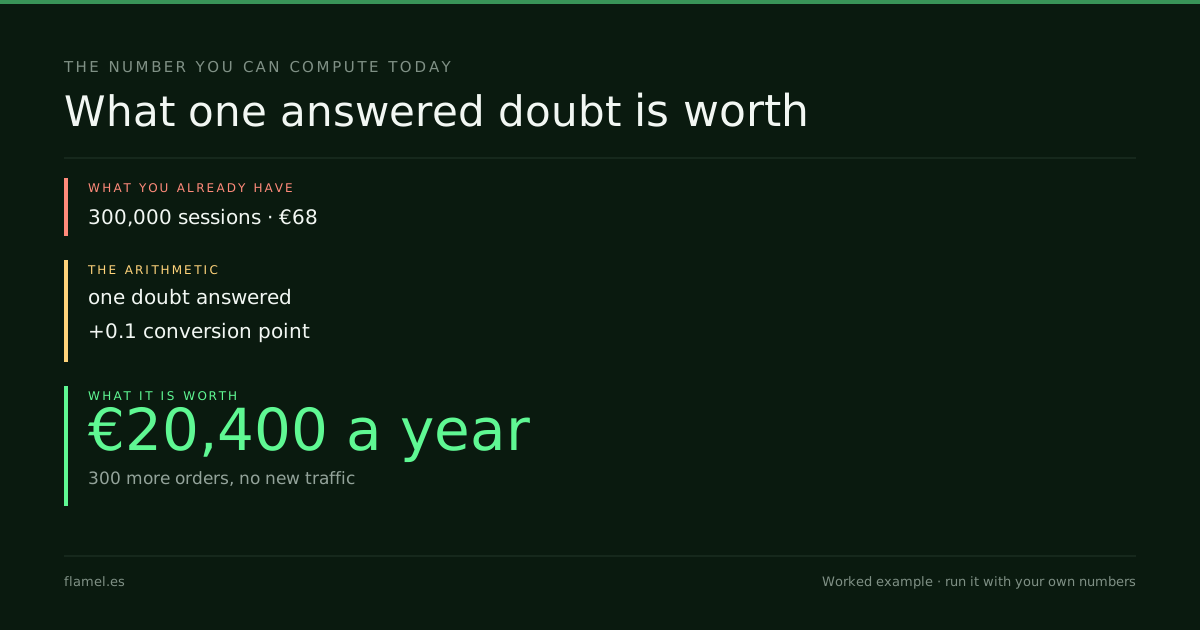
Doubt value = sessions a year × conversion points recovered × average orderTake the store used across this blog: 300,000 sessions a year, a €68 average order and a 1.0 % conversion rate, which is 3,000 orders and €204,000 a year. Suppose listening to buyers and near-buyers surfaces one doubt the product page leaves unanswered, and the dated test shows that answering it moves conversion from 1.0 % to 1.1 %.
That tenth of a point is 300 more orders a year (300,000 × 0.001). At €68 each, it is €20,400 a year, the same value per tenth of a point worked out in the ecommerce conversion rate post, and it needed no new traffic.
Both halves are in that number. The insight is the design work: without it there is no doubt to answer and nothing specific to test. The €20,400 only exists once growth has dated the test, run it and read it. An insight that never reaches a test is worth what it changed, which is nothing.
What to do this week: read the last 30 questions customers asked before buying, in DMs, email or chat. Group them by doubt and count each group. Take the largest, write its five lines and put a date on the read. Then multiply your yearly sessions by a tenth of a point and by your average order: that is the size of the prize.
Work through this with your own numbers
You run a creative brand that sells through [drops / a catalog / a membership / seasons], with [yearly sessions] sessions a year, a [conversion rate] conversion rate and a [average order value] average order. Here are the last 30 questions customers asked before buying: [paste them]. Group them by the doubt behind each one, count each group and name the largest in the customer's own words. Then write a five-line test for it (the doubt, the change that answers it and where, the measure, the threshold to keep it and the date to read it), say whether my traffic can read it as a split test or needs a dated before-and-after, and calculate what a tenth of a conversion point is worth a year as sessions times 0.001 times the average order.FAQ
What is design thinking in business?
It is a human-centered way of solving business problems: research what customers do, say, think and feel, define the problem in their words, then prototype and test an answer. In a store, its most useful output is the specific doubt that stops people from buying, the one no benchmark or competitor will tell you about.
What is the difference between design thinking and growth?
Design thinking finds and names the problem by studying a few people in depth. Growth measures how many people the problem affects, puts a value on solving it and runs a dated test to see whether the answer worked. The first gives the test something specific to change; the second decides whether the change stays.
How do you measure the value of design thinking?
Through the test it leads to. Multiply your yearly sessions by the points of conversion rate the answered doubt recovers and by your average order. On a store with 300,000 sessions a year and a €68 average order, a tenth of a point is worth €20,400 a year. An insight that never reaches a test has no measurable value.
Can a growing brand use design thinking without a research team?
Yes. Most brands already hold the raw material: questions in DMs, emails, chat and return notes. Reading the last 30 questions customers asked before buying, grouping them by doubt and talking to a few recent buyers and near-buyers is enough to find the doubt worth testing first.
Reading the questions your customers ask before they buy, and pricing the largest one on your own numbers, is part of what The Conversion Audit maps. Five business days, $500, and the map stays with you whether or not you hire anyone next.
Your store, five days.
$500. Zero commitment. Yours either way.