Ecommerce consultant: what one costs, against revenue
What an ecommerce consultant costs: €103 an hour on Europe's freelance market, set against online revenue and priced in hours on a €204,000 store.

An ecommerce consultant bills hours. What the store pays for is what happens after them: someone still has to build the change, launch it and read whether it moved anything. The Redi Foods case is read that way. The store moved off WooCommerce to Shopify, its weekly kit order went from fifteen stacked dropdowns to a three-step builder, and the work is measured on 130,465 sessions across 22 months.
So the hourly rate is only half of the price. The other half is whether the hours fit the store: what they weigh against a year of online revenue, and whether anyone inside can turn advice into a shipped change.
Below: the European rate, the ceiling it has to fit under, the hours that ceiling buys on a worked store, and the same store priced with a growth team and with a one-off diagnosis.
An ecommerce consultant in Germany, Austria or Switzerland bills about €103 an hour, the 2026 freelance average. The people side of marketing should weigh no more than about €3.30 of every €100 of online revenue, so a €204,000 store can carry about €560 a month: roughly five consultant hours.
Key takeaways
- An ecommerce consultant sells hours of advice; the store's own team still builds, launches and reads every change.
- Freelancers in Germany, Austria and Switzerland averaged €103 an hour in 2026, across all fields, in freelancermap's survey.
- Weigh the hours as rate × hours × 12 ÷ online revenue, against a ceiling of about €3.30 of every €100.
- On a €204,000 store the ceiling buys about 5.4 hours a month; ten hours need about €377,000 of revenue.
- Run the proposal on your desk through the formula; above 0.0328, narrow the brief or buy a diagnosis first.
Before the arithmetic: the Conversion Audit maps where a store loses orders in five business days, for $500, before any hourly rate or monthly fee is on the table.
What an ecommerce consultant actually sells
An ecommerce consultant sells time and judgment. The usual brief is a review of the store, a list of what to change and a few calls a month to answer questions. That can be worth a lot. A good consultant has seen the same checkout problem, the same feed error or the same platform migration many times, and says in an hour what a founder would take weeks to find.
What the hours do not include is the work after them. The store's own people still have to design the change, build it, launch it and read the result. If nobody inside has that time, the advice waits in a document.
That is the real difference between the three ways to buy outside help:
- Hours. A consultant answers questions. The store executes.
- A cycle. A growth team takes one question, ships one change and closes with a written answer, as ecommerce growth agency prices it.
- A diagnosis. A fixed price, a few days and a map of where orders leave.
Ecommerce consultant rates: the European number
For a store selling in Europe, a dollar range from an American marketplace is a loose guide. A closer reference is the Freelancer Study 2026 by freelancermap, a survey of freelancers in Germany, Austria and Switzerland. Its income finding: "The average hourly rate in the DACH region sits at €103 in 2026, a slight dip from €104 in 2025." The German edition adds the trend behind it, €102 in 2024 and €100 in 2023, and bases the rate on 1,310 respondents.
Two cautions. It is an average across all fields, not ecommerce alone, and it comes from freelancers who use one platform. Treat it as a reference point for the conversation, not as a quote. A specialist in one platform or one channel may bill more; a generalist, less.
The ceiling an ecommerce consultant has to fit
A consultant is a people cost, so the bill belongs in the same share as staff and agencies. Gartner's 2025 CMO Spend Survey of 402 marketing leaders, as Chief Marketer reported it, puts marketing budgets at an average of 7.7% of revenue. Labor takes about 22 of every 100 marketing dollars and agencies 20.7%, so the two together take 42.6%.
Consultant weight = hourly rate × hours a month × 12 ÷ annual online revenue
Ceiling           = 0.077 × 0.426 ≈ 0.0328  (about €3.30 of every €100)
Hours that fit    = annual online revenue × 0.0328 ÷ 12 ÷ hourly rate
The same line prices a growth team's fee, and an in-house hire in in-house marketing vs agency. One line for every option is the point. The comparison is not hourly rate against monthly fee: it is each one against revenue.

Ecommerce consultant cost on a €204,000 store
The worked store this blog uses, as an example: 300,000 sessions a year, a €68 average order and 1 order for every 100 sessions. That makes 3,000 orders and €204,000 of online revenue a year.
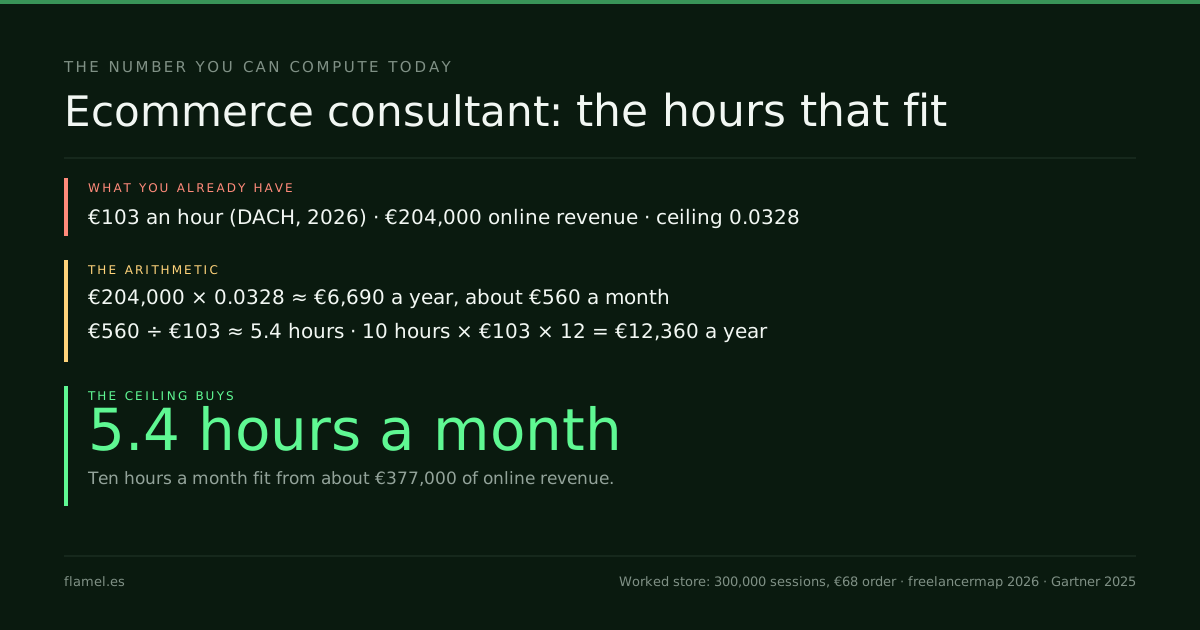
Ceiling = €204,000 × 0.0328 ≈ €6,690 a year, about €560 a month
Hours   = €560 ÷ €103 ≈ 5.4 consultant hours a month
Five hours a month is a review and two calls. Now take a common brief, as an example: ten hours a month.
10 hours × €103       = €1,030 a month
€1,030 × 12           = €12,360 a year
€12,360 ÷ €204,000    ≈ 6.1 of every €100 of online revenue
Revenue line          = €12,360 ÷ 0.0328 ≈ €377,000 a year
Ten hours weigh nearly twice the ceiling on this store. They start to fit at about €377,000 of online revenue. A €2,000-a-month growth fee, priced on the same store, needs about €732,000.
Hours against a cycle
Same store, same line, three ways to buy outside help:
| On a €204,000 store | Consultant, 10 hours a month | Growth team, €2,000 a month | One-off diagnosis |
|---|---|---|---|
| What it buys | Advice; the store builds | One question, one change shipped, one written answer | A map of where orders leave |
| Who executes | The store's team | The outside team | Nobody yet |
| Cost a year | €12,360 | €24,000 | $500 once, about €460 |
| Weight per €100 of revenue | 6.1 | 11.8 | 0.2 |
| Fits under the ceiling from | about €377,000 | about €732,000 | any revenue |
Neither monthly option fits this store yet. What fits is a reading: five consultant hours on one question, or a diagnosis that costs less than one month of the ceiling. Either way, the first purchase is knowing where the orders leave.
When an ecommerce consultant is the right buy
Hours are the right purchase when three things are true:
- The question is narrow. A platform migration, a product feed that keeps failing, a checkout setting. One expert answer saves weeks.
- Someone inside executes. A developer or a marketer with time to build what the consultant says, this month.
- The hours fit. Hourly rate × hours × 12, divided by last year's online revenue, stays under 0.0328.
When the question is wide, such as why orders are flat, hours tend to produce a list with no order of priority. That is a diagnosis job. Ecommerce conversion rate optimization shows the four places revenue leaves a store, and a UX audit shows what a fixed-price reading covers.
The ecommerce consultant number for your store
Consultant weight = hourly rate × hours a month × 12 ÷ annual online revenue
Hours that fit    = annual online revenue × 0.0328 ÷ 12 ÷ hourly rate
On the worked store, the ceiling buys about 5.4 hours a month at €103, and ten hours need about €377,000 of online revenue.
What to do by Monday: take the consultant's rate and the hours in the proposal. Multiply them, multiply by 12 and divide by last year's online revenue. Above 0.0328, cut the brief to one narrow question, or buy the diagnosis first.
Outside work worth paying for is read over months on real sessions. Redi Foods is measured on 130,465 of them, across 22 months.
Work through this with your own numbers
I run an online store that sold [annual online revenue] last year. An ecommerce consultant has proposed [hours a month] hours a month at [hourly rate] an hour. Calculate the weight as hourly rate × hours a month × 12 ÷ annual online revenue and compare it with a ceiling of 0.0328 (marketing at 7.7% of revenue × labor and agencies at 42.6% of that budget, from Gartner's 2025 CMO Spend Survey). Then tell me how many hours a month fit under the ceiling (annual online revenue × 0.0328 ÷ 12 ÷ hourly rate) and how much online revenue the proposal needs to fit (hourly rate × hours × 12 ÷ 0.0328). Say whether I should narrow the brief to one question, keep it as it is, or buy a diagnosis first, and show every step of the arithmetic.FAQ
What does an ecommerce consultant do?
An ecommerce consultant reviews a store and advises on what to change: platform, catalog, checkout or marketing channels. The store's own team usually executes. The useful version answers one narrow question and puts the changes in order of priority, instead of handing over a long list.
How much does an ecommerce consultant cost?
Freelancers in Germany, Austria and Switzerland averaged €103 an hour in 2026, across all fields, in freelancermap's survey. The useful number is the weight: hourly rate × hours a month × 12 ÷ annual online revenue. Under about 0.0328 it fits; on a €204,000 store that is about 5.4 hours a month.
Is an ecommerce consultant worth it?
When the question is narrow, someone inside can execute the advice the same month, and the hours fit under the ceiling for the store's revenue. When the question is wide, such as why orders are flat, a fixed-price diagnosis comes first.
What is the difference between an ecommerce consultant and an agency?
A consultant sells hours of advice and the store executes. An agency or growth team sells execution, billed by the month or by the cycle, with the work done outside. Both weigh against the same share of online revenue, so run both through the same formula.
The Conversion Audit maps where your store loses orders: five business days, $500, and the map stays with you whether or not you hire anyone next.
Your store, five days.
$500. Zero commitment. Yours either way.

Made between
Barcelona and Bogotá.
What’s holding your store’s sales back, in minutes.
Free, no card. Shopify stores for now.