
Retention marketing agency: the fee, in repeat orders
What a retention marketing agency fee costs in repeat orders: one point of repeat purchase rate priced on a €204,000 store, and the points a fee needs.

A retention marketing agency sells repeat orders, so its fee should be read in repeat orders: how many more customers have to come back before the fee is paid. Redi Foods shows where that reading starts. Its business runs on a weekly frozen-meal kit, and the second order is where it lives. The kit order was rebuilt on Shopify, from fifteen stacked dropdowns into a three-step builder, and the result is measured on 130,465 sessions across 22 months.
Most retention proposals arrive as a monthly fee and a list of flows. Neither line says how many repeat orders the store has to add just to cover the fee. That number exists, and it takes two lines of arithmetic.
What follows prices one point of repeat purchase rate on the worked store this blog uses, turns an example fee into points, and says what to buy before any retainer.
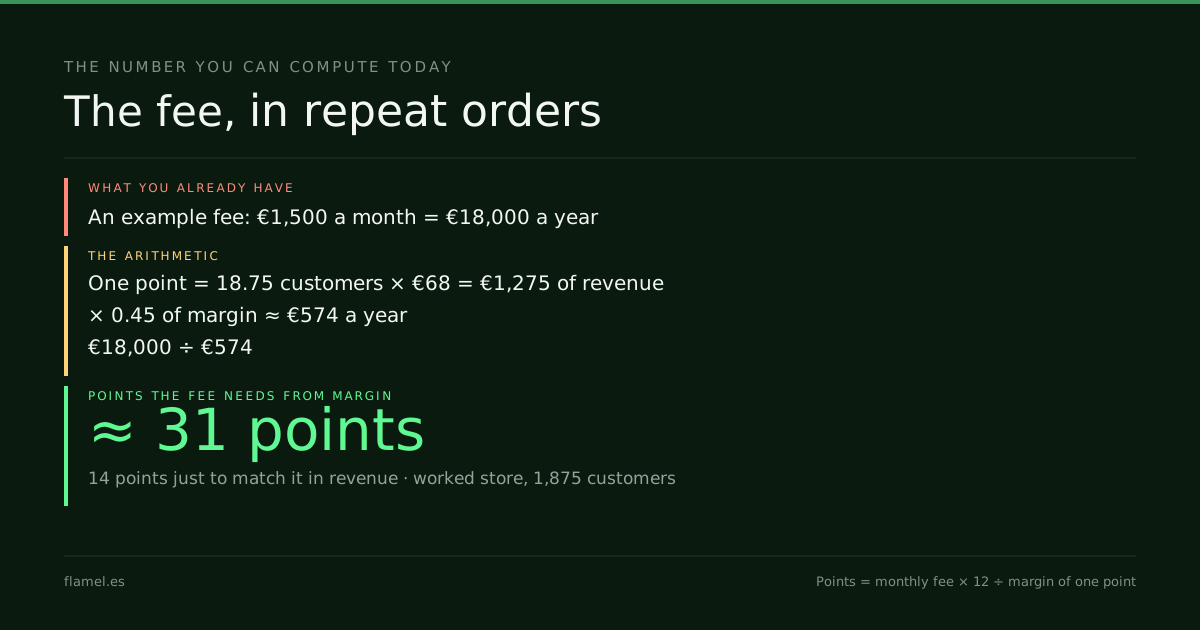
A retention marketing agency fee pays for itself only through extra repeat orders. Divide the annual fee by the margin one point of repeat purchase rate adds. On a €204,000 store, one point adds €1,275 of revenue and about €574 of margin, so a €1,500 monthly fee needs about 31 points.
Key takeaways
- A retention marketing agency sells repeat orders, so read its fee in points of repeat purchase rate, not as a monthly number.
- On a €204,000 store, one point is 18.75 more returning customers: €1,275 of revenue and about €574 of margin a year.
- An example fee of €1,500 a month needs about 14 points to match in revenue and about 31 to pay from margin.
- Ask any proposal for its base, its window and a holdout group, or the report measures something else.
- Divide your fee by the margin of one point; if the store cannot add that many in a year, map where customers leave first.
Before the arithmetic: The Conversion Audit maps where a store loses customers between the first order and the second, in five business days, for $500.
What a retention marketing agency actually sells
The work is familiar. Klaviyo's guide to repeat purchase rate lists the usual machinery: a replenishment flow, an up-sell and cross-sell flow, SMS for loyal customers, and segments such as first-time buyers, lapsed buyers and the expected date of the next order. A retention agency builds and runs that machinery, usually for a monthly fee.
None of it is the product. The product is a customer who orders a second time and would not have done so otherwise. Flows, segments and texts are the means. The repeat order is the result, and it is the only unit the fee can be read in.
That second order is worth more than its own value. Shopify's retention table, updated in September 2026, puts it plainly: "Once someone buys twice, they're also 95% more likely to buy again." The second order changes the odds on every order after it. So a store should know what one more of them is worth before it pays anyone to chase it.
One point of repeat purchase rate, in euros
Take the worked store this blog uses, as an example: 300,000 sessions a year, a €68 average order, 1 order for every 100 sessions and 1.6 orders per customer. That makes 3,000 orders from 1,875 customers, and €204,000 of online revenue a year.
Repeat purchase rate is customers with two or more orders divided by all customers who ordered. One point of it, on this store, is 18.75 more customers placing a second order:
One point       = 1,875 × 0.01 = 18.75 customers
Revenue a year  = 18.75 × €68 ≈ €1,275
Margin a year   = €1,275 × 0.45 ≈ €574
The margin line is the one that pays the fee. A fee does not come out of revenue. It comes out of what is left once the goods are paid for, and at 45 cents of margin on the euro each point leaves about €574 a year.
This credits each new returner with one extra order, the conservative reading. Customers who already come back to this store average 2.5 orders, so a real move can be worth more. The next section runs both readings.

The fee, in points
Now take an example fee of €1,500 a month. That is €18,000 a year.
Points to match in revenue = €18,000 ÷ €1,275 ≈ 14 points
Points to pay from margin  = €18,000 ÷ €574   ≈ 31 points
Repeat orders from margin  = €18,000 ÷ (€68 × 0.45) ≈ 588 orders
On this store, 40 of every 100 customers already order twice. Paying the fee from margin would take that to about 71 of every 100 within the year. Even if every new returner ordered as often as the current ones, 1.5 extra orders each, the line would still sit near 21 points.
Turn it around. A four-point move is 75 more returning customers: €5,100 of revenue and about €2,295 of margin a year. That pays for a fee of about €190 a month, not €1,500.
The same store's ceiling for any outside growth team is about €560 a month, set from Gartner's survey in the ecommerce growth agency post. A €1,500 retention fee is nearly three times that line. The two readings agree: the store is not ready for this fee, and the repeat orders that would pay it do not exist yet.
Reading a retention marketing agency proposal before you sign
Five questions turn a proposal into a number the store can check:
- What does one point cost? Annual fee ÷ the margin one point of repeat purchase rate adds. On the worked store, €18,000 ÷ €574.
- Which base does the report use? Customers with two or more orders, divided by all customers who ordered. A report built on orders, or on open rates, measures something else.
- Which window? Twelve rolling months, fixed before the work starts, so before and after compare like with like.
- What would have happened anyway? A product people run out of brings some customers back on its own. The extra orders should be shown against a group that did not get the flow.
- What stays if the contract ends? The flows, the segments and the record of what was tested belong to the store.
A proposal that answers the first question with a list of flows is selling hours. One that answers it with points, a window and a holdout group is selling repeat orders.
What to buy before the retainer
On most stores that already sell, the second order is lost before any flow can win it. It goes in the stretch between the thank-you page and the parcel: a confirmation that reads like a receipt, a first use that disappoints, a prompt that arrives too early or too late. Customer lifetime value is decided there, and so is one of the four places revenue leaves a store. A flow sent into a broken stretch makes the break louder.
That is why the honest first purchase is a map, not a retainer. The Conversion Audit takes five business days and four ways in:
- A real order, on a real card and the device customers use.
- The data: GA4, the Shopify admin and the email program, with the store's access.
- A comparison against stores already built and measured.
- An AI agent sent to shop the catalog, to see whether it finds the store.
It returns a 15 to 20 minute video of every leak, a one-page roadmap ranked red, amber and green, a live review session and a living document kept updated for 30 days. The store keeps all four, whether or not it hires anyone.
After the map, the work moves inside the marketing team. The first experiment runs with real customers. Then comes one growth cycle per launch, season or drop, and each cycle ends with a number read from the store's own admin. For a retention problem, that number is the repeat purchase rate, on the same base and window as before.
The number for your own store
One point            = customers who ordered in 12 months × 0.01
Margin of one point  = one point × average order × gross margin
Points the fee needs = monthly fee × 12 ÷ margin of one point
On the worked store, one point leaves about €574 of margin, and a €1,500 monthly fee needs about 31 points to pay for itself.
What to do by Monday: take the retention proposal on your desk, multiply the fee by 12 and divide by the margin of one point. If the answer is more points than the store could add in a year, find where customers leave after the first order before paying anyone to bring them back.
A business that lives on its second order is read over months, on real sessions. Redi Foods is measured on 130,465 of them, across 22 months.
Work through this with your own numbers
I run an online store. In the last twelve months [CUSTOMERS] customers ordered, and [REPEAT CUSTOMERS] of them ordered at least twice. My average order is [AVERAGE ORDER] and my gross margin is [MARGIN] cents on the euro. A retention marketing agency has quoted [MONTHLY FEE] a month. Calculate my repeat purchase rate. Then calculate what one point of it is worth in a year, in revenue (one hundredth of my customers × average order) and in margin. Then calculate how many points the fee needs to match in revenue and to pay for itself from margin (monthly fee × 12 ÷ value of one point), and the repeat purchase rate I would have to reach. Tell me whether that rate is plausible for my product within a year, and show every step of the arithmetic.FAQ
What does a retention marketing agency do?
It builds and runs the programs that bring existing customers back: replenishment and cross-sell flows, SMS, and segments by purchase history. The useful version is measured in extra repeat orders, set against a group that did not receive the program.
How much does a retention marketing agency cost?
Quotes are usually monthly, so the useful number is what the fee costs in points of repeat purchase rate: annual fee ÷ the margin one point adds. On a €204,000 store, a €1,500 monthly fee needs about 31 points to pay for itself from margin.
Is a retention marketing agency worth it?
When the points the fee needs are fewer than the store can add in a year, and the stretch after the first order already works. If either fails, a fixed-price map of where customers leave comes before any retainer.
What is the difference between retention marketing and lifecycle marketing?
Retention marketing aims at an existing customer's next order. Lifecycle marketing covers the whole relationship, from the first visit to win-back. For a store, both are read in the same unit: extra repeat orders and the margin they leave.
The Conversion Audit maps where your customers leave after the first order: five business days, $500, and the map stays with you whether or not you hire anyone next.
Your store, five days.
$500. Zero commitment. Yours either way.