SaaS financial model: the 5 inputs behind 2027
A SaaS financial model runs on five inputs. On a 1,100-customer product: which one moves 2027 ARR most, and what one churn point is worth.

A SaaS financial model for 2027 runs on five inputs: customers at the start, ARPU, new customers a month, monthly churn and net expansion. Revenue, ARR and how many people the plan can pay for all follow from those five.
Most models get the five from different places. Marketing sends the new customers. Finance copies last year's churn and holds it fixed. Then the whole debate is about the acquisition budget, because it is the only input anyone moved.
Move each input by the same amount and the model says where the year really depends. On the example product below, one point of churn is worth about €80,800 of ARR at the end of 2027.
A SaaS financial model runs on five inputs: starting customers, ARPU, new customers a month, monthly churn and net expansion. On a product with 1,100 customers at €60 and 4 of every 100 leaving a month, cutting churn by one point adds about €80,800 to ARR at the end of 2027.
Key takeaways
- A SaaS financial model runs on five inputs: starting customers, ARPU, new customers a month, monthly churn and net expansion.
- On the example product, 44 in and 44 out keep 1,100 customers; expansion alone takes ARR from €792,000 to €887,040.
- Moving each input 10 in every 100: ARPU adds €79,200, churn €31,300 and new customers €30,700. Only the new ones cost CAC.
- One churn point, 4 to 3 of every 100, is worth about €80,800 of ARR at the end of 2027.
- By Monday: take six months of the five inputs from billing, move each 10 in every 100 and rank them before the budget is signed.
The 5 inputs of a SaaS financial model, on one product
The example product this blog uses for SaaS has 1,100 customers paying €60 a month: €66,000 of MRR and €792,000 of ARR. Its five inputs for 2027:
1. Customers on January 1    1,100
2. ARPU                      €60 a month
3. New customers a month     44
4. Monthly churn             4 of every 100 (44 customers leave a month)
5. Net expansion             €660 of MRR added each month
Net expansion is upgrades minus downgrades: €1,320 up and €660 down a month, as in net revenue retention. Churn is counted as customers lost in the month ÷ customers at its start, the way SaaS churn rate counts it.
Each input has an owner. Marketing and sales own new customers. Product and customer success own churn and expansion. Pricing owns ARPU. Customers on January 1 is simply what December leaves behind.
The formula that turns 5 inputs into ARR
The model needs three lines. The first runs once a month, twelve times.
Customers next month = customers × (1 − churn) + new customers
MRR after 12 months  = customers after 12 months × ARPU + 12 × net expansion
ARR at end of 2027   = MRR after 12 months × 12
On the example product, 44 customers join and 44 leave every month. The base stays at 1,100.
Customers after 12 months = 1,100
MRR = 1,100 × €60 + 12 × €660 = €66,000 + €7,920 = €73,920
ARR = €73,920 × 12            = €887,040
That is 12 more in every 100 than today's €792,000. All of it comes from expansion. Acquisition only refills what churn takes: reduce churn prices that refill at €17,600 a month at a €400 CAC.
Which input moves the SaaS financial model the most
Now move each input 10 in every 100 in the good direction, one at a time, and leave the other four alone.
| Input moved 10 in every 100 | New value | ARR at end of 2027 | Change |
|---|---|---|---|
| ARPU | €66 | €966,240 | +€79,200 |
| Customers on January 1 | 1,210 | €935,600 | +€48,500 |
| Monthly churn | 3.6 of every 100 | €918,400 | +€31,300 |
| New customers a month | 48.4 | €917,700 | +€30,700 |
| Net expansion | €726 a month | €896,544 | +€9,504 |
ARPU tops the table because it multiplies every customer at once. But a price rise on existing customers is also a churn test. A model that raises ARPU and keeps churn fixed has assumed nobody leaves over the price.
Churn and new customers move ARR by almost the same amount. That is no accident: 0.4 points less churn keeps 4.4 customers a month, and 48.4 new customers bring 4.4 more. The difference is the bill. The 4.4 extra new customers cost 52.8 × €400 = €21,120 a year at the example CAC. The kept ones were already paid for.
That is the line a plan usually misses: the cheapest customers in 2027 are the ones already in the base. The Activation Audit finds what makes customers stay, in five business days, before the plan is signed.

What one churn point is worth in 2027
A product team can usually name what one point of churn would take. Here is what it pays. Churn goes from 4 to 3 of every 100 a month, and nothing else changes.
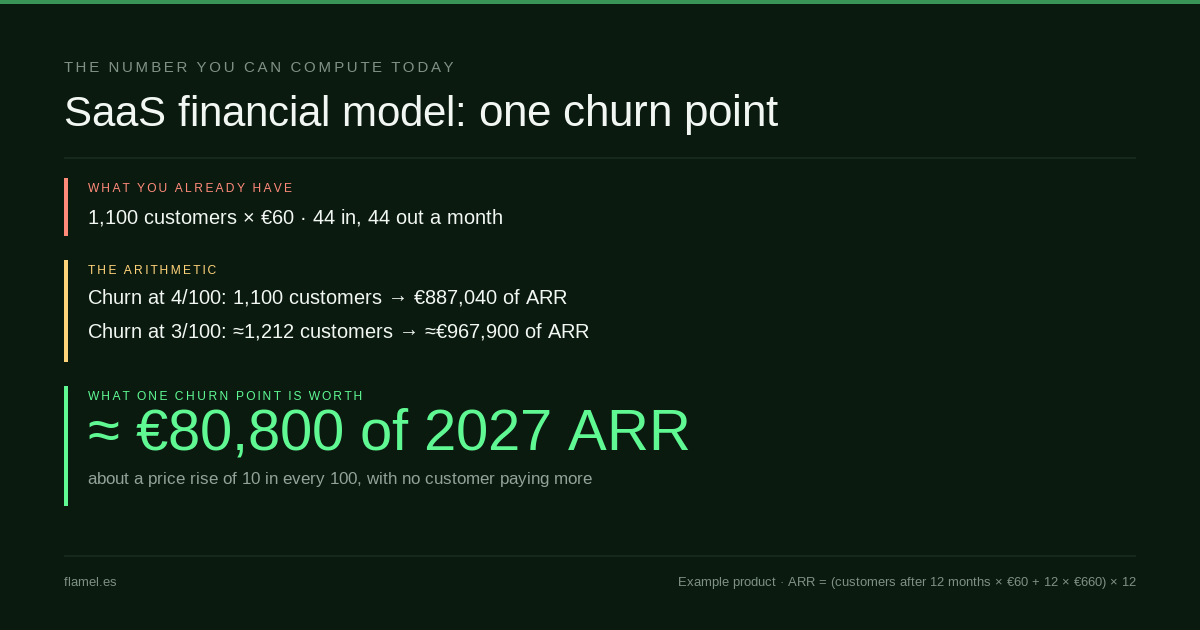
Customers after 12 months = 1,100 × 0.97^12 + 44 × (1 − 0.97^12) ÷ 0.03 ≈ 1,212
MRR = 1,212 × €60 + €7,920 ≈ €80,656
ARR ≈ €80,656 × 12         ≈ €967,900
One churn point ≈ €967,900 − €887,040 ≈ €80,800 of ARR
The end of 2027 lands 22 more in every 100 above today, not 12. One churn point is worth about as much as a price rise of 10 in every 100, without asking any customer to pay more.
The same point shows up per customer in SaaS LTV: at 3 instead of 4 of every 100 a month, each customer's lifetime value goes from €1,200 to €1,600.
The people line: same salary, different cost
The five inputs set revenue. The biggest cost line in most SaaS models is people. In Europe the same salary does not cost the same in every country.
Eurostat puts the average hourly labor cost in 2025 at €34.9 in the EU, from €12.0 in Bulgaria to €56.8 in Luxembourg. Non-wage costs, such as employers' social contributions, made up 24.8 of every 100 euros of labor cost across the EU. In France they made up 32.3, the highest share (Eurostat).
Cost of a hire ≈ gross salary ÷ (1 − non-wage share)

€48,000 at the EU share:  48,000 ÷ 0.752 ≈ €63,800
€48,000 in France:        48,000 ÷ 0.677 ≈ €70,900
The shares are economy-wide averages, so treat the result as an estimate until payroll gives the real figure. Still, a model built in one country and hiring in another has to change this line, not only the salary band.
On the example product, the €80,800 of ARR from one churn point would cover a year of one such hire even at the French share, with about €9,900 left before any other cost.
Before signing the SaaS financial model, name the owners
The ranking only helps if it changes the plan:
- Put a name on each input. Who moves it in 2027, and by how much.
- Move churn on purpose. A model that holds it fixed has already decided product will not change it.
- Test a price rise with churn, never alone. The ARPU row is only as good as the churn assumption next to it.
- Price the people line by country. Use the non-wage share before the salary bands.
The SaaS financial model number for your 2027
Customers after 12 months = start × (1 − churn)^12 + new × (1 − (1 − churn)^12) ÷ churn
ARR at end of year        = (customers after 12 months × ARPU + 12 × net expansion) × 12
One churn point           = ARR with churn one point lower − ARR at current churn
On the example product, one churn point is worth about €80,800 of ARR at the end of 2027: more than a year of one hire at the French labor cost.
What to do by Monday: take the last six months of the five inputs from billing, not from last year's plan. Move each one 10 in every 100, rank them, and put the ranking in front of both teams before the budget is signed.
Work through this with your own numbers
I run a SaaS product with [customers] customers on January 1, an ARPU of [ARPU] a month, [new customers] new customers a month, monthly churn of [churn] (customers lost ÷ customers at the start of the month) and [net expansion] of net expansion MRR added each month. 1) Run the customer line month by month for 12 months: customers × (1 − churn) + new customers. 2) Calculate ARR at the end of the year as (customers after 12 months × ARPU + 12 × net expansion) × 12. 3) Move each of the five inputs 10 in every 100 in the good direction, one at a time, and give me a table of the ARR change for each, ranked. 4) Calculate the ARR change if churn falls one full point. 5) For new customers, multiply the extra customers a year by a CAC of [CAC]. Show every step of the arithmetic.FAQ
What should a SaaS financial model include?
Five revenue inputs (customers at the start, ARPU, new customers a month, monthly churn and net expansion) and the cost lines that follow from them: people, acquisition, hosting and tools. The people line should be priced by country, with the employer's non-wage costs.
How do you forecast SaaS revenue for next year?
Run the customer line month by month: customers × (1 − churn) + new customers. After twelve months, multiply customers by ARPU, add twelve months of net expansion, and multiply by 12 for ARR. On the example product that gives €887,040.
Which input matters most in a SaaS financial model?
Move each input by the same amount and compare. On the example product, ARPU moves ARR most, then starting customers; churn and new customers move it about equally. Churn is the cheaper one, because the kept customers were already acquired.
Is a SaaS financial model template enough?
A template gives the structure. The work is the five inputs: taken from billing rather than last year's plan, each with an owner, and moved one at a time to see which one the year depends on.
The Activation Audit maps what makes customers stay: five business days, $500, and the map stays with the team.
Your store, five days.
$500. Zero commitment. Yours either way.

Made between
Barcelona and Bogotá.
What’s holding your store’s sales back, in minutes.
Free, no card. Shopify stores for now.