SaaS LTV: how to calculate it, churn included
SaaS LTV is ARPU times gross margin, divided by monthly churn. The formula, a worked example, why churn moves it most, and why ARPU is net of VAT.

SaaS LTV, the lifetime value of a subscriber, is the gross margin a customer brings in before canceling. The formula: average revenue per user (ARPU) times gross margin, divided by monthly churn. At €60 a month, 80 of every 100 euros of margin and 4 of every 100 customers leaving each month, SaaS LTV is €1,200. Most of that number lives in the churn.
One customer less in every 100 leaving each month is worth as much as a month of acquisition.
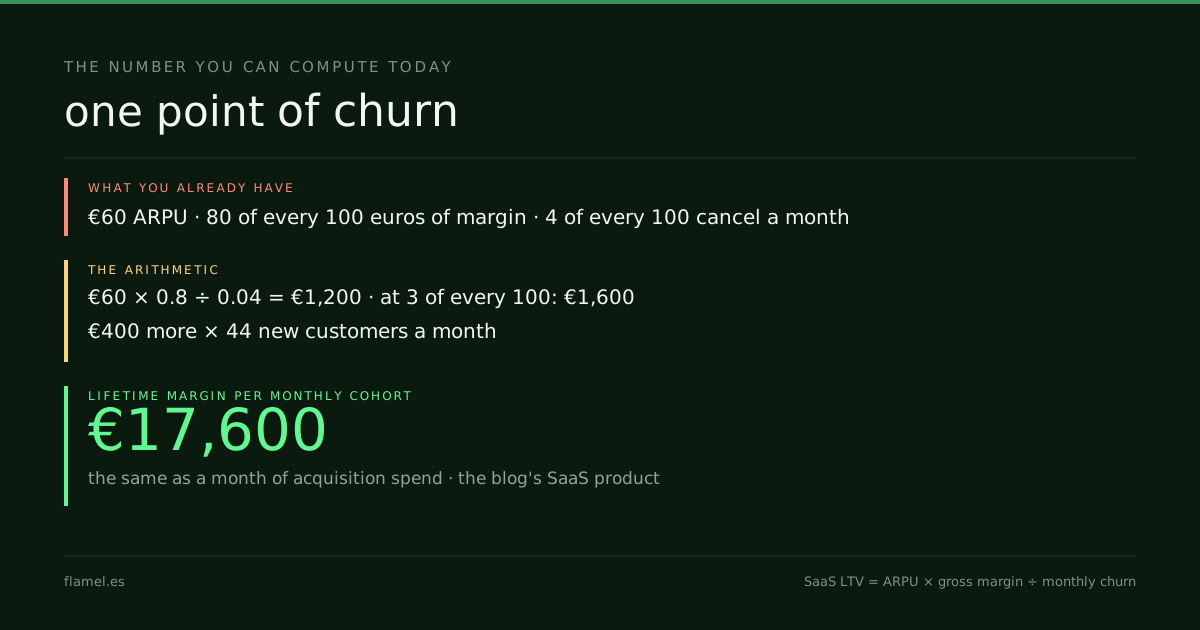
SaaS LTV = ARPU × gross margin ÷ monthly churn. On the example product: €60 × 0.8 ÷ 0.04 = €1,200. At 3 of every 100 leaving instead of 4, it is €1,600. Those €400 more for each of the 44 customers acquired every month add €17,600 of lifetime margin, the same as a month of acquisition spend.
SaaS LTV is ARPU times gross margin, divided by monthly churn. At €60 a month, 80 of every 100 euros of margin and 4 of every 100 customers canceling monthly, LTV is €1,200. At 3 of every 100 it is €1,600, and on 44 new customers a month that adds €17,600 of lifetime margin.
Key takeaways
- SaaS LTV is ARPU times gross margin, divided by monthly churn: €60 × 0.8 ÷ 0.04 = €1,200 on the example product.
- Without the margin it is lifetime revenue, €1,500, a quarter higher than what the business keeps.
- One customer less in every 100 leaving each month lifts LTV to €1,600: €17,600 more per monthly cohort, a month of acquisition spend.
- In the EU, ARPU is net of VAT: a €60 price with Spain's 21% included gives an LTV of €992.
- Run the formula with your churn and with one point less, and compare the difference with a month of acquisition.
The SaaS LTV formula, line by line
SaaS LTV = ARPU × gross margin ÷ monthly churn

ARPU          = monthly revenue per paying customer, net of VAT and discounts
gross margin  = share of each euro left after hosting, support and payment fees
monthly churn = share of paying customers who cancel in a month
1 ÷ churn     = average customer lifetime, in months
At 4 of every 100 leaving each month, the average customer stays 1 ÷ 0.04 = 25 months. LTV is the margin of those 25 months. The churn in the denominator is the one in SaaS churn rate: customers who canceled in the month over customers at its start.
Not every tool includes the margin. ChartMogul's LTV report divides average revenue per account by “the average of the churn rates from the previous six months, excluding the current month”, and gives this example: “with an ARPA of $100 and a 5% six-month trailing average customer churn rate, LTV is $2,000.” No margin: that is lifetime revenue. Multiply it by the margin before comparing it with acquisition cost.
The store version of the formula, with orders instead of subscriptions, is in customer lifetime value.
SaaS LTV on the example product
Take the product this blog's SaaS posts use: 1,100 paying customers at €60 a month, and 4 of every 100 cancel each month. Gross margin is 80 of every 100 euros, and each new customer costs €400 to acquire. Both figures are declared for the example.
Lifetime revenue = €60 ÷ 0.04       = €1,500
SaaS LTV         = €60 × 0.8 ÷ 0.04 = €1,200
LTV : CAC        = €1,200 ÷ €400    = 3
The gap between €1,500 and €1,200 is the cost of serving the customer for 25 months. Leave the margin out and the product looks a quarter more valuable than it is.

Why churn is most of it
Move the denominator by one customer in every 100:
At 4 of every 100 a month: €48 ÷ 0.04 = €1,200  (25 months)
At 3 of every 100 a month: €48 ÷ 0.03 = €1,600  (about 33 months)
Difference per customer:                €400
× 44 new customers a month            = €17,600 of lifetime margin
€17,600 is what the product spends on acquisition in a month: 44 customers at €400. One customer less in every 100 leaving adds, to every monthly cohort, the margin of a full month of marketing. LTV to CAC moves from 3 to 4. Why 3 is a weak target is in the LTV:CAC ratio, written for stores; the arithmetic is the same.
At 4 of every 100 the product loses 44 customers a month and marketing brings 44: it stays flat. At 3 it grows by 11 a month.
The simple formula assumes ARPU stays still. Customers who move up a plan raise it, and that is what net revenue retention measures.
In the EU, SaaS LTV starts net of VAT
A price on a European pricing page often includes VAT, and that money is never ARPU. The EU's Your Europe portal says electronic services sold to consumers are “always taxed in the customer's country”. A business buying from another EU country pays the VAT itself, “using the reverse charge procedure”. The same sticker price leaves a different ARPU in each market.
If the example's €60 were the price with VAT included, at the standard rates Your Europe lists:
| Customer in | Standard VAT | Net ARPU | SaaS LTV |
|---|---|---|---|
| Spain | 21% | €49.59 | €992 |
| France | 20% | €50.00 | €1,000 |
| Germany | 19% | €50.42 | €1,008 |
| Italy | 22% | €49.18 | €984 |
Counting the gross price overstates LTV by about €200 a customer, half of what one point of churn is worth.
The SaaS LTV number for your own data
Take last month's recurring revenue from paying customers, net of VAT and discounts, and divide it by those customers: that is ARPU. Multiply by gross margin. Divide by the average monthly churn of the last six months. Then run it again with one customer less in every 100 leaving, and multiply the difference by the customers acquired in a month.
What to do by Monday: put that last number next to one month of acquisition spend. If it comes close, the next cycle belongs to churn, not to the top of the funnel.
Work through this with your own numbers
You are a SaaS operator calculating customer lifetime value. Inputs: [last month's recurring revenue from paying customers, net of VAT and discounts], [paying customers], [gross margin as a share of revenue, after hosting, support and payment fees], [average monthly customer churn over the last six months], [new customers acquired per month] and [monthly acquisition spend]. Calculate ARPU as revenue divided by customers. Calculate LTV as ARPU × gross margin ÷ monthly churn, and the average lifetime as 1 ÷ churn in months. Then recalculate LTV with churn one point lower. Multiply the difference by new customers per month and compare it with monthly acquisition spend. Report LTV to CAC both ways, where CAC is acquisition spend divided by new customers, and say whether the next cycle should work on churn or on acquisition.FAQ
What is LTV in SaaS?
LTV, or customer lifetime value, is the gross margin a subscriber brings in before canceling. It is ARPU times gross margin, divided by monthly churn. At €60 a month, 80 of every 100 euros of margin and 4 of every 100 customers leaving each month, it is €1,200.
How do you calculate SaaS LTV?
Divide monthly recurring revenue by paying customers to get ARPU, net of VAT and discounts. Multiply by gross margin and divide by monthly churn. €60 × 0.8 ÷ 0.04 = €1,200. Without the margin, €60 ÷ 0.04 = €1,500 is lifetime revenue, not lifetime value.
Why does churn change LTV so much?
Because it is the denominator. One divided by churn is the average lifetime in months: 25 at 4 of every 100, about 33 at 3. The same €48 of monthly margin over eight more months adds €400 to every customer.
Should SaaS LTV include gross margin?
Yes, when it is compared with acquisition cost. Some analytics tools report ARPA divided by churn, which is lifetime revenue. On the example product that is €1,500 against €1,200 with 80 of every 100 euros of margin: a quarter higher than the value the business keeps.
Does VAT count in ARPU?
No. VAT belongs to the tax office. In the EU, electronic services sold to consumers are taxed in the customer's country, so a €60 price with Spain's 21% included leaves €49.59 of ARPU and an LTV of €992, not €1,200.
If you don't know where in the first weeks your churn starts, the Activation Audit maps where activation breaks in five business days, for $500, and the map stays with you whether or not you hire anyone.
Your store, five days.
$500. Zero commitment. Yours either way.

Made between
Barcelona and Bogotá.
What’s holding your store’s sales back, in minutes.
Free, no card. Shopify stores for now.