CAC payback period: the formula with churn
The CAC payback period formula, worked on one SaaS product: 8.3 months on paper, month 10 once churn is counted, and which lever shortens it.

The CAC payback period is the number of months a customer takes to repay what it cost to acquire them: CAC ÷ (ARPU × gross margin). On the example product below it is 8.3 months on paper. Counted with the customers who leave on the way, the cohort pays back in month 10.
Marketing sets the CAC. Product sets how many customers are still paying when that month comes. Read together, the payback says which side can shorten it faster.
Andrés Ossa, CEO of Flamel, asked on LinkedIn in October what would change if a website redesign were judged by how many users stay active, not by how many sign up. The payback with churn is the same test applied to acquisition. It only counts the customers still paying in the month the cost comes back.
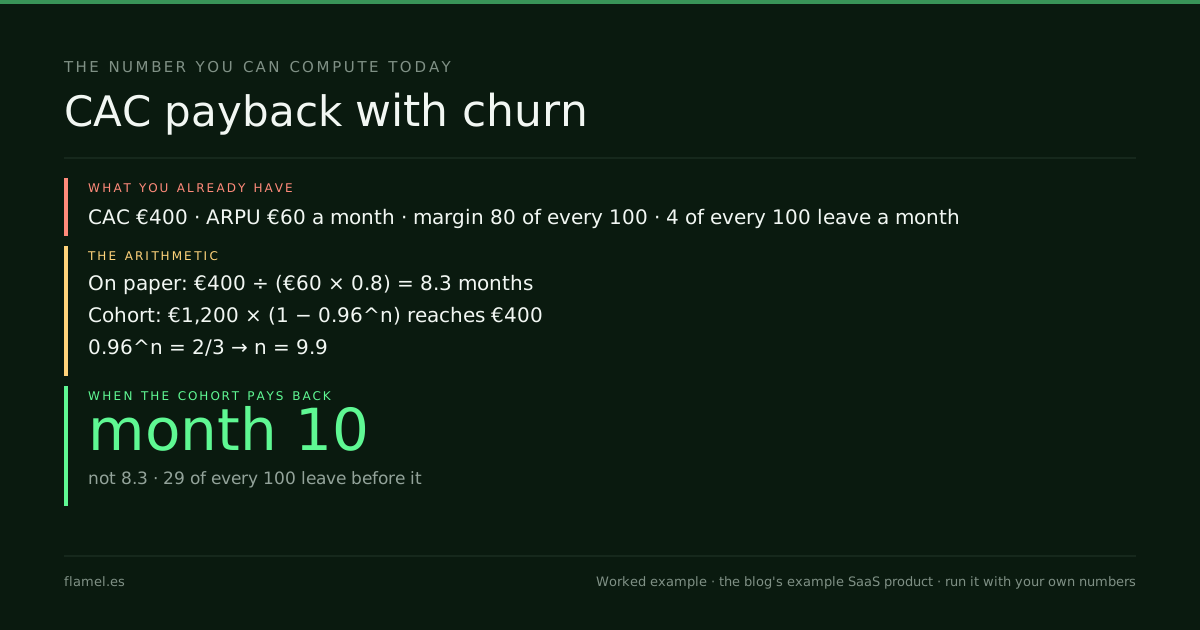
The CAC payback period is CAC ÷ (ARPU × gross margin): the months a customer takes to repay its acquisition cost. At €400 of CAC, €60 a month and 80 of every 100 euros as margin, it is 8.3 months on paper. With 4 of every 100 customers leaving each month, the cohort pays back in month 10.
Key takeaways
- CAC payback period = CAC ÷ (ARPU × gross margin): the months a customer takes to repay what acquiring it cost.
- On the example product: €400 ÷ (€60 × 0.8) = 8.3 months on paper.
- With 4 of every 100 customers leaving each month, 29 of every 100 are gone before month 8.3, and the cohort pays back in month 10.
- Here, €40 off the CAC shortens the cohort payback more than one point less churn, but the churn point lifts lifetime margin from €1,200 to €1,600.
- This week: work out both paybacks, then multiply the payback on paper by monthly churn. The closer to 1, the riskier the CAC.
The CAC payback period formula, line by line
CAC payback period = CAC ÷ (ARPU × gross margin)

CAC          = acquisition spend ÷ new customers
ARPU         = monthly revenue per customer
gross margin = share of revenue left after the cost of serving it
Wall Street Prep defines the period as "the number of months needed by a company to recoup the initial costs incurred in the process of acquiring a new customer". It writes the formula for a whole cohort: the sales and marketing expense divided by "(New MRR × Gross Margin)" (Wall Street Prep). Per customer or per cohort, the arithmetic is the same.
Gross margin belongs in the formula. Revenue repays nothing until hosting, support and payment fees are covered. On a product that keeps 80 of every 100 euros, leaving margin out makes the payback look a fifth shorter than it is.
The CAC side is worked out in customer acquisition cost: every euro spent to bring customers in, divided by the customers who came. Count the whole spend: ads, tools and the people who run them. A CAC built from ad spend alone makes every payback look shorter than the cash says.
CAC payback period on the example product
Take the product this blog's SaaS posts use: 1,100 paying customers at €60 a month. Marketing spends €17,600 a month to bring in 44 new customers, a CAC of €400. Gross margin is 80 of every 100 euros. Both are declared as an example.
Margin per customer per month = €60 × 0.8   = €48
CAC payback period            = €400 ÷ €48 = 8.3 months
That is the payback a calculator returns. The formula has no term for the customers who leave, so it assumes every customer in the cohort is still paying in month 8.3.

The CAC payback formula with churn
They are not. On the example product, 4 of every 100 customers leave each month, counted the way SaaS churn rate counts it: customers lost in the month ÷ customers at its start. Of a cohort of 100, 96 are left after one month, 92 after two, and so on.
Still paying after 8.3 months = 0.96^8.3 = 0.71
Gone before the payback       = 29 of every 100
So read the cohort, not the customer. Each month, the margin that comes in is €48 times the share still paying. Added up month by month:
Margin repaid by month n = €48 × (1 − 0.96^n) ÷ 0.04
                         = €1,200 × (1 − 0.96^n)

Reaches €400 when 0.96^n = 2/3  →  n = 9.9
The cohort as a whole pays back in month 10, not in month 8.3. That is 1.6 months later, from churn alone.
The €1,200 is the margin a customer brings over its whole life: the same figure SaaS LTV gets with churn included, €48 ÷ 0.04. The cohort pays back when it has earned a third of it. The ratio of the two, LTV:CAC, is €1,200 ÷ €400 = 3 to 1 on this product.
If the payback runs long and it is not clear which side to work on first, the Activation Audit reads where new customers stop, in five business days.
CAC payback period at five churn rates
The payback on paper does not move with churn. The cohort payback does, and past a point it never arrives.
| Customers leaving a month | Margin over a lifetime | Payback on paper | Cohort payback |
|---|---|---|---|
| 2 of every 100 | €2,400 | 8.3 months | month 9.0 |
| 4 of every 100 | €1,200 | 8.3 months | month 9.9 |
| 6 of every 100 | €800 | 8.3 months | month 11.2 |
| 8 of every 100 | €600 | 8.3 months | month 13.2 |
| 12 of every 100 | €400 | 8.3 months | never |
At 12 of every 100 a month, a customer's lifetime margin is €400, exactly the CAC. The cohort never catches up, and the formula on paper still says 8.3 months.
Which lever shortens the cohort payback
Two levers move the same number. Marketing lowers the CAC. Product keeps customers paying longer.
CAC €40 lower:    €360 ÷ €48 = 7.5 months on paper
                  0.96^n = 0.70  →  cohort pays back in month 8.7
Churn 3 of 100:   €400 ÷ €48 = 8.3 months on paper
                  0.97^n = 0.75  →  cohort pays back in month 9.4
Cutting the CAC by €40 brings the cohort payback forward by 1.2 months. One point less churn brings it forward by half a month, but it lifts the lifetime margin from €1,200 to €1,600.
Payback rewards the CAC cut. Lifetime margin rewards the retention fix. A team that reads only the payback will always cut acquisition first, and a team that reads only churn will never see how long its cash is out.
On this product the two readings meet. At 4 of every 100 leaving, the 44 new customers a month only replace the 44 who left. The €17,600 a month buys a cohort that pays back in month 10 and leaves the base at 1,100: reduce churn prices that replacement at €211,200 a year.
The CAC payback number for your product
Payback on paper   P = CAC ÷ (ARPU × gross margin)
Cohort payback     n = ln(1 − P × churn) ÷ ln(1 − churn)
If P × churn ≥ 1, the cohort never pays back
On the example product: ln(1 − 8.33 × 0.04) ÷ ln(0.96) = 9.9 months.
What to do by Monday: take last quarter's acquisition spend and new customers for the CAC, this month's ARPU and gross margin, and the monthly churn of the customers who signed up a year ago. Work out both paybacks. Then multiply the payback on paper by the churn. The closer that product gets to 1, the more of the payback depends on customers who will not be there to make it.
Work through this with your own numbers
I run a subscription product. Last quarter I spent [acquisition spend] to bring in [new customers] new customers. My monthly ARPU is [ARPU], my gross margin is [gross margin per 100 euros] euros for every 100 euros of revenue, and [monthly churn] of every 100 customers leave each month. Calculate my CAC (acquisition spend ÷ new customers), my CAC payback on paper (CAC ÷ (ARPU × gross margin)) and my cohort payback with churn: n = ln(1 − payback on paper × churn) ÷ ln(1 − churn). If payback on paper × churn is 1 or more, say that the cohort never pays back. Then recalculate both paybacks with a CAC 10 of every 100 euros lower, and with churn one point lower, and tell me which lever shortens the cohort payback more and which one raises lifetime margin more. Show every step of the arithmetic.FAQ
What is the CAC payback period?
It is the number of months a customer takes to repay what it cost to acquire: CAC ÷ (ARPU × gross margin). At €400 of CAC, €60 a month and 80 of every 100 euros as margin, it is 8.3 months.
How do you calculate CAC payback with churn?
Count only the customers still paying. With a payback on paper P and monthly churn c, the cohort pays back in month n = ln(1 − P × c) ÷ ln(1 − c). At 8.3 months and 4 of every 100 leaving, n = 9.9.
Should CAC payback include gross margin?
Yes. Revenue repays nothing until the cost of serving the customer is covered. Without margin, the example product's payback reads 6.7 months instead of 8.3.
Can a cohort never pay back its CAC?
Yes, when the margin a customer brings over its life is no larger than the CAC. On the example product, at 12 of every 100 leaving each month, lifetime margin is €400, the same as the CAC, while the payback on paper still says 8.3 months.
The Activation Audit maps where new customers stop: five business days, $500, and the map stays with you whether or not you hire anyone.
Your store, five days.
$500. Zero commitment. Yours either way.
Made between
Barcelona and Bogotá.
What’s holding your store’s sales back, in minutes.
Free, no card. Shopify stores for now.