Ecommerce return rate: formula, benchmarks and the EU rule
Ecommerce return rate: the formula three ways, the NRF benchmarks, what returns cost in euros, and the EU right of withdrawal that US guides leave out.

An ecommerce return rate is the share of delivered orders that come back: returned orders ÷ delivered orders × 100. It looks like a customer-service number. It is a cost line of the season, and it gets booked before the peak, not discovered in January.
Priced in full, every return costs twice. Once in logistics: the store sends the order, takes it back and inspects it. Once in margin: the margin it had already counted at checkout never arrives. In the EU it costs more than most US guides assume, because the store refunds the outbound delivery too, and the customer has 14 days from delivery to change their mind without giving a reason.
So returns belong in the launch budget, and they get attacked on the product page, where the wrong size or the wrong expectation starts, before the traffic arrives.
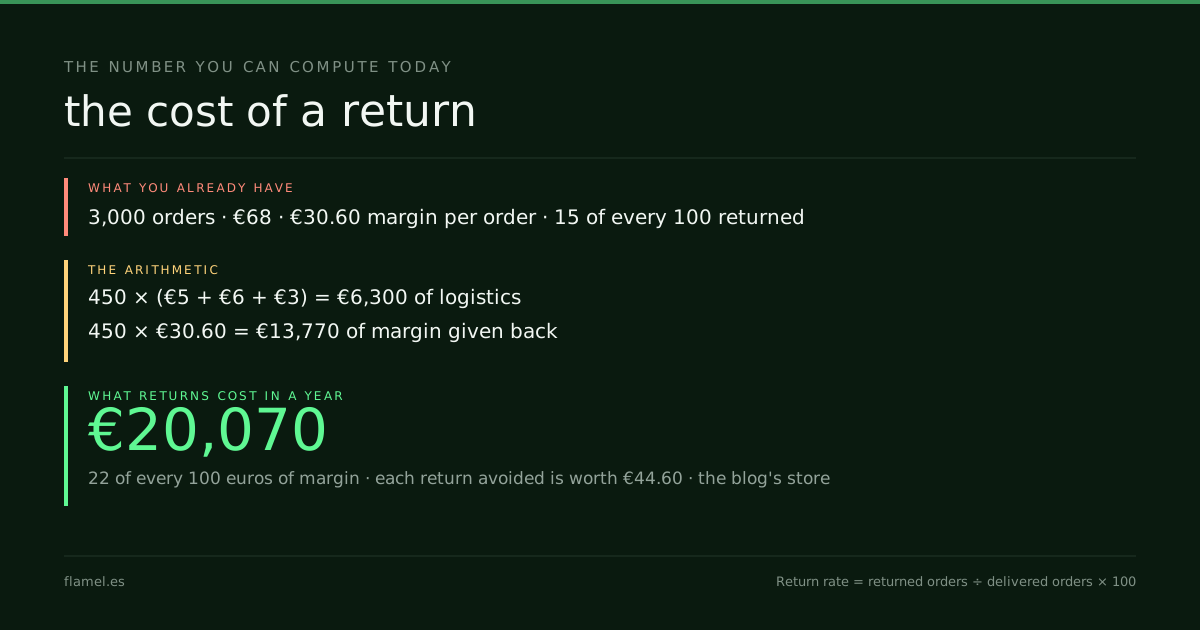
Ecommerce return rate = returned orders ÷ delivered orders × 100. On a store with 3,000 orders a year at €68 and 15 of every 100 coming back, 450 returns cost €6,300 in logistics and give back €13,770 of margin: €20,070, or 22 of every 100 euros of the year's margin. Each return avoided is worth €44.60.
Ecommerce return rate is returned orders divided by delivered orders, times 100. On a store with 3,000 orders a year at €68, returning 15 of every 100 means 450 returns: €6,300 of logistics plus €13,770 of margin given back, €20,070. In the EU the store also refunds the outbound delivery.
Key takeaways
- Ecommerce return rate is returned orders over delivered orders, counted in the month of the order so the peak's returns stay with the peak.
- On a store with 3,000 orders at €68, returning 15 of every 100 costs €20,070: 22 of every 100 euros of margin.
- The NRF's 16.9 of every 100 dollars is by value, across all US retail: compare the store with its own annual rate instead.
- In the EU the store refunds the outbound delivery, and the customer has 14 days from delivery to withdraw.
- Multiply next peak's expected orders by last peak's return rate and by €44.60 a return, and put that line in the launch budget.
The ecommerce return rate formula, three ways
Return rate by orders = returned orders ÷ delivered orders × 100
Return rate by units  = returned units ÷ units shipped × 100
Return rate by value  = refunded revenue ÷ gross revenue × 100
The same returns give three different answers. By orders is the one that drives logistics: one parcel back is one label and one inspection. By value is the one that drives margin: an €80 jacket coming back weighs more than a €12 accessory. By units catches the customer who orders two sizes to keep one: one order, one return, half of its units.
Pick one and keep it every month. The cost below uses orders.
Two details decide whether the number means anything. The denominator is delivered orders, not placed ones: an order canceled before it ships is not a return. And a return belongs to the month of its order, not the month it arrives. Counted on arrival, November's returns land in December, November looks clean and January looks broken.
Ecommerce return rate benchmarks, read carefully
The most cited figure comes from the National Retail Federation and Happy Returns, a UPS company. Their December 2024 report says: “Retailers estimate that 16.9% of their annual sales in 2024 will be returned.” It also gives the peak: “A separate NRF study found that for the 2024 winter holidays, retailers expect their return rate to be 17% higher, on average, than their annual return rate.”
Read what that benchmark is before using it. It is measured by value, not by orders. It covers all US retail, in stores and online. And it comes from 249 ecommerce and finance professionals at large US retailers, with more than $500 million in revenue each, plus 2,007 consumers who had returned an online purchase.
A store with one category in Europe should not aim at that number. The comparison that holds is the store against itself: by category, by month of order, and the peak against its own annual rate. Apply the NRF holiday ratio to a store that returns 15 of every 100 orders across the year, and its peak weeks run near 17.5.

The ecommerce return rate in euros
Take the store this blog uses for its eCommerce examples: 3,000 orders a year at €68. With 45 of every 100 euros as margin, each order leaves €30.60, the same base as AOV meaning and the Black Friday discount strategy. Say it returns 15 of every 100 orders, and each return costs €5 of outbound delivery refunded, a €6 return label and €3 of inspection and repacking. Those four figures are declared for the example.
Returns           = 3,000 × 0.15          = 450
Logistics         = 450 × (€5 + €6 + €3)  = €6,300
Margin given back = 450 × €30.60          = €13,770
Cost of returns   = €6,300 + €13,770      = €20,070
Share of margin   = €20,070 ÷ €91,800     = 22 of every 100 euros
The logistics part is money spent. The margin part is margin the store counted at checkout and never earned. If the item goes back on the shelf, its cost of goods returns to stock, but the season's forecast still included that €30.60. Items that cannot be resold add their cost of goods on top. This example leaves them out.
Each return avoided is worth €44.60: a kept order keeps its margin and never pays the €14. Three fewer returns in every 100 orders, 90 a year, are worth €4,014.
Knowing which product pages produce those 450 returns is the first thing the Conversion Audit puts on the map, before the peak traffic reaches them.
The right of withdrawal: 14 days, no reason
The EU's Your Europe portal sets out the rule for canceling an online purchase: a customer “can cancel the contract within 14 days without providing any justification”, and “for goods this means 14 days from the date of delivery”.
The return postage is the customer's by default. Your Europe adds the exceptions: “if the seller offers to pay, or if the seller fails to inform you about those costs before you buy.”
The refund is where EU stores pay more than US guides count. France's official public-service site, Service-Public.fr, applies the same EU rule: “The seller must reimburse you for all the sums you have paid, including delivery costs.” The refund is due within 14 days of the store being told, and the store may wait until the goods are back or the customer shows proof of shipment. A store that never informed the customer of the right of withdrawal sees the period extended by 12 months.
So the outbound delivery comes back out of the store on every return, and the return label depends on what the store says before the order:
| Return policy | Store pays per return | On 450 returns |
|---|---|---|
| Free returns: store pays the label | €5 + €6 + €3 = €14 | €6,300 |
| Customer pays the label, stated before purchase | €5 + €3 = €8 | €3,600 |
| Return costs not stated before purchase | €5 + €6 + €3 = €14 | €6,300 |
The calendar matters as much as the cost. Black Friday falls on 27 November in 2026. An order delivered on 1 December can be withdrawn until 15 December, the customer then has 14 days to send it back, and the refund follows. The peak's returns land in December's books, and some in January's.
Where returns start: the product page
The usual reasons for a return, a size that did not fit, a color that looked different, a product that was not what the page described, all start on the page, before the order. That is why the place to work on them is the product page, not the returns desk.
Rank the product pages by returns per 100 orders and by the reason the customer gave. If two or three pages carry most of the returns, that is where most of the €20,070 sits. The return terms belong on those pages too: in the EU, what the store states before the purchase decides who pays the label.
Returns also touch the other numbers of the season. A promotion's orders minus their returns is closer to what it really sold, which is what promotion incrementality measures. And a refund handled well is where a customer can still come back: a repeat purchase rate counts them.
The ecommerce return rate number before the peak
Cost of returns = returns × (outbound delivery + return label paid + handling)
                + returns × margin per order
Value of one return avoided = margin per order + logistics per return
What to do by Monday: take last year's peak orders and count their returns by month of order, not month of arrival. Divide by the annual rate to get the store's own holiday ratio. Multiply this year's expected peak orders by that rate, then by the cost of one return: that is the line for returns in the launch budget. Then rank the product pages by returns per 100 orders, and start with the top one.
Work through this with your own numbers
You are an ecommerce operator pricing returns before the peak season. Inputs: [delivered orders last year], [returned orders last year, counted by month of order], [peak-season orders and their returns last year], [expected peak orders this year], [average order value], [margin per order], [outbound delivery cost per order], [return label cost, if the store pays it] and [inspection and repacking cost per return]. Calculate the annual return rate as returned orders ÷ delivered orders × 100, and the peak rate the same way. Divide the peak rate by the annual rate to get the store's holiday ratio. Calculate the cost of one return as outbound delivery + return label + handling + margin per order. Multiply expected peak orders × peak return rate × cost of one return to get the returns line for the launch budget. Then say how much one fewer return in every 100 peak orders would be worth.FAQ
How do you calculate ecommerce return rate?
Divide returned orders by delivered orders and multiply by 100. A store with 3,000 delivered orders and 450 returns has a return rate of 15 of every 100. Count each return in the month of its order, not the month it arrives, so the peak's returns stay with the peak.
What is the average ecommerce return rate?
The most cited figure is the NRF and Happy Returns estimate for 2024: retailers expected 16.9 of every 100 dollars of their annual sales to come back. It is measured by value, across all US retail, by large retailers. A store compares better against its own annual rate, by category.
Are return rates higher during the holidays?
Yes. For the 2024 winter holidays, US retailers expected their holiday return rate to be 1.17 times their annual rate, on average, according to the NRF. A store returning 15 of every 100 orders across the year would run near 17.5 in the peak weeks.
Do EU online stores have to refund shipping?
Yes. When a customer withdraws, the seller must reimburse all the sums paid, including delivery costs, within 14 days of being told. The store may wait until the goods are back or the customer shows proof of shipment.
Who pays for return shipping in the EU?
The customer, by default. The store pays if it offers to, or if it did not inform the customer about the return costs before the purchase. Free returns are a choice the store makes and pays for on every return.
Before the peak reaches the product pages, know which ones send orders back. The Conversion Audit maps where the store loses customers in five business days, for $500, and the map stays with you whether or not you hire anyone.
Your store, five days.
$500. Zero commitment. Yours either way.

Made between
Barcelona and Bogotá.
What’s holding your store’s sales back, in minutes.
Free, no card. Shopify stores for now.