Net new MRR: how to calculate the month's growth
Net new MRR = new + expansion − churned − contraction. How to calculate it, worked on an example product, and what the net leaves out.

Net new MRR is the recurring revenue a SaaS product added in a month after the leaks. The formula: net new MRR = new MRR + expansion MRR − churned MRR − contraction MRR. Above zero, the product grew. At zero, it signed up customers and stood still.
New MRR is marketing's number. Churned MRR is product's. The net is the one figure that puts both teams in the same sentence, and the one that says whether the month's acquisition spend bought growth or only replacement.
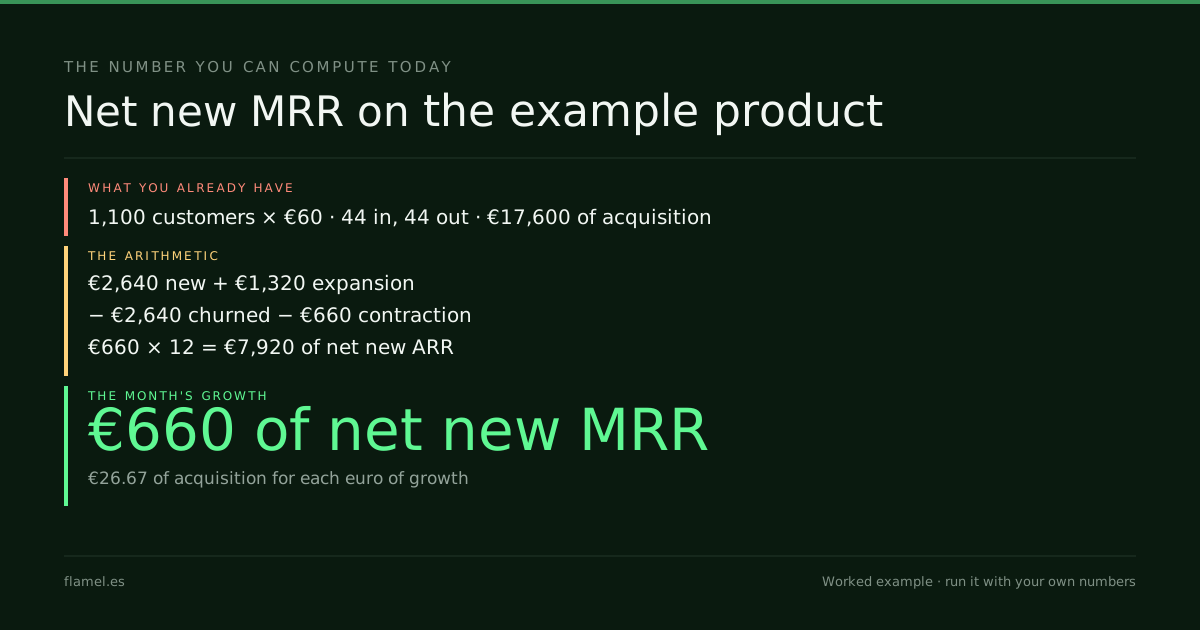
Net new MRR is new MRR plus expansion, minus churned MRR and contraction. On a product with 44 new customers and 44 lost at €60, plus €1,320 of expansion and €660 of contraction, net new MRR is €660 a month: €7,920 of net new ARR, for €17,600 of acquisition.
Key takeaways
- Net new MRR is new plus expansion, minus churned and contraction: the month's growth after the leaks.
- On the example product, 44 customers in and 44 out leave €660 of net new MRR, all of it from expansion.
- That month, €17,600 of acquisition bought replacement, not growth: €26.67 for each euro of net new MRR.
- Net new ARR is twelve times net new MRR; never compare a monthly net with a yearly target.
- Pull twelve months of MRR movements and mark the months where new MRR was bigger than the net.
The net new MRR formula, line by line
Net new MRR = new MRR + expansion MRR − churned MRR − contraction MRR

new MRR         = recurring revenue from customers who started paying this month
expansion MRR   = what existing customers added: upgrades, seats, add-ons
churned MRR     = what left with the customers who canceled
contraction MRR = what existing customers removed by moving to a cheaper plan
Stripe's billing analytics builds MRR growth from the same four lines and two more: reactivations, customers who come back after canceling, and an adjustment for currencies (Stripe Docs). Its MRR is "the sum of the monthly-normalized value" of active and past-due subscriptions, so an annual plan counts at a twelfth of its price each month.
Net new MRR on the example product
Take the product this blog's SaaS posts use: 1,100 paying customers at €60 a month, €66,000 of MRR. Every month 4 of every 100 customers leave: 44 customers, €2,640 of MRR. Marketing brings 44 new ones at €400 each: €2,640 of new MRR for €17,600 of acquisition spend. The customers who stay add €1,320 by moving up a plan and remove €660 by moving down, the same declared figures as net revenue retention.
Net new MRR = 2,640 + 1,320 − 2,640 − 660
            = €660 a month
            = €7,920 of net new ARR
The product signed up 44 customers and lost 44. All of the month's growth came from customers already paying. The €17,600 bought replacement, not growth: reduce churn prices that replacement at €211,200 a year.
The margin is thin. If 5 of every 100 customers left instead of 4, churned MRR would be 55 × €60 = €3,300:
Net new MRR = 2,640 + 1,320 − 3,300 − 660 = €0One more customer in every hundred leaving each month, and the month's growth is gone.

Net new MRR vs net new ARR
Net new ARR is the same movement on a yearly scale: twelve times net new MRR. Teams that sell annual plans often report it this way. On the example product, €660 of net new MRR is €7,920 of net new ARR.
Compare like with like. A monthly net next to a yearly target looks twelve times smaller than it is, and a yearly net next to a monthly budget looks twelve times bigger.
What net new MRR leaves out
The net hides the size of the two flows. €660 from 44 in and 44 out is a different product from €660 with nobody leaving. So each line is read on its own as well. SaaS churn rate counts what leaves. Customer retention rate counts customers instead of euros. Net revenue retention follows what the same customers do, with the new ones left out.
On a team with a north star metric, net new MRR is the line under it that says where the growth came from: new customers or the ones already paying.
The net new MRR number for your product
Net new MRR             = new + expansion − churned − contraction
Acquisition per net euro = acquisition spend ÷ net new MRR
On the example product: €17,600 ÷ €660 = €26.67 of acquisition for each euro of net new MRR.
Andrés Ossa, CEO of Flamel, wrote on LinkedIn in October that the clean data of these weeks is what tells a team what to repeat next year. For a SaaS product, net new MRR split month by month into its four lines is that data: what marketing added, what the product lost, and which line 2027 should work on.
What to do by Monday: pull the last twelve months of MRR movements from billing. Write each month's four lines side by side, then the net. Mark the months where new MRR was bigger than the net: those are the months acquisition paid for replacement.
Work through this with your own numbers
You are reviewing a SaaS product's revenue for the year. Inputs, for each of the last twelve months: [new MRR], [expansion MRR], [churned MRR], [contraction MRR] and [acquisition spend]. Calculate net new MRR for each month as new + expansion − churned − contraction, and net new ARR as twelve times that figure. For each month, calculate acquisition spend ÷ net new MRR, and flag the months where new MRR was larger than net new MRR, which means acquisition mostly replaced what left. Then say which of the four lines moved the net the most over the year, and which one the next plan should work on. Show every step of the arithmetic.FAQ
What is net new MRR?
Net new MRR is the recurring revenue a SaaS product added in a month after the leaks: new MRR plus expansion, minus churned MRR and contraction. Above zero the product grew; at zero, its new customers only replaced the ones who left.
How do you calculate net new MRR?
Add new MRR and expansion MRR, then subtract churned MRR and contraction MRR. With €2,640 of new MRR, €1,320 of expansion, €2,640 of churn and €660 of contraction, net new MRR is €660 for the month.
What is the difference between net new MRR and net new ARR?
Net new ARR is the same movement on a yearly scale, twelve times net new MRR. €660 of net new MRR is €7,920 of net new ARR. Compare monthly figures with monthly targets and yearly with yearly.
Does net new MRR include reactivations?
It can. Some billing tools, Stripe among them, report reactivations, customers who come back after canceling, as their own line. If yours does not split them out, count them with new MRR and keep the same rule every month.
If the net is flat and you don't know which line to work on first, the Activation Audit maps where activation breaks in five business days, for $500, and the map stays with you whether or not you hire anyone.
Your store, five days.
$500. Zero commitment. Yours either way.

Made between
Barcelona and Bogotá.
What’s holding your store’s sales back, in minutes.
Free, no card. Shopify stores for now.