Post purchase experience: 7 touchpoints, in order
The post purchase experience in 7 touchpoints, from confirmation to the next order: who owns each one, the EU email rule, and what one point is worth.

The post purchase experience is everything a customer meets between paying and deciding whether to order again. It runs through seven touchpoints, from the confirmation email to the first message that is not about this order. That stretch is where the second order starts.
Most stores design up to the checkout and leave the rest to the platform's defaults. Marketing stops at the order, operations ships it, customer service handles the returns, and nobody owns the moment that decides the next one.
The peak makes it urgent. Black Friday's first-time customers live their post-purchase stretch in December, with the return window open. If it is designed in January, their 90 days have already started.
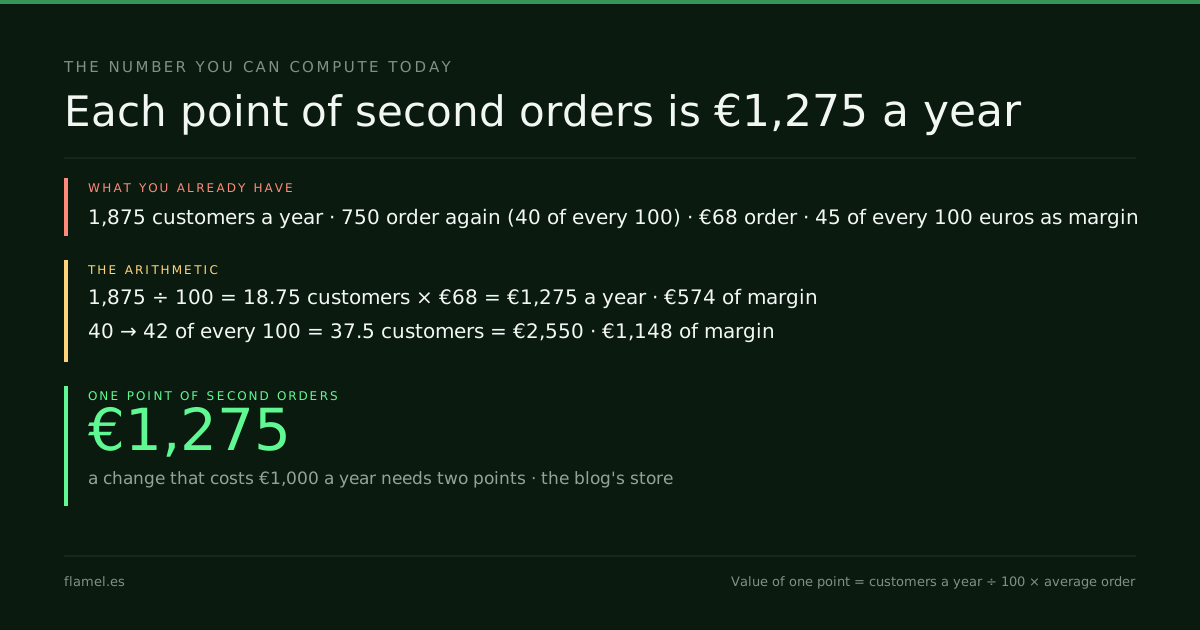
On a store with a €68 order and 1,875 customers a year, 1,125 never place a second order. Each point of second orders the post-purchase stretch moves is 18.75 customers and €1,275 a year. Two points, from 40 to 42 of every 100, are €2,550.
The post purchase experience is the seven touchpoints between payment and the next order: confirmation, shipping updates, delivery, unboxing, first use, returns and the first message not about the order. On a store with 1,875 customers a year and a €68 order, each point of second orders is worth €1,275.
Key takeaways
- The post purchase experience runs through seven touchpoints, from the confirmation email to the first message that is not about the order.
- Platforms send the confirmation and tracking emails by default; unboxing, first use and the next message exist only if someone designs them.
- Black Friday's first-time customers live the stretch in December, with the EU's 14-day return window running from delivery.
- On a store with 1,875 customers and a €68 order, one point of second orders is €1,275 a year, €574 of margin.
- List the seven touchpoints with an owner, price one point with your numbers, and divide the cost of any change by that margin.
The post purchase experience: seven touchpoints
In order, from the moment the customer pays:
| # | Touchpoint | When | Its job | By default |
|---|---|---|---|---|
| 1 | Order confirmation | Minutes after checkout | Confirm what was bought and when it arrives | Sent automatically |
| 2 | Shipping updates | At dispatch and each tracking change | Answer "where is my order" before it is asked | Sent automatically |
| 3 | Delivery | The day it arrives | Arrive when promised, in one piece | The carrier's event |
| 4 | Unboxing | The first minute | Look like what the product page promised | Nothing |
| 5 | First use | The first days | Make the product work the first time | Nothing |
| 6 | Return or exchange | Within 14 days of delivery, in the EU | Turn a wrong size into an exchange | A refund notice |
| 7 | The first message not about this order | After the return window | Propose the next product, for the reason this customer bought | Nothing |
The first three exist on any store. Shopify's page on customer notifications lists order confirmation, shipping confirmation, shipping update, out for delivery and delivered, and says: "Most customer notifications are sent automatically and can't be deactivated."
So they go out whether anyone wrote them or not. Left as defaults, they read like receipts.
Touchpoints 4, 5 and 7 do not exist until someone designs them. They are the ones that decide whether the customer thinks of the brand again.
Why the post purchase experience belongs to nobody
Each team owns a piece of the table. Nobody owns the row that matters.
- Marketing owns acquisition and the order. Its numbers stop at the checkout.
- Operations owns touchpoints 2 and 3: the parcel and the carrier.
- Customer service owns touchpoint 6, and is judged on how fast it closes tickets.
- Nobody owns 4, 5 and 7, and nobody owns the second order.
The post on ecommerce customer experience makes the same point from the other side: the experience becomes growth only when someone dates a change and reads whether more first-time buyers came back.
The fix is not a new department. It is one line per touchpoint: its job, its owner, and the date it was last changed.
After the peak, the timing shifts
Black Friday falls on November 27 this year. Most of its orders arrive in early December.
In the EU, the return clock starts at the door. The Your Europe page on returns says the customer can cancel "within 14 days without providing any justification", and for goods that means "14 days from the date of delivery". The peak's return window runs through mid-December, when the store is busiest. The ecommerce return rate post prices what those returns cost.
Take the Black Friday week from new vs returning customers: 120 orders, 45 of them from first-time customers. Those 45 live touchpoints 1 to 6 in December. If touchpoint 7 is not ready, the first message they get that is not about their order is the next promotion, sent to everyone.

What the post purchase experience is worth
Take the store this blog uses for its eCommerce examples: 3,000 orders a year at €68, from 1,875 customers, the base of repeat purchase rate. Each order leaves 45 of every 100 euros as margin.
Customers a year                   1,875
Place a second order                 750   (40 of every 100)
Stop at the first order            1,125

One point of second orders         18.75 customers × €68 = €1,275 a year
Margin of one point                €1,275 × 45 ÷ 100     = €574
Two points (40 → 42 of every 100)  37.5 × €68            = €2,550 · €1,148 of margin
The customer experience post prices four points at €5,100: the same arithmetic, twice the move.
The margin line is the budget. A post-purchase change that costs €1,000 a year, such as a printed card in the box and a first-use guide, pays for itself only if it moves two points. One point leaves it €426 short.
Knowing which of the seven touchpoints loses the second order is part of what the Conversion Audit maps, before the peak's first-time customers arrive.
In the EU, touchpoint seven has a rule
Touchpoints 1 to 6 are about the order. Touchpoint 7 is direct marketing, and European law treats it that way.
Article 13 of the ePrivacy Directive, Directive 2002/58/EC, sets the default: direct marketing by email "may be allowed only in respect of subscribers or users who have given their prior consent." Paragraph 2 makes the exception that touchpoint 7 lives on. A business that got the email address from its customers when they bought may use it "for direct marketing of its own similar products or services provided that customers clearly and distinctly are given the opportunity to object, free of charge and in an easy manner". That chance to object comes "at the time of their collection and on the occasion of each message".
Each EU country writes the directive into its own law, so the details vary. The three conditions do not:
- An opt-out at checkout, clear and free, before the first message.
- An unsubscribe link in every message of touchpoint 7.
- A next product similar to the first. A message about something unrelated needs prior consent.
So touchpoint 7 is designed around what the customer bought. That is also what makes it worth reading.
Have it ready before the peak
Four things, in this order:
- Write the table. Seven rows, each with its job, its owner and the date it was last changed.
- Rewrite touchpoints 1 and 2. The confirmation and the tracking emails go out anyway; make them answer the questions customers ask.
- Design 4, 5 and 7 for the best-selling product first. One box, one first-use guide, one next product.
- Tag the peak's first-time customers and follow them as one cohort for 90 days, as in customer cohort analysis.
With that in place, January's report can say whether the post-purchase stretch moved the second order, and by how many points.
The post purchase experience number for your store
Value of one point   = customers a year ÷ 100 × average order
Margin of one point  = value of one point × margin per euro
Points needed        = yearly cost of the change ÷ margin of one point
What to do by Monday: list the seven touchpoints and write who owns each one. Count last year's customers and how many placed a second order. Price one point with your average order and your margin. Then divide the cost of the change you have in mind by that margin: that is how many points it has to move before the peak's first-time customers decide.
Work through this with your own numbers
You are an ecommerce analyst reviewing a store's post purchase experience before the peak. Inputs: [customers last year], [customers who placed a second order], [average order value], [margin per euro of revenue] and [yearly cost of a planned post-purchase change]. Calculate the second-order rate as customers with a second order ÷ customers. Calculate the value of one point of that rate as customers ÷ 100 × average order, and its margin. Then calculate how many points the planned change has to move to pay for itself: yearly cost ÷ margin of one point. List the seven touchpoints (confirmation, shipping updates, delivery, unboxing, first use, return or exchange, first message not about the order), mark which ones are platform defaults, and say which one to redesign first and why.FAQ
What is the post purchase experience?
Everything a customer meets between paying and deciding whether to order again: the confirmation, shipping updates, delivery, unboxing, first use, returns and the first message that is not about the order. It is where the second order is won or lost.
What are the touchpoints of the post-purchase journey?
Seven, in order: order confirmation, shipping updates, delivery, unboxing, first use, return or exchange, and the first message not about this order. The platform sends the first three by default; the rest exist only if someone designs them.
How do you improve the post purchase experience?
Give each touchpoint a job, an owner and a date. Rewrite the default confirmation and tracking emails, design the unboxing, the first use and the next message for the best-selling product, and read the second-order rate of first-time customers 90 days later.
Can a store email customers after a purchase without consent in the EU?
Order emails, yes. A message proposing the next product is direct marketing: under Article 13(2) of Directive 2002/58/EC it can go to existing customers only for similar products, with a free opt-out at checkout and in every message.
How much is the post purchase experience worth?
Price one point of second orders: customers a year ÷ 100 × average order. On a store with 1,875 customers and a €68 order, one point is 18.75 customers and €1,275 a year, €574 of margin at 45 of every 100 euros.
Before the peak's first-time customers go quiet, know which touchpoint loses the second order. The Conversion Audit maps where the store loses customers in five business days, for $500, and the map stays with you whether or not you hire anyone.
Your store, five days.
$500. Zero commitment. Yours either way.

Made between
Barcelona and Bogotá.
What’s holding your store’s sales back, in minutes.
Free, no card. Shopify stores for now.